
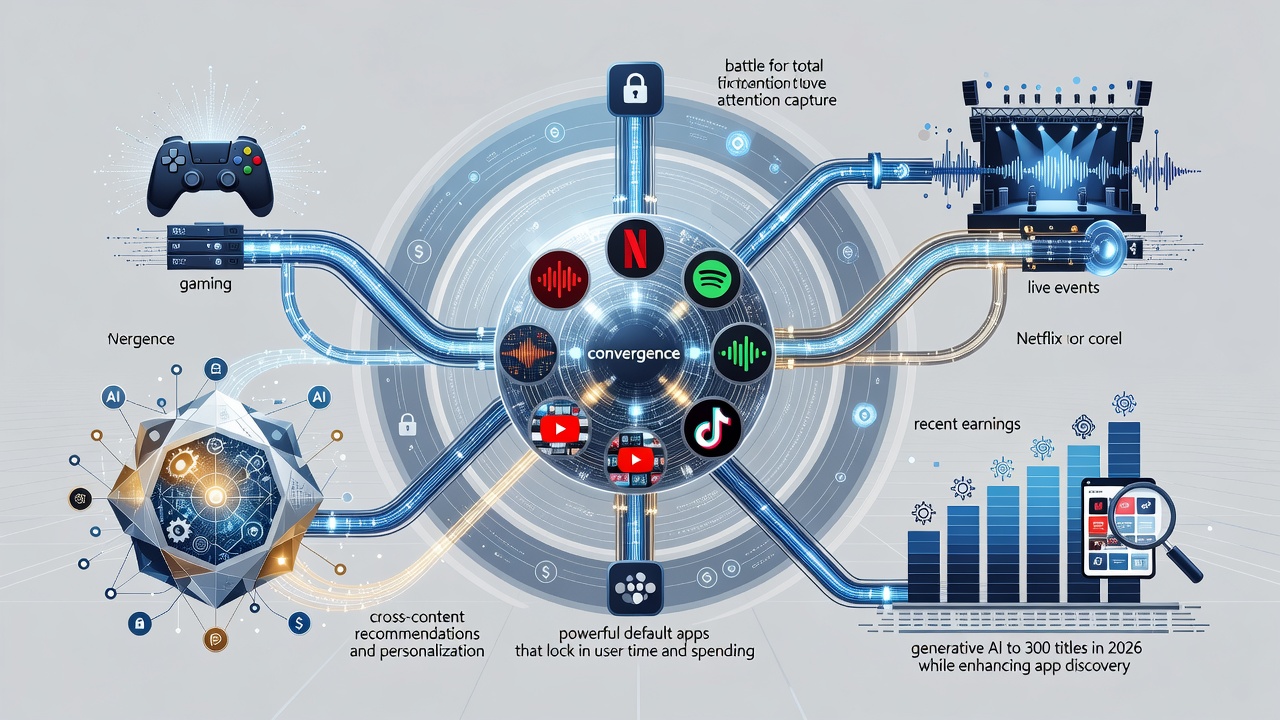
Entertainment giants no longer fight for dominance in one medium. They chase something larger. They want to become the single app users open first. And last. When free time appears, that default choice captures attention. It drives subscriptions. It multiplies ad dollars.
The shift didn’t happen overnight. For years platforms specialized. Music here. Long-form video there. Podcasts in their lane. Yet markets matured. User growth slowed. Companies pivoted to metrics that mattered more: hours spent inside the app and revenue extracted from each one. Creators, meanwhile, hopped formats without pause. A musician drops tracks, then films videos, then records chats. Apps that housed only one piece of their output left money and loyalty on the table.
Artificial intelligence supplies the decisive push. It shrinks the cost and complexity of supporting many formats at once. It sharpens recommendations that cross those formats. Recommendation engines once optimized for similar songs now weigh podcasts, clips, live events and even ticket sales in the same breath. The result looks less like competition between categories. It looks like convergence on a universal player.
Consider Netflix. Once the home of binge-worthy series, it now experiments with gaming, live sports and short vertical video. In April its co-CEO Greg Peters told investors the company would add a vertical video feed and rely on new model architectures to improve personalization, according to a TechCrunch report. By July Netflix had acquired an AI filmmaking startup founded with involvement from Ben Affleck for $587 million, TechCrunch noted. And fresh earnings disclosures show the streamer applied generative AI across roughly 300 movies and shows in 2026 alone. The technology touched everything from concept art to post-production crowds and visual effects. It also entered the app itself to refine title discovery and understand viewer tastes better, Variety reported on July 16.
But. The move carries risks. Hollywood writers and actors voiced concerns in prior years about job losses. Netflix insists AI lowers costs and enables scenes once too expensive to film. Still, public reaction split. Some praised efficiency. Others mourned the human touch.
Spotify followed a parallel path. The audio leader layered on video podcasts, social features such as comments and direct messaging, fitness classes, audiobooks, narrated magazine articles and even sales of physical books. Each addition kept users inside the app longer. AI tools now generate prompted playlists, power conversational assistants and let listeners edit their taste profiles directly. One TechCrunch article from July 14 detailed the latest assistant rollout. The company no longer sells music alone. It sells an environment where audio, video and community coexist.
YouTube, already vast, doubled down. Short-form clips compete with TikTok. Podcasts gained dedicated pages, AI recommendation tools and automatic speed adjustment. The platform streams free ad-supported movies and TV, live sports, news, shopping and rental content. More than one million channels used its AI creation tools in a single month. Twenty million consumers tried the Gemini-powered discovery feature in December, according to the original TechCrunch analysis published July 21.
Alphabet CEO Sundar Pichai has called AI central to the YouTube experience. In interviews he described training models on the platform’s vast video library to enable smarter search, summaries and conversational queries. A May conversation with The Verge explored how these changes could affect creators. Watch time metrics might dip when AI surfaces exact clips instead of full videos. Yet Pichai argued the overall value to users and the platform would rise.
TikTok pushes the boundary furthest toward super-app status. It expanded from short dances to 10-minute videos, then long-form series. Users now plan travel, shop products, explore local events, buy concert tickets and watch microdramas. The app even launched TikTok Pro Events for cultural moments such as the FIFA World Cup. ByteDance experiments with in-app AI chatbots and image-to-video generators. Its road to broader utility was chronicled in a June TechCrunch piece.
And the data backs the strategy. Wider content mixes correlate with higher engagement. More time spent means more opportunities for targeted ads and subscription upsells. Personalization engines once limited to one data type now fuse signals from music listens, video watches, search queries and social interactions. Users gain controls to steer those suggestions. They can tweak taste profiles or ask conversational interfaces for specific moods. The apps feel less like broadcasters. They start to resemble intelligent companions.
Yet challenges remain. Creators worry about diminished visibility when algorithms favor cross-format bundles. Regulators eye data practices that power such deep personalization. Technical debt grows when teams maintain gaming engines, live streaming infrastructure, e-commerce checkout and AI training pipelines under one roof. Integration is never perfect. Glitches appear. User frustration follows.
Still, the trajectory holds. Format no longer defines the battle. Connection quality does. The company that best matches a user’s fleeting desire, whether for a three-minute clip, a two-hour film, a guided workout or a narrated essay, wins the session. AI supplies the connective tissue. It surfaces options users didn’t know they wanted. It generates supporting content on the fly. It even helps advertisers reach the right eyeballs across mediums.
Netflix’s recent shareholder letter underscored the dual use of AI for production savings and discovery improvements. That dual track accelerates the universal model. Content becomes cheaper to make. Discovery becomes sharper. Retention climbs. The loop reinforces itself.
Industry watchers see this consolidation as inevitable. A July 18 GamesRadar+ report captured the scale of Netflix’s AI deployment this year. Similar expansions appear at rivals, though they disclose less. The competitive pressure only intensifies.
So what does the future hold? One app to rule attention. Not because it does everything perfectly. But because it does enough things well enough, guided by models that learn individual habits faster than humans can express them. Users may resist at first. Habits die hard. Yet convenience usually prevails.
The universal entertainment app is not a distant vision. It is already taking shape. One recommendation at a time. One format expansion at a time. One AI improvement at a time. The winners will be those who master the blend of content breadth, algorithmic precision and user agency. The losers may find their specialized offerings commoditized or absorbed.
Entertainment, in other words, is becoming platformed. And the platform is getting smarter by the day.


 WebProNews is an iEntry Publication