
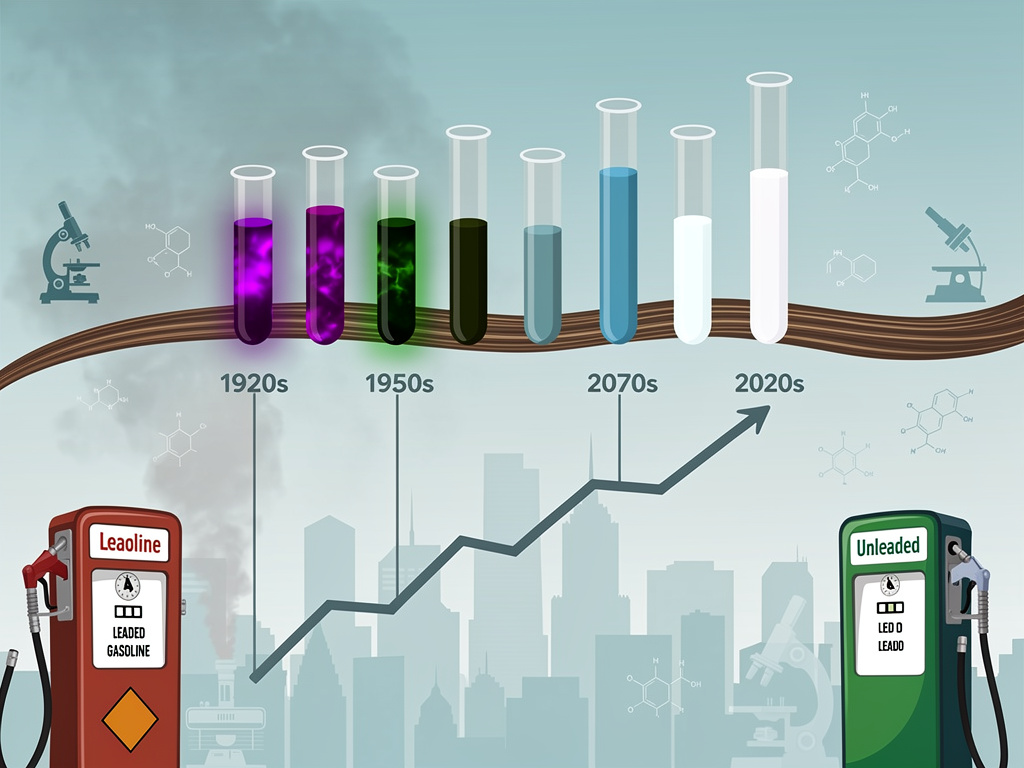
For decades, scientists and policymakers have argued about the effectiveness of banning leaded gasoline, one of the most sweeping environmental regulations in American history. Now, an unprecedented analysis of hair samples spanning 100 years has provided the most conclusive evidence yet that removing lead from fuel delivered measurable health benefits to millions of people. The research, which examined preserved hair strands from museum collections and private archives, offers a rare glimpse into how toxic exposure evolved across generations and validates a policy decision that faced fierce industry opposition.
According to Slashdot, researchers analyzed hair samples collected between the 1920s and present day, revealing dramatic declines in lead concentrations that closely tracked the phase-out of leaded gasoline. The study represents a breakthrough in environmental health research because hair preserves a chemical record of exposure over time, creating an archive of pollution history written in keratin. Unlike blood or urine samples that reflect only recent exposure, hair strands capture months of accumulated environmental contact, making them ideal for long-term historical analysis.
The introduction of tetraethyl lead to gasoline in 1921 marked the beginning of what public health experts now recognize as one of history’s most widespread environmental poisoning events. Added to fuel to prevent engine knocking and boost octane ratings, leaded gasoline became nearly universal in the United States by the 1930s. As automobile ownership exploded in the post-World War II era, lead emissions from vehicle exhaust blanketed urban areas, contaminating soil, water, and air. The hair sample analysis documented this rise with stark clarity, showing lead concentrations in human hair climbing steadily from the 1920s through the 1970s.
General Motors, Standard Oil, and DuPont championed tetraethyl lead as a technological marvel that made modern motoring possible, despite early warnings about its toxicity. Workers at manufacturing plants suffered acute lead poisoning, hallucinations, and deaths during the 1920s, incidents that briefly sparked public concern. However, industry-funded research downplayed these risks, and leaded gasoline became entrenched in American infrastructure. The economic incentives were substantial: leaded fuel was cheaper to produce than alternatives, and the patent holders profited handsomely from licensing agreements with oil companies worldwide.
The Scientific Case Against Lead Builds Momentum
By the 1960s, independent researchers began documenting lead’s devastating effects on child development, cognitive function, and behavior. Geochemist Clair Patterson’s pioneering work demonstrated that lead levels in modern humans far exceeded natural background levels, providing crucial evidence that environmental contamination was a recent, human-caused phenomenon. His research faced significant pushback from industry groups who questioned his methodology and funding. Patterson’s persistence, however, laid the groundwork for understanding lead as a neurotoxin with no safe exposure threshold, particularly for developing children.
The Clean Air Act amendments of 1970 gave the newly formed Environmental Protection Agency authority to regulate automotive emissions, setting the stage for confrontation over leaded gasoline. The EPA proposed phasing out lead additives, triggering intense lobbying from petroleum and automotive industries who warned of economic catastrophe, engine damage, and fuel shortages. Legal challenges delayed implementation, but the agency prevailed in court battles throughout the 1970s. The phase-down began in earnest in 1975, requiring new cars to use unleaded fuel to protect catalytic converters, a technology mandated to reduce other pollutants.
Hair Archives Reveal Population-Wide Exposure Patterns
The century-spanning hair analysis overcame a fundamental challenge in environmental health research: the absence of biological samples from populations before pollution controls existed. Researchers obtained hair from museum specimens, genealogical collections, and medical archives, creating a biobank that spanned multiple generations. Advanced analytical techniques allowed scientists to measure lead concentrations at parts-per-million levels, detecting changes that reflected both rising and falling environmental exposure. The samples came from diverse geographic regions and demographic groups, providing insights into how lead exposure varied across American society.
Results showed that lead concentrations in hair peaked during the 1960s and 1970s, precisely when leaded gasoline consumption reached its zenith. Urban residents showed higher exposure levels than rural populations, consistent with traffic density patterns. Children’s hair samples revealed particularly elevated lead levels, confirming that young people faced disproportionate risks from environmental contamination. These findings align with blood-lead studies from the same era, but the hair archive extended the historical record decades further back, documenting the rise of lead exposure in populations before systematic monitoring existed.
The Phase-Out Delivers Measurable Results
Following the 1975 phase-down initiation, lead concentrations in hair samples began declining sharply. By 1986, when the EPA banned lead additives entirely for on-road vehicles, average lead levels had dropped by more than 75 percent from peak values. The hair evidence corroborated other environmental indicators: atmospheric lead measurements fell dramatically, soil contamination stopped increasing, and blood-lead levels in children plummeted. The correlation between policy implementation and biological outcomes was remarkably tight, suggesting that leaded gasoline was indeed the dominant source of population-wide lead exposure.
The public health benefits extended beyond simple exposure reduction. Research has linked declining lead levels to improvements in childhood IQ scores, reduced violent crime rates, and better educational outcomes. Economists have calculated that the leaded gasoline ban delivered benefits worth trillions of dollars when accounting for increased productivity, reduced healthcare costs, and decreased criminal justice expenses. The hair sample study adds another dimension to this evidence base, providing biological proof that regulatory intervention successfully reduced human exposure to a known neurotoxin.
Global Implications and Remaining Challenges
While the United States completed its leaded gasoline phase-out in 1986, many countries continued using lead additives for decades longer. The hair sample methodology offers a template for documenting exposure patterns in nations where historical monitoring data is sparse or nonexistent. International efforts finally eliminated leaded gasoline for cars worldwide in 2021, when Algeria became the last country to stop its sale. However, aviation fuel for piston-engine aircraft still contains lead, creating ongoing exposure risks for communities near small airports.
The century of hair samples also reveals that environmental lead persists long after emissions cease. Contaminated soil continues to expose children through dust and direct contact, particularly in urban areas where decades of leaded gasoline use left a toxic legacy. Paint containing lead, though banned for residential use in 1978, remains in millions of older homes. The hair archive documents that while acute exposure from gasoline has ended, chronic low-level exposure continues from these legacy sources, suggesting that complete remediation will require sustained effort across multiple fronts.
Methodological Innovations Open New Research Avenues
The hair sample analysis demonstrates how archived biological materials can answer pressing questions about long-term environmental trends. Museums and medical collections contain vast repositories of preserved tissues, teeth, and other specimens that could illuminate exposure to various pollutants over time. Researchers are now applying similar techniques to study mercury, arsenic, and other toxic elements, creating retrospective exposure assessments that would be impossible through conventional monitoring. These biological archives effectively turn museum collections into public health laboratories, extracting new insights from specimens that were preserved for entirely different purposes.
Advanced analytical methods made this research possible. Mass spectrometry and other technologies can now measure trace elements at concentrations that were undetectable just decades ago. These capabilities allow scientists to distinguish between different sources of contamination and track how exposure pathways have changed over time. The hair sample study employed quality controls and validation procedures to ensure that measured lead concentrations reflected actual historical exposure rather than contamination during storage or analysis. This methodological rigor strengthens confidence in the findings and establishes protocols for future historical exposure studies.
Policy Lessons for Contemporary Environmental Challenges
The leaded gasoline story offers crucial lessons for addressing current environmental health threats. Industry opposition to regulation is predictable and often fierce, requiring policymakers to maintain scientific integrity in the face of economic pressure. The decades-long delay between recognizing lead’s dangers and achieving regulatory action resulted in unnecessary harm to millions of people. Contemporary challenges like PFAS contamination, microplastics, and endocrine-disrupting chemicals may require similarly decisive action before complete scientific certainty exists about long-term health effects.
The hair sample evidence also illustrates the value of environmental monitoring and biobanking for future research. Systematic collection and preservation of biological samples creates options for answering questions that haven’t yet been formulated. Blood spots collected from newborns, tissue samples from medical procedures, and environmental specimens all represent potential resources for understanding how exposures evolve over time. The century of hair samples proved invaluable for validating the leaded gasoline ban’s effectiveness, but this resource existed largely by accident rather than intentional design. Future-oriented public health planning should include deliberate creation of biological archives that will serve researchers decades hence.
The research confirms that environmental regulations can work when implemented with sufficient resolve and backed by scientific evidence. The leaded gasoline ban faced predictions of economic disaster that never materialized; instead, the automotive and petroleum industries adapted, developing superior technologies that delivered better performance without toxic additives. This experience suggests that industry warnings about the costs of environmental protection often prove exaggerated, while the benefits of reducing pollution exposure accumulate over generations. The century of hair samples provides biological testimony to a successful intervention, written in the chemical composition of strands that survived long enough to tell their story.


 WebProNews is an iEntry Publication