
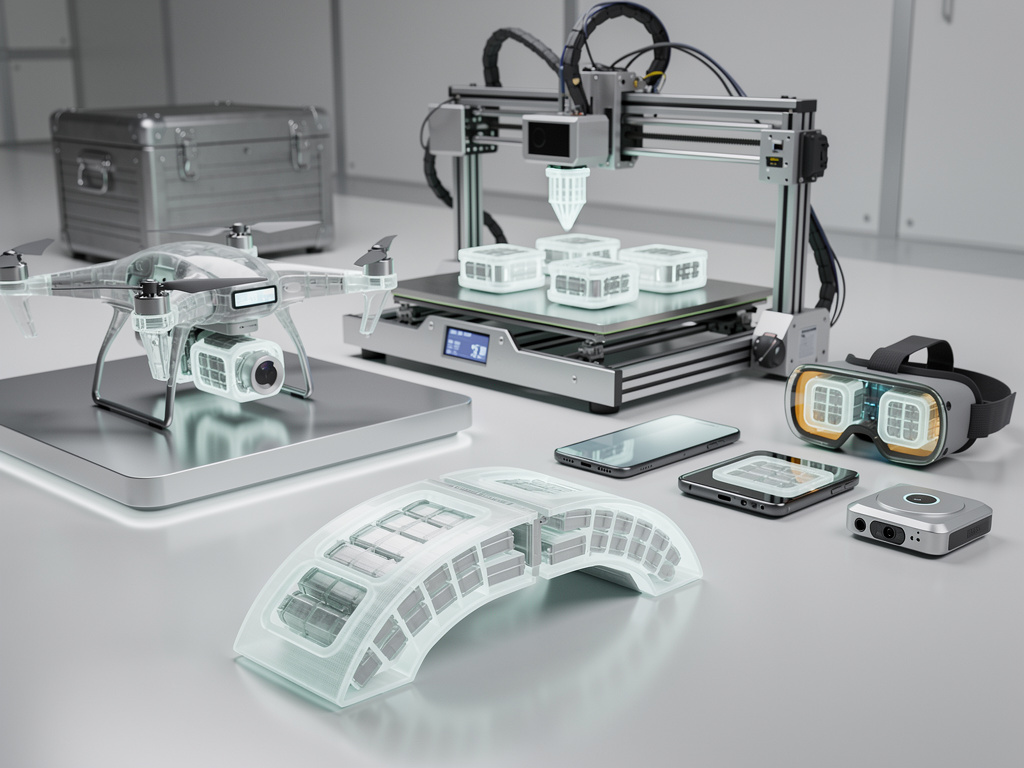
Batteries have barely changed their form in three decades. Factories still stamp out pouches and cylinders. Chemists chase incremental gains in energy density while the physical constraints remain. Yet a quieter shift gathers speed. Additive manufacturing now lets engineers print power sources that conform exactly to available space.
The Wall Street Journal laid out the case days ago. Energy storage could fill drone airframes, smartglass frames, even structural elements of vehicles. No more wasted volume. No more compromise on shape. The approach works across lithium-ion, sodium-ion, or solid-state chemistries. It sidesteps the rigid formats that have dictated product design for generations.
Researchers published some 25,000 papers on the subject in 2025 alone. Commercial traction stays limited. A handful of startups nevertheless push forward. They target defense first. Cost sensitivity runs lower there. Performance margins matter more. And prototypes can reach the field faster.
Gabe Elias spent six years as an engineer on the Mercedes-AMG Formula One team. He wrestled with fitting batteries under Lewis Hamilton’s seat. Conventional packs never quite worked. Later he met Christopher Reyes, whose doctoral work at Duke University explored printed battery techniques. The pair founded Material Hybrid Manufacturing in Miami.
The company’s Hybrid3D platform combines direct ink writing with fused deposition modeling. It prints full battery stacks—anode, cathode, separator, even casing—without molds or tooling. Early tests show it handles multiple electrode recipes. “Our approach is, instead of innovating on the chemistry side of things, let’s innovate on the way that the batteries are made,” Elias told the Journal. “Chemistry innovation is happening all across the industry.”
Material closed a $7.1 million seed round. It also landed a $1.25 million contract from the U.S. Air Force. By the end of August the firm expects to deliver prototype cells for Teledyne FLIR’s SkyRaider drone. Conventional packs leave room for only four lithium-ion units. Printed versions could pack 35 percent more energy in the same footprint. Some accounts cite gains approaching 50 percent when geometry is fully optimized. Either way the difference counts in a system where every gram affects flight time.
Defense contractors notice. Drone wars in Ukraine, the Middle East and elsewhere drive demand for lighter, longer-endurance craft. Larger aircraft seek every possible weight reduction too. Material’s technology promises conformal packs that hug internal contours. No bulky boxes. No excess wiring. Just power where the structure already exists.
Across the country in Silicon Valley, Sakuu takes a different tack. The firm developed a dry electrode process that eliminates toxic solvents and the massive drying ovens required in traditional lines. Its additive platform deposits materials in thin, precise layers. Chief operating officer Arwed Niestroj, a nuclear physicist and former Mercedes-Benz research executive, described the system as a way to attack one of battery manufacturing’s biggest cost and environmental headaches.
Sakuu has worked with SK On in the past and now collaborates with another major battery producer. The goal is not necessarily to print entire cells for every application but to improve electrode production at volume. Success here could reach consumer and automotive markets sooner than fully custom structural packs. The company’s earlier demonstrations included a functional 3 ampere-hour lithium-metal solid-state cell produced via its Kavian platform. That work, covered years ago by IEEE Spectrum, showed the process could match or exceed conventional lithium-ion performance while removing flammable liquids.
But. Scaling remains the test. Battery longevity, cycle life, and manufacturing cost must compete with entrenched gigafactories. Many earlier printed-electrode experiments delivered impressive lab results only to falter when output increased. Material and Sakuu both acknowledge the gap. Their bet is that starting with high-value, low-volume defense contracts buys time to refine the process.
Other efforts explore even bolder territory. Researchers at the University of Texas at El Paso, including Alexis Maurel, have examined printing batteries from lunar regolith. The idea supports NASA’s Artemis program. In-situ resource utilization could one day power lunar bases without shipping every kilogram from Earth. Maurel notes the typical 20-year timeline from concept to commercialization. His team has already logged half that span. Structural batteries for cars represent another active front. Several automakers quietly integrate energy storage into chassis elements. 3D printing could accelerate those designs.
Wright Electric in Malta, New York, pursues aluminum-air batteries. These offer exceptional capacity yet cannot recharge. The chemistry suits remote military outposts where troops need disposable power packs to recharge radios, night-vision gear and drones. Used cells return for recycling or remanufacture. Jeff Engler, the company’s chief executive, sees 3D printing as essential to making the format practical at usable scale. Like Material, Wright focuses first on defense customers willing to pay for performance.
Recent coverage echoes the momentum. An IEEE Spectrum article from earlier this year detailed Material’s progress printing batteries into “every nook and cranny.” The piece highlighted how the Hybrid3D system turns energy storage into just another subsystem, much like electronics or cooling. “Things are shrinking, so we’re shrinking around it,” Elias said there as well.
A Digital Trends story published yesterday picked up the Journal report and framed the opportunity around consumer devices. Smartphones, wearables and laptops could shed dedicated battery compartments. Power becomes part of the casing or frame. Battery anxiety eases when every cubic millimeter contributes to runtime.
Academic literature continues to expand. A 2026 review in the Journal of Power Sources surveyed direct ink writing, laser powder bed fusion and other additive methods for lithium batteries. It noted improved ion transport through precisely engineered porous electrodes. Solid-state variants benefit especially. Printed separators achieve better interfacial contact and reduce dendrite risk. Energy density gains of two to three times appear in some lab architectures compared with conventionally coated electrodes.
Yet skepticism persists in online discussions. Slashdot commenters questioned long-term durability of thin printed layers, potential thermal runaway risks, and whether recycling will prove harder than with standard cells. Those concerns mirror broader industry worries. No one disputes the geometric advantage. The question is whether the printed parts can survive thousands of cycles in real products.
So the military incubator makes sense. The U.S. Department of Defense has increased its additive manufacturing budget sharply. Projects worth over $3 billion appear in the 2026 request, an 83 percent jump. Some of that money flows to battery-related work. Success with drones and portable power could validate the processes. Cost curves would then bend for civilian markets.
Automotive structural batteries already show the direction. If a vehicle’s floor or doors store energy, range improves without adding weight or volume. Printed techniques allow complex internal channels for cooling or wiring while maintaining mechanical strength. The same logic applies to electric vertical takeoff aircraft, where every kilogram saved extends payload or flight distance.
Nanoscale robots represent the extreme. Researchers imagine tiny machines powered by printed microbatteries. Medical applications could follow—swallowable diagnostics or implantable sensors that draw power from their own casings. Those uses sit further out. They illustrate how completely the design paradigm could change.
Challenges stack up. Registration between printed layers must stay precise to avoid shorts. Material interfaces require careful tuning for conductivity and adhesion. Drying, calendering and electrolyte filling steps must adapt to three-dimensional forms rather than flat sheets. Capital equipment costs remain high. Few suppliers yet offer turnkey systems for battery-grade printing at speed.
Still, the trajectory looks promising. Sakuu ships pilot machines this year. Material advances its Air Force prototypes. Wright refines its aluminum-air packs. University labs iterate on solid electrolytes compatible with additive processes. The 25,000 papers of 2025 will likely be surpassed in 2026.
Battery progress has long centered on chemistry. Lithium metal anodes, silicon additives, solid electrolytes—all critical. Manufacturing innovation now claims equal billing. The ability to place energy exactly where designers want it may unlock product categories that rigid cells could never support. Drones fly farther. Glasses stay sleek. Vehicles shed mass. And one day, perhaps, the battery disappears altogether into the device itself.
That future is not guaranteed. Technical and economic hurdles remain. But the quiet accumulation of research, funding and early contracts suggests the shift has begun. Defense will test it first. If it holds, the rest of industry will follow.


 WebProNews is an iEntry Publication