
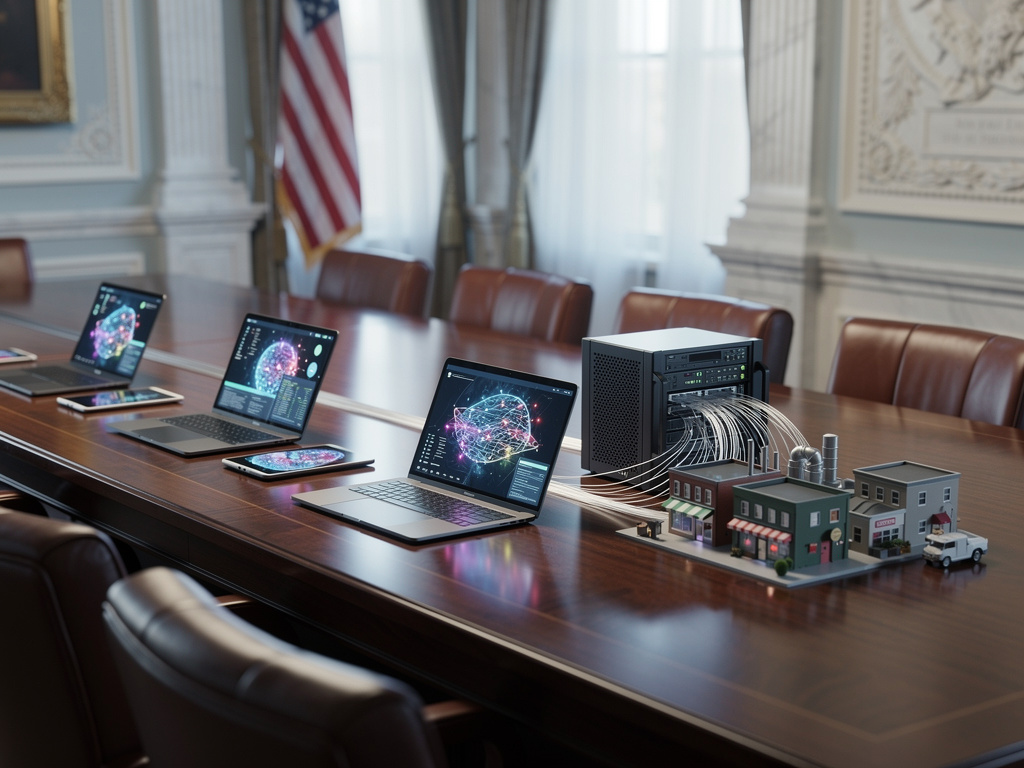
In a rare show of unity amid partisan gridlock, the U.S. House of Representatives on January 20, 2026, passed two bipartisan bills aimed at arming small businesses with artificial intelligence tools through the Small Business Administration. The AI for Main Street Act (H.R. 5764) sailed through with a resounding 395-14 vote, while the Artificial Intelligence Wisdom for Innovative Small Enterprises Act, or AI-WISE Act (H.R. 5784), cleared by voice vote. Both measures now await Senate action, where companion legislation introduced by Sens. Todd Young (R-Ind.) and Maria Cantwell (D-Wash.) earlier in January signals potential momentum. FedScoop reported the passage as a key step to bridge the technology gap for Main Street firms.
These bills respond to a stark divide: Large corporations pour billions into AI, while small businesses—employing nearly half of the private workforce—often lack resources to adopt it safely. Rep. Mark Alford (R-Mo.), lead sponsor of the AI for Main Street Act alongside Rep. Hillary Scholten (D-Mich.), emphasized empowerment over replacement. “This is not about replacing people; it is about empowering people. It’s about giving a family-owned business the same opportunity to compete and grow and innovate as a Fortune 500 company,” Alford said. The legislation mandates SBA-funded Small Business Development Centers (SBDCs)—a network of over 900 locations nationwide—to deliver AI guidance, training, and outreach on best practices, cybersecurity, data protection, and operational streamlining. Fox News highlighted the landslide support.
The measures build directly on existing efforts like Google’s AI U program, launched with a $10 million Google.org grant in 2024 to America’s SBDCs. This initiative already offers one-on-one coaching and resources, proving a model for scaling AI literacy without new spending—both bills draw solely from current SBA funds. Rep. Nydia Velázquez (D-N.Y.), ranking member of the House Small Business Committee, warned of risks: “While it is becoming increasingly common for small businesses to use AI to streamline their operations, many still do not have access to it responsibly. But if you use it incorrectly, AI could have disastrous consequences.” Congress.gov details the bill’s progress.
Empowering SBDCs as AI Frontline Advisors
Under H.R. 5764, SBDCs must conduct outreach to gauge small business AI concerns and provide tailored counseling. This includes evaluating AI tools for tasks like inventory management or customer service, planning for disruptions, and navigating regulations. The House Small Business Committee advanced the bill unanimously from markup in November 2025 after hearings on SBA restoration, reflecting months of bipartisan refinement. Rep. Roger Williams (R-Texas), committee chair, has long championed small business innovation, noting AI’s real-time transformation of operations.
For rural and underserved areas, these resources could prove transformative. Rep. Troy Downing (R-Mont.), cosponsor of the AI-WISE Act with Scholten, spotlighted his district’s challenges: “The small businesses in rural communities that I represent often lack the resources and information needed to facilitate technology adoption. My AI-WISE Act will help Main Street Montana stay competitive and thrive in the AI era.” Downing’s press release celebrated the House passage, quoting endorsements from OpenAI and Intuit. Rep. Troy Downing’s office.
SBDCs, public-private partnerships, already counsel on financing and planning; expanding to AI formalizes this role amid booming adoption. A September 2025 SBA Office of Advocacy report noted small firms rapidly closing the AI gap, with 78% of companies using it but only 26% capturing full value—per Forbes Insights. These bills aim to accelerate responsible uptake. Rep. Mark Alford’s office.
AI-WISE Act: Building Digital Literacy Platforms
H.R. 5784 directs the SBA administrator to develop and host online learning modules on an existing platform, covering AI model mechanics, task identification, third-party coordination, data privacy, and spotting AI outputs. Consultation with the National Institute of Standards and Technology (NIST) and an expert advisory group ensures accuracy and neutrality—no favoritism toward specific providers. OpenAI praised this in a November 2025 letter: “OpenAI also strongly supports H.R. 5784… This bill would require the Small Business Administration to develop and maintain clear educational resources and online learning modules that explain how AI tools work, their limitations and risks.” Congressional record.
Rep. Scholten, a consistent force, tweeted post-passage: “West Michigan entrepreneurs showed up, and today Congress delivered. My AI-WISE Act and AI for Main Street Act passed the House with bipartisan support.” The bill engages SBDCs and Women’s Business Centers for dissemination, including localized training. Williams added: “Artificial intelligence is changing how businesses operate in real time. And while large corporations can afford expensive consultants… many small businesses do not have the luxury… The AI WISE Act helps bridge that gap.” FedScoop on committee advance.
This modular approach prioritizes accessibility, with no new authorizations—leveraging SBA’s e-learning infrastructure. Industry backing from OpenAI underscores model-agnostic design, vital as agentic AI emerges for workflows like forecasting and personalization, per 2026 Forbes predictions on small business trends.
Senate Path and Broader Momentum
Sens. Young and Cantwell’s January 2026 Senate companion mirrors House provisions, directing SBDCs to expand AI training on operations, cybersecurity, and IP protection. Young stated: “This legislation will help provide guidance and training to thousands of… small businesses on how they can use AI to help their businesses grow and thrive.” Cantwell echoed for Washington state. As of late January 2026, no Senate floor action, but bipartisan sponsors and House momentum position them well—especially post-SBA IT modernization passage in December 2025. Sen. Todd Young’s office.
Recent SBA moves, like a February 5, 2026, roundtable on AI executive orders, align with this push. Google’s ongoing AI U expansion via Grow with Google further validates the model. Rep. Alford tweeted: “PASSED: AI FOR MAIN STREET ACT! @HouseSmallBiz is finding solutions that give small businesses the tools, training, and trusted guidance needed to compete.” X posts from insiders confirm overwhelming support. SBA AI resources page.
For industry insiders, these bills signal Washington’s pivot to pragmatic AI enablement for the 33 million small businesses driving 44% of U.S. GDP. With no fiscal offset needed, Senate passage could codify AI as a Main Street equalizer by mid-2026, amid rising agentic tools and federal frameworks.


 WebProNews is an iEntry Publication