
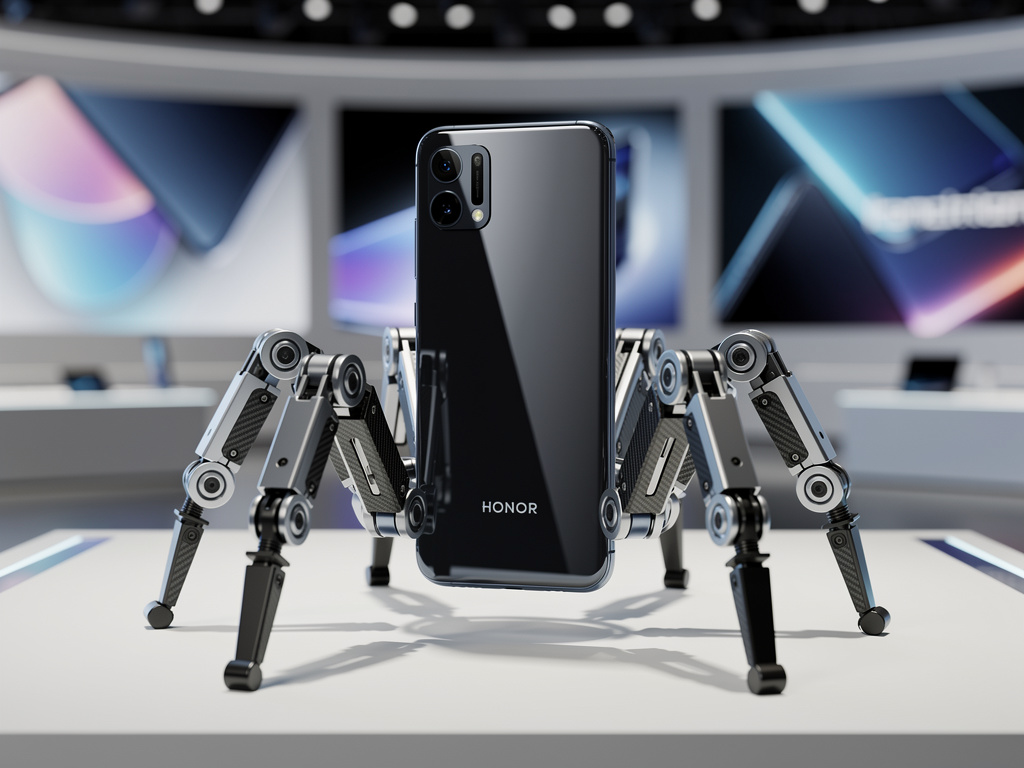
At Mobile World Congress 2025 in Barcelona, Chinese smartphone maker Honor turned heads not with a thinner device or a faster chip, but with a phone that walks. The Honor Robophone, a prototype that attaches spider-like mechanical legs to a smartphone, represents one of the most unconventional concepts to emerge from a major handset manufacturer in years — and it raises serious questions about where the smartphone form factor is headed as the industry grapples with stagnating innovation.
The device, first reported by The Verge, is not a product destined for store shelves anytime soon. It is a research concept, a provocation dressed in plastic and servos. But Honor’s willingness to publicly demonstrate such an outlandish idea signals something deeper about the competitive pressures facing Chinese smartphone brands as they attempt to differentiate themselves in saturated global markets.
A Phone That Stands, Walks, and Stabilizes Itself
The Robophone concept consists of a smartphone body mounted atop six articulated mechanical legs. According to Honor’s demonstration at MWC, the device can stand upright on its own, walk across a flat surface, and — perhaps most practically — use its legs as a built-in gimbal stabilization system for video recording. The legs can adjust in real time to keep the phone’s camera steady, functioning as a tripod and stabilizer without requiring any additional accessories.
Honor showed the device responding to voice commands and repositioning itself autonomously. In demonstrations captured by attendees and journalists, the Robophone shuffled across tabletops with a slightly eerie, insectoid gait. The company framed the concept as an exploration of how robotics and AI could merge with personal electronics, though it stopped short of announcing any timeline for commercialization.
The Gimbal Problem That Nobody Asked to Solve This Way
The most grounded application Honor pitched for the Robophone is camera stabilization. Content creators and videographers have long relied on external gimbals — motorized handheld stabilizers that counteract shaky movement — to produce smooth footage. Companies like DJI have built significant businesses around standalone gimbal products, with devices like the DJI Osmo Mobile series retailing for $100 to $200. Smartphone makers have also invested heavily in optical and electronic image stabilization built directly into camera modules.
Honor’s approach is different: rather than stabilizing the lens inside the phone, the entire phone becomes the stabilized platform. The mechanical legs act as a six-axis stabilization system, absorbing vibrations and adjusting the phone’s position relative to the ground. Whether this approach offers meaningful advantages over existing stabilization technology remains an open question. External gimbals are already compact, affordable, and well-understood by consumers. A phone with legs introduces mechanical complexity, durability concerns, and a form factor that is, to put it mildly, unusual.
Honor’s Broader Strategy: Standing Out in a Crowded Field
Honor, which was spun off from Huawei in late 2020 amid U.S. trade restrictions on its former parent company, has been aggressively working to establish itself as an independent global brand. The company has expanded into European and Asian markets with a lineup that spans budget devices to premium flagships. At MWC 2025, Honor also showcased more conventional products, including updates to its Magic series and advances in on-device AI capabilities.
But conventional launches alone may not be enough. The global smartphone market has been largely flat, with shipments hovering around 1.2 billion units annually according to IDC data. Differentiation has become increasingly difficult as hardware specifications converge across brands. Samsung, Apple, and Chinese rivals like Xiaomi, Oppo, and Vivo all offer devices with similar processors, camera systems, and display technologies. In this environment, attention-grabbing concepts like the Robophone serve a dual purpose: they generate media coverage and social media buzz, and they position the brand as forward-thinking even if the specific product never ships.
The Long History of Wild Phone Concepts at MWC
Honor is hardly the first company to use Mobile World Congress as a stage for ambitious prototypes. The trade show has a rich tradition of concept devices that push boundaries — some of which eventually influence real products, and many of which quietly disappear. Samsung’s early foldable phone concepts, first shown years before the Galaxy Fold launched in 2019, are perhaps the most notable example of an MWC prototype that eventually became a commercial product category. LG’s modular G5, unveiled at MWC 2016, is a cautionary counterexample — a bold concept that flopped in the market.
More recently, companies have shown rollable displays, transparent phones, and devices with holographic projectors at the Barcelona event. The vast majority never reach consumers. But they serve as public R&D demonstrations, allowing companies to gauge reaction, attract engineering talent, and signal to investors and partners that they are investing in future technologies. Honor’s Robophone fits squarely within this tradition, though its sheer visual strangeness sets it apart from most concept devices.
Robotics Meets Consumer Electronics: A Convergence Years in the Making
The Robophone also reflects a broader trend of robotics technology filtering into consumer products. Boston Dynamics has spent years developing advanced legged robots, and while its Spot robot dog remains primarily an industrial tool, the underlying technologies — servo motors, real-time balance algorithms, sensor fusion — have become cheaper and more accessible. Chinese robotics companies like Unitree have begun selling quadruped robots for under $2,000, bringing legged locomotion into the price range of consumer electronics.
At the same time, major tech companies have been investing heavily in humanoid and semi-humanoid robots. Tesla’s Optimus project, various efforts from Chinese firms like UBTech, and Amazon’s warehouse robotics all point toward a future where robotic systems are more present in daily life. Honor’s concept, while far less sophisticated than a humanoid robot, borrows from this same technological toolkit and asks whether those components can be miniaturized enough to fit inside — or onto — a smartphone.
Practical Hurdles and the Question of Consumer Appetite
Even if Honor could engineer a commercially viable version of the Robophone, significant practical challenges remain. Battery life is an obvious concern: powering six motorized legs in addition to a smartphone’s existing power demands would likely drain a battery rapidly. Weight and bulk are another issue. Current flagship phones already push the limits of what consumers consider comfortable to carry, and adding a mechanical leg assembly would increase both dimensions and mass substantially.
Durability presents yet another obstacle. Smartphones are dropped, shoved into pockets, and subjected to daily abuse. Mechanical legs with joints and servos introduce moving parts that could break, jam, or wear out. The ingress of dust, moisture, and pocket lint into leg mechanisms would need to be addressed — a non-trivial engineering challenge for a device meant to be carried everywhere.
What the Industry Can Actually Learn From a Walking Phone
Perhaps the most valuable takeaway from the Robophone is not the device itself but the underlying technologies it demonstrates. Miniaturized servo motors, real-time AI-driven stabilization algorithms, and autonomous positioning systems all have applications beyond a phone with legs. These technologies could improve drone stabilization, enhance augmented reality headsets, or contribute to wearable robotics for accessibility applications.
Honor’s AI capabilities, which the company has been developing for on-device processing, are also central to the Robophone concept. The device uses AI to interpret voice commands, determine optimal positioning for photography, and manage the complex coordination of six independent leg motors. These AI systems, even if the Robophone itself never ships, could find their way into more conventional Honor products — smarter tripod modes, better video stabilization, or AI-directed camera positioning features built into standard phones.
The Spectacle Is the Point
In a smartphone industry where year-over-year improvements have become incremental — a slightly better camera sensor here, a marginally brighter display there — Honor’s Robophone is a reminder that hardware innovation can still surprise. The device is impractical, possibly absurd, and almost certainly not coming to a store near you. But it accomplished exactly what Honor needed at MWC 2025: it made people pay attention.
For an industry that has struggled to generate genuine excitement since the arrival of foldable phones several years ago, a walking smartphone is, at minimum, a conversation starter. Whether that conversation leads anywhere productive remains to be seen. But in a market where attention is currency, Honor’s six-legged prototype may have been the smartest thing at the show — even if it looked like something out of a science fiction film.


 WebProNews is an iEntry Publication