
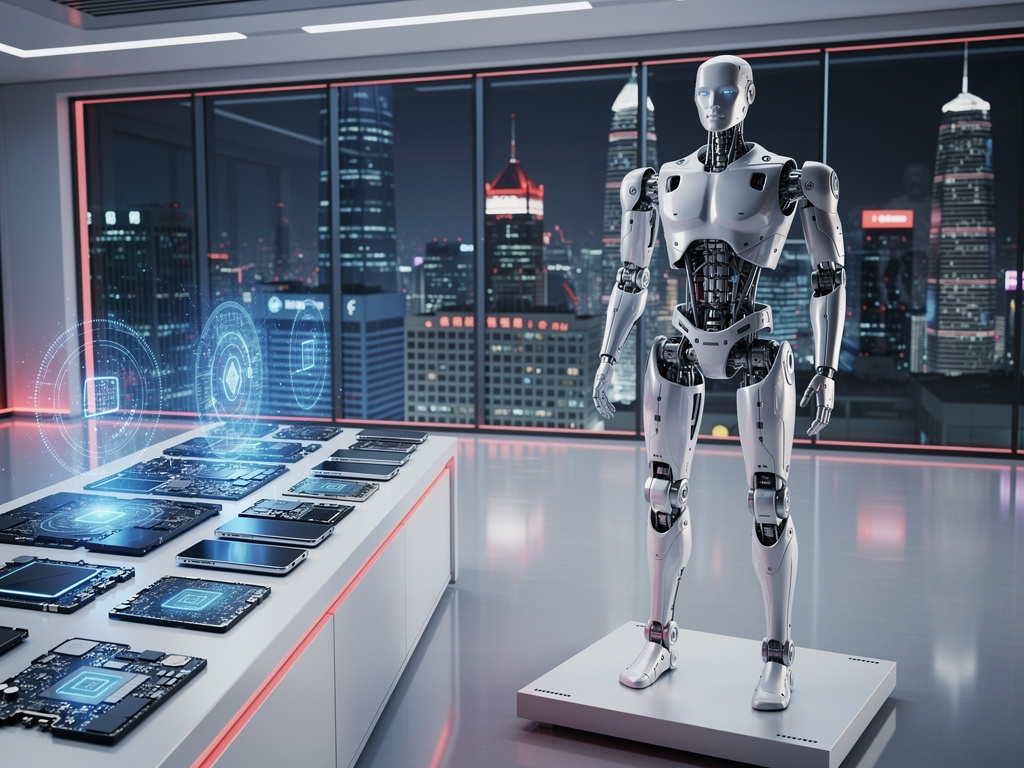
The Chinese smartphone maker Honor, once a budget sub-brand of Huawei, has announced plans to develop a humanoid robot — a move that places the company squarely in the middle of an intensifying race among Chinese technology firms to dominate the next generation of intelligent machines. The announcement, made by Honor CEO George Zhao at a company event, represents a significant strategic expansion for a firm that has spent the past several years rebuilding its identity as an independent premium device maker.
According to Mashable, Zhao revealed the humanoid robot project alongside a broader vision for Honor’s artificial intelligence strategy, suggesting that the company sees physical AI embodiment as a natural extension of the software intelligence it has been building into its smartphones. The robot is expected to incorporate Honor’s proprietary AI agent technology, which the company has been developing to power on-device intelligence across its product lineup.
From Smartphones to Bipedal Machines: Honor’s Strategic Leap
Honor’s entry into humanoid robotics may seem like a dramatic departure from its core business, but it follows a pattern now well-established among major Chinese tech companies. Xiaomi unveiled its CyberOne humanoid robot prototype in 2022. Huawei has invested in robotics-adjacent AI capabilities. And a growing constellation of Chinese startups — including Unitree Robotics, Fourier Intelligence, and Agibot — have attracted billions of yuan in venture funding as Beijing pushes to make China a global leader in humanoid robot development by 2027.
The Chinese government’s explicit policy support for humanoid robotics has created a gold rush mentality. In late 2023, the Ministry of Industry and Information Technology released guidelines calling for breakthroughs in humanoid robot technology by 2025 and mass production capabilities by 2027. That policy framework has turned humanoid robotics into a strategic priority on par with semiconductors and electric vehicles, drawing in companies from well outside the traditional robotics sector.
What Honor Has Said — and What Remains Unclear
Details about Honor’s humanoid robot remain sparse. As Mashable reported, CEO George Zhao presented the project as part of a broader AI-centric product roadmap, but the company has not disclosed technical specifications, a target release date, or whether the robot would be aimed at industrial, commercial, or consumer applications. The announcement was made with enough fanfare to signal serious intent, but without the kind of technical detail that would allow independent assessment of the project’s maturity.
This ambiguity is not unusual for early-stage humanoid robot announcements in the Chinese tech sector. Many companies have used high-profile product reveals to stake a claim in the space, attract engineering talent, and signal to investors and government officials that they are aligned with national technology priorities. Whether Honor’s robot program will produce a commercially viable product or remain a research initiative is a question that likely won’t be answered for years.
The AI Agent Connection: On-Device Intelligence as a Foundation
One thread that connects Honor’s robotics ambitions to its existing business is the company’s investment in AI agent technology. Honor has been developing on-device AI capabilities that allow its smartphones to perform complex tasks autonomously — scheduling, information retrieval, app interaction — without relying entirely on cloud processing. The company has positioned this technology as a differentiator in an increasingly crowded Android smartphone market.
The logic of extending AI agent capabilities to a physical robot is straightforward, at least conceptually. A humanoid robot requires not just mechanical locomotion but also the ability to perceive its environment, make decisions, and interact with humans in natural ways. The AI models that power smartphone agents — particularly those focused on natural language understanding, task planning, and contextual awareness — could theoretically serve as building blocks for robotic intelligence. However, the engineering challenges of embodied AI are orders of magnitude more complex than anything required for a phone-based assistant.
A Crowded and Capital-Intensive Field
Honor is entering a field that is already attracting enormous investment and fierce competition. In the United States, Tesla’s Optimus robot program has become a central part of Elon Musk’s narrative about the company’s future value. Figure AI raised $675 million in early 2024 at a $2.6 billion valuation, with backing from Jeff Bezos, Microsoft, and Nvidia. Agility Robotics has begun pilot deployments of its Digit robot in Amazon warehouses.
In China, the competitive dynamics are equally intense. Unitree Robotics made headlines in early 2025 with demonstrations of its G1 humanoid robot performing backflips and complex manipulation tasks at price points that undercut Western competitors. Fourier Intelligence has focused on rehabilitation and healthcare applications. Agibot, backed by significant venture capital, is pursuing general-purpose humanoid platforms. The sheer number of entrants raises questions about which companies will ultimately achieve the scale and technical capability needed to produce robots that are genuinely useful rather than merely impressive in controlled demonstrations.
The Talent and Supply Chain Question
One advantage Honor may bring to the table is its access to China’s deep manufacturing supply chain and its existing relationships with component suppliers. Building humanoid robots at scale requires expertise in actuators, sensors, batteries, and precision manufacturing — areas where Chinese firms have developed significant capabilities through decades of electronics and automotive production. Honor’s experience managing complex hardware supply chains for millions of smartphones annually could prove relevant, even if the specific engineering challenges of robotics are very different.
The talent question is more complicated. Humanoid robotics requires specialized expertise in mechanical engineering, control systems, computer vision, and reinforcement learning that goes well beyond what a smartphone company typically employs. Honor would need to recruit aggressively from universities and competing robotics firms, or acquire smaller teams with relevant experience. The company has not disclosed the size of its robotics team or the organizational structure of the new initiative.
Beijing’s Industrial Policy as Tailwind
It would be difficult to overstate the role of Chinese government policy in driving the current wave of humanoid robot development. The 2023 guidelines from the Ministry of Industry and Information Technology set explicit targets and signaled that companies pursuing humanoid robotics could expect favorable treatment in terms of funding, regulatory support, and access to government contracts. Provincial and municipal governments have followed with their own incentive programs, creating a layered system of support that reduces the financial risk for companies entering the space.
For Honor, which has been rebuilding its business after being spun off from Huawei in late 2020 amid U.S. sanctions pressure, alignment with national technology priorities carries additional strategic value. Demonstrating commitment to advanced AI and robotics helps position the company as a national champion in emerging technology, which can translate into preferential treatment across multiple dimensions of the Chinese business environment.
Skepticism Is Warranted, but the Trend Is Real
Industry analysts have greeted Honor’s announcement with a mix of interest and caution. The history of consumer electronics companies expanding into robotics is littered with projects that generated excitement but failed to produce commercially successful products. Sony’s AIBO and Honda’s ASIMO were technological showcases that never became viable businesses. More recently, several high-profile robot demonstrations have been revealed to rely heavily on remote human operation rather than genuine autonomy.
Yet the current moment is different in important respects. Advances in large language models, computer vision, and reinforcement learning have made it possible for robots to handle a wider range of unstructured tasks than ever before. The cost of key components — particularly actuators and sensors — has fallen dramatically. And the combination of aging populations and rising labor costs in major economies has created genuine demand for robotic labor in manufacturing, logistics, elder care, and other sectors.
What Comes Next for Honor and the Industry
Honor’s humanoid robot announcement is best understood not as a product launch but as a statement of strategic direction. The company is signaling to employees, investors, partners, and the Chinese government that it intends to be more than a smartphone maker. Whether that ambition translates into a functional humanoid robot that can compete with offerings from dedicated robotics companies remains an open question.
The broader trend, however, is unmistakable. The number of serious entrants in the humanoid robotics space — from both traditional tech companies and well-funded startups — has grown dramatically over the past two years. The convergence of AI capability, manufacturing capacity, government support, and market demand suggests that humanoid robots will move from laboratory curiosities to commercial products within this decade. Honor’s bet is that when that transition happens, it wants to be among the companies positioned to benefit. The risk, as always, is that ambition outpaces execution in a field where the engineering challenges remain formidable and the path to profitability is far from certain.


 WebProNews is an iEntry Publication