
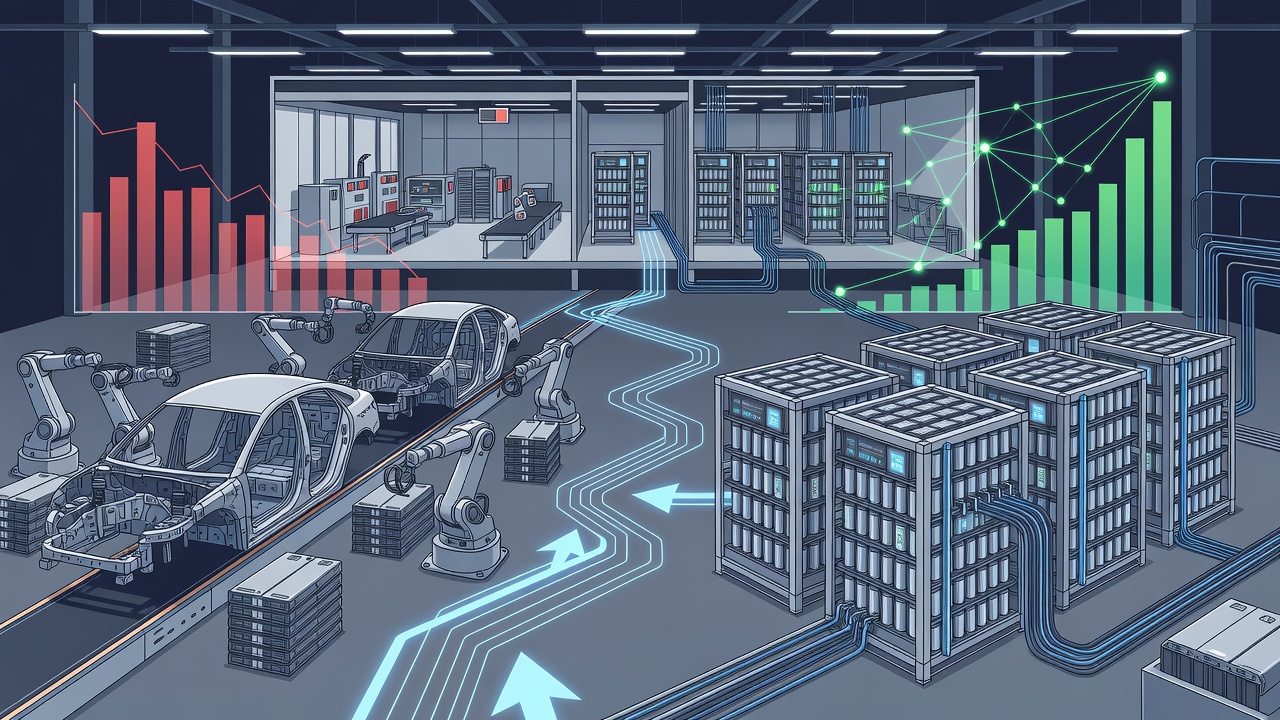
Honda Motor has begun turning out batteries for energy storage systems at a massive Ohio factory originally built to feed its electric vehicles. The shift, which started in early June, buys the Japanese automaker time while it waits for EV demand to strengthen. It also throws the company into a booming market for stationary storage driven by power-hungry AI facilities.
The plant in Fayette County was part of a $4.4 billion joint venture with South Korea’s LG Energy Solution announced in 2022. Plans called for lithium-ion cells to supply Honda and Acura EVs sold in North America. Construction wrapped up in 2025. Then the market turned.
U.S. EV sales slowed after federal tax incentives were revoked under President Donald Trump. Honda scaled back aggressive electrification targets, canceled several planned battery-electric models and wrote down billions. The factory risked sitting idle. But data centers changed the math.
“Honda started producing batteries for artificial intelligence data centers at a U.S. plant where it planned to make electric vehicle batteries,” reported Nikkei Asia on June 27. The company aims to keep its lines running until consumer appetite for full EVs returns.
Production of energy storage system, or ESS, batteries for data centers is a pragmatic bridge. These large-scale battery packs help data center operators manage massive electricity loads from AI training and inference. They store power during off-peak hours and discharge during spikes. They stabilize grids strained by new hyperscale facilities.
Honda bought the plant buildings and related assets from its partner for $2.5 billion, according to multiple reports citing the Nikkei article. The deal gives the automaker flexibility. It will begin producing batteries for hybrid vehicles at the same site in 2028. Output will swing between ESS units and hybrid packs depending on demand and the pace of vehicle electrification. Honda plans to roll out 15 new hybrid models, mostly for North America, by fiscal 2029.
The move mirrors actions by other automakers. Ford has committed roughly $2 billion over two years to build a battery energy storage business aimed at data centers and grid support, Latitude Media noted in December. General Motors has redirected capacity at a Tennessee plant to make cells for stationary storage, rehiring laid-off workers in the process. Even battery makers such as LG Energy Solution are converting lines to produce up to 50 GWh a year of storage batteries.
Stationary storage installations hit record levels in the first quarter of 2026. The U.S. added about 10 GWh, a 32% jump from the prior year, according to data cited by The Next Web. Projections show annual deployments could reach 110 GWh by 2030. Data centers represent a key growth driver alongside broader grid modernization.
Tesla already demonstrates the profit potential. Its energy storage business carries gross margins near 30%, far higher than its automotive segment. That reality has not escaped traditional car companies facing soft EV sales and high battery plant costs.
Honda’s pivot also taps into second-life opportunities. Companies like Redwood Materials repurpose used EV batteries for data center microgrids. One Nevada installation uses 12 MW / 63 MWh of second-life packs to power a modular AI facility alongside solar. While Honda’s current output focuses on new cells, the broader trend shows automakers building expertise across the battery lifespan.
The Ohio facility was designed for substantial scale. Early plans targeted annual capacity of 40 GWh. Exact current output for ESS remains undisclosed. Yet even partial utilization keeps workers employed and preserves supplier relationships. Honda and LG began the joint effort expecting strong EV uptake. Policy shifts and slower adoption forced a rethink.
Executives have described the strategy as a way to respond flexibly to market signals. A Honda spokesperson told Reuters the asset purchase “has enabled Honda to commit to batteries over the long term, allowing us to flexibly respond to batteries, not only for electric vehicles, but also hybrid vehicles.”
Industry observers see the pattern repeating. Carmakers poured capital into battery plants when EV forecasts looked rosy. Now many redirect that capacity toward stationary applications where demand is immediate and margins attractive. Data center operators face power shortages and interconnection delays. Battery storage offers a faster path to reliable, dispatchable electricity than waiting years for new transmission lines or gas plants.
But challenges remain. Battery chemistry optimized for vehicles does not always match stationary needs. Cycle life, safety standards and cost structures differ. Automakers must adapt manufacturing processes, secure new customers in the energy sector and compete with specialized storage players. Honda will balance ESS production against future hybrid output. The balance will shift with EV recovery.
Still, the Ohio decision shows clear-eyed pragmatism. Honda no longer bets everything on a rapid full-EV transition in the U.S. Hybrids buy time. Stationary storage monetizes existing assets today. And the AI boom provides a willing buyer for every kilowatt-hour of capacity the factory can ship.
Recent coverage reinforces the momentum. Autoblog highlighted how the plant now supplies batteries that keep AI data centers humming instead of idling while EV demand recovers. Yahoo Finance and Seeking Alpha echoed the theme of automakers pivoting capacity to meet surging electricity needs from artificial intelligence.
Honda’s broader electrification roadmap has moderated but not vanished. The company still talks of carbon neutrality and next-generation solid-state batteries. Yet near-term reality favors hybrids in North America and new revenue from energy storage. The Ohio plant, once a symbol of EV ambition, now illustrates adaptation.
Power demand from data centers could nearly triple by decade’s end. That forecast drives investment across nuclear restarts, fuel cells, geothermal and, crucially, batteries. Honda’s entry adds another established manufacturer to the mix. Its success or struggles will signal how well traditional automakers can translate vehicle battery know-how into grid-scale solutions.
For now the lines are running. Workers stay on the job. And a factory built for one future finds purpose in another. The pivot may look like a retreat from EVs. In practice it keeps Honda in the battery business at a moment when every megawatt counts.


 WebProNews is an iEntry Publication