
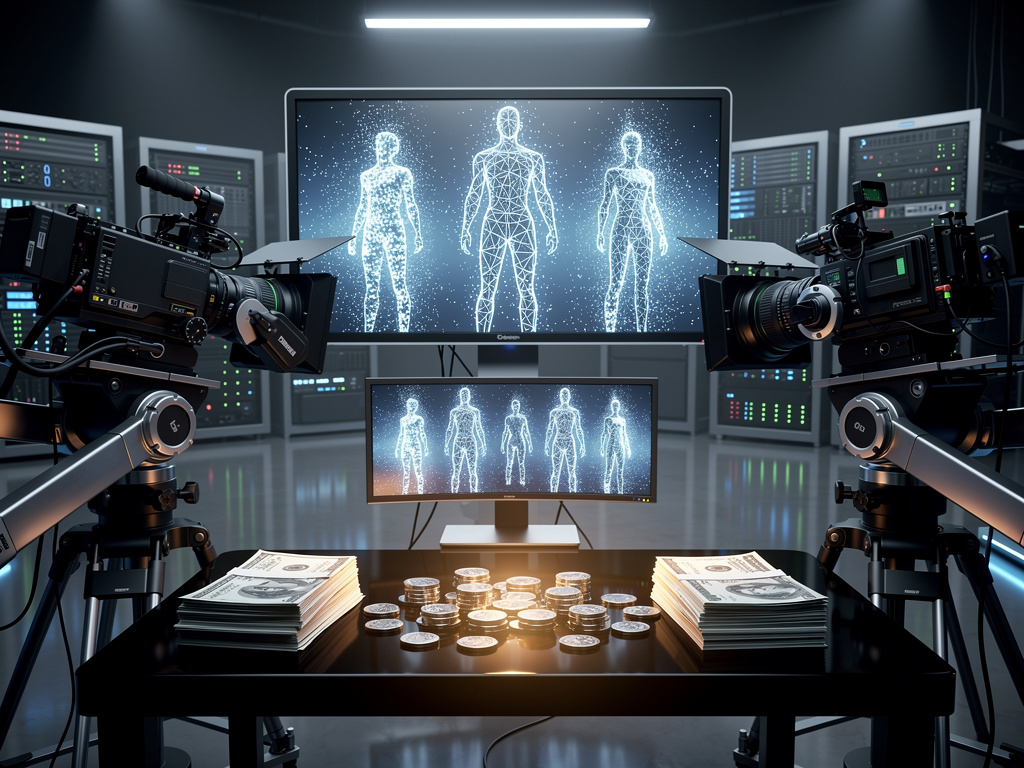
The Screen Actors Guild-American Federation of Television and Radio Artists finds itself at a crossroads as artificial intelligence technology continues to outpace the union’s ability to protect its members through traditional regulatory frameworks. After months of attempting to establish guardrails around the use of AI-generated digital performers, the union is now exploring a fundamentally different approach: implementing a tax on studios that deploy synthetic actors in their productions.
This strategic pivot represents a significant acknowledgment that conventional union tactics may prove insufficient against the rapid advancement of generative AI technology. According to Slashdot, the proposed taxation framework would require production companies to pay fees when utilizing AI-generated performers, with revenues potentially directed toward displaced workers or training programs designed to help human actors adapt to an industry increasingly influenced by artificial intelligence.
The entertainment industry has witnessed an unprecedented acceleration in AI capabilities over the past two years. Studios have demonstrated the ability to create photorealistic digital humans, resurrect deceased performers, and generate entirely synthetic actors capable of delivering convincing performances. These technological advances have created existential questions about the future of acting as a profession, particularly for background performers and character actors whose roles are most vulnerable to AI replacement.
The Evolution of Labor Protection in the Digital Age
SAG-AFTRA’s consideration of a tax-based approach marks a departure from the union’s traditional emphasis on prohibition and consent-based frameworks. During the 2023 strikes that paralyzed Hollywood production for months, the union secured language in its contracts requiring explicit consent from performers before their digital likenesses could be used. However, these provisions have proven difficult to enforce, and they do nothing to address the creation of entirely synthetic performers that bear no resemblance to existing actors.
The proposed tax mechanism would function similarly to other industry levies, such as residuals or pension contributions, that studios routinely pay as part of their production budgets. By treating AI performer usage as a taxable event rather than a prohibited practice, the union acknowledges the practical reality that studios will continue deploying this technology regardless of union opposition. The question becomes not whether AI performers will be used, but how to ensure human workers receive compensation when they are.
Economic Implications for Studio Production Budgets
Industry analysts suggest that a tax on AI performers could significantly impact production economics, particularly for large-scale projects that have traditionally employed hundreds of background actors. A typical blockbuster film might feature thousands of extras across various scenes—roles that AI technology can now fill at a fraction of the cost. If studios face taxation on these digital replacements, the economic calculus changes, potentially preserving some opportunities for human performers.
However, the effectiveness of such a tax depends entirely on its structure and enforcement mechanisms. If set too low, it becomes merely a cost of doing business that studios gladly pay to access AI’s efficiency gains. If set too high, it might drive production to jurisdictions outside SAG-AFTRA’s reach, accelerating the offshoring of entertainment production that has already reduced opportunities for American actors. The union faces the delicate challenge of calibrating a tax rate that meaningfully supports displaced workers without incentivizing studios to abandon union labor entirely.
Legal and Jurisdictional Challenges Ahead
Implementing a tax on AI performers presents substantial legal complexities. Unlike traditional union negotiations over wages and working conditions, a tax on technology usage enters murky regulatory territory. Studios could argue that such levies represent an unlawful restraint on their business practices or an improper attempt by a labor union to regulate technology adoption. The legal framework for such taxation remains untested, and SAG-AFTRA would likely face immediate court challenges from major studios.
Jurisdictional issues further complicate enforcement. The entertainment industry operates globally, with productions increasingly distributed across multiple countries to access tax incentives and diverse locations. A SAG-AFTRA tax on AI performers would apply only to productions under the union’s contracts, potentially creating competitive disadvantages for unionized productions. Studios might respond by restructuring their corporate entities or production workflows to minimize exposure to such taxes, much as they have optimized around other regulatory requirements.
Technology Outpacing Regulatory Frameworks
The rapid evolution of AI technology has consistently outpaced the entertainment industry’s ability to establish governance frameworks. When SAG-AFTRA began negotiating AI provisions in 2023, the technology could create convincing digital doubles of specific performers but struggled with generating entirely original synthetic humans. Today, generative AI systems can create photorealistic actors from text descriptions, complete with consistent appearances across multiple scenes and the ability to deliver performances in any language.
This technological velocity creates a moving target for union negotiators. By the time contract language is drafted, ratified, and implemented, the underlying technology has often evolved beyond the scope of those provisions. A tax-based approach offers potential advantages in this environment because it can apply broadly to AI performer usage regardless of specific technical implementation, providing more flexibility as the technology continues advancing.
The Broader Labor Movement’s Interest
SAG-AFTRA’s exploration of AI taxation is being closely watched by labor organizations across multiple industries facing similar technological disruption. Writers, musicians, visual artists, and voice actors all confront AI systems capable of replicating or replacing aspects of their work. If SAG-AFTRA successfully implements a tax framework that provides meaningful support for displaced workers, it could establish a template for other creative industries grappling with artificial intelligence.
The precedent could extend beyond entertainment. As AI systems become capable of performing an expanding range of cognitive and creative tasks, the question of how to support workers displaced by automation becomes increasingly urgent across the economy. A successful tax mechanism in Hollywood might inform broader policy discussions about AI’s economic impact and society’s responsibility to workers whose livelihoods are disrupted by technological change.
Alternative Approaches and Hybrid Models
Some industry observers suggest that taxation might work best as part of a hybrid approach combining multiple protective mechanisms. Rather than replacing consent-based frameworks and usage restrictions, a tax could supplement these existing protections, creating multiple layers of safeguards for human performers. Studios would still need performer consent to use specific likenesses, but would also pay taxes when deploying synthetic actors, with those revenues supporting training programs and transition assistance for affected workers.
This layered approach acknowledges that no single mechanism will adequately address AI’s multifaceted impact on the entertainment industry. Consent provisions protect individual performers’ rights to control their digital likenesses. Usage restrictions can preserve certain categories of work for human actors. Taxation provides economic support for displaced workers and creates financial incentives for studios to consider human performers. Together, these mechanisms might prove more effective than any single approach in isolation.
The Path Forward for Entertainment Labor
As SAG-AFTRA continues deliberating its approach to AI performers, the union faces pressure from multiple directions. Members want protection from technological displacement, but also recognize that overly restrictive policies might drive production away from union labor entirely. Studios argue that AI technology offers creative possibilities and economic efficiencies that benefit the industry broadly, while also acknowledging concerns about worker displacement and the need for orderly transition mechanisms.
The coming months will likely see intensive negotiations as the union refines its taxation proposal and engages with studios about implementation. Success will require balancing competing interests while establishing frameworks flexible enough to accommodate continued technological evolution. Whatever approach ultimately emerges from these discussions will shape not only the future of acting as a profession, but also broader conversations about how society manages the economic disruption created by increasingly capable artificial intelligence systems across all sectors of the economy.


 WebProNews is an iEntry Publication