
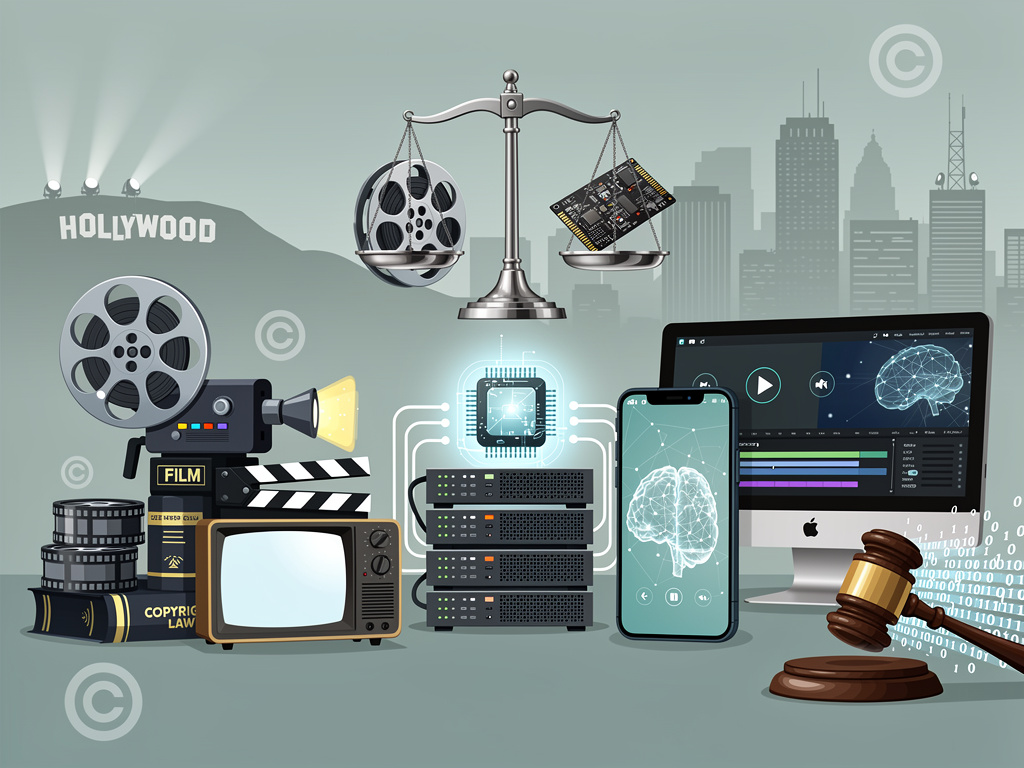
The collision between artificial intelligence and intellectual property has found its latest and perhaps most consequential flashpoint. A powerful coalition of Hollywood studios and entertainment industry groups has publicly condemned ByteDance, the Chinese parent company of TikTok, over allegations that its AI-powered video generation tool was built on the back of copyrighted content — without permission, compensation, or credit.
The confrontation marks a significant escalation in the broader battle between content creators and the technology companies racing to deploy generative AI tools that can produce sophisticated video, music, and text. It also underscores the growing anxiety in the entertainment world that the very content fueling AI’s rapid advancement is being harvested in ways that undermine the economic foundations of creative industries.
A Coalition of Hollywood Heavyweights Takes Aim at ByteDance
As first reported by The Information, a prominent group representing major Hollywood studios and entertainment companies has issued a sharp rebuke of ByteDance’s AI video service, accusing the company of copyright infringement on a sweeping scale. The group’s complaint centers on allegations that ByteDance used vast libraries of copyrighted film, television, and other audiovisual content to train its generative AI video models without obtaining the necessary licenses or authorizations from rights holders.
The industry coalition — which includes representatives from some of the most powerful studios and trade organizations in the entertainment business — argues that ByteDance’s practices represent a fundamental breach of copyright law. Their position is unambiguous: using copyrighted works to train AI systems that then generate competing content is not fair use, and it cannot be tolerated as a business practice, regardless of how transformative the underlying technology may be.
ByteDance’s Ambitious Push Into AI-Generated Video
ByteDance has been aggressively expanding its AI capabilities, leveraging its massive trove of user-generated and licensed content on TikTok and its Chinese counterpart Douyin to build increasingly sophisticated generative models. The company’s AI video tools are designed to allow users to create realistic, high-quality video content from text prompts or reference images — capabilities that place ByteDance in direct competition with other AI video pioneers such as OpenAI’s Sora, Google’s Veo, and Runway.
The appeal of such tools is obvious. AI-generated video has the potential to democratize content creation, slash production costs, and open new creative possibilities. But the technology’s reliance on enormous datasets of existing content — much of it copyrighted — has created a legal and ethical minefield. Hollywood’s complaint against ByteDance is the latest indication that the entertainment industry is prepared to fight aggressively to protect its intellectual property in this new era.
The Core Legal Dispute: Training Data and Fair Use
At the heart of the controversy is a question that courts, regulators, and lawmakers around the world are still grappling with: Does using copyrighted material to train an AI model constitute fair use, or does it amount to unauthorized copying? The entertainment industry has consistently argued that ingesting copyrighted works into AI training datasets is, in effect, a massive act of reproduction that requires licensing. Technology companies, by contrast, have generally maintained that training AI on publicly available data — including copyrighted material — falls within the bounds of fair use, particularly when the output is transformative rather than a direct copy.
The Hollywood coalition’s complaint against ByteDance suggests that the industry sees the Chinese tech giant’s practices as particularly egregious. According to the allegations outlined in The Information‘s reporting, the group contends that ByteDance not only used copyrighted content without authorization but did so on a scale and in a manner that directly threatens the market for the original works. If an AI tool can generate video content that mimics the style, tone, and even specific elements of copyrighted films and shows, the argument goes, it effectively substitutes for the original — a key factor in fair use analysis.
A Pattern of Legal Confrontation Across the AI Industry
ByteDance is far from the only technology company facing copyright challenges from the creative industries. In recent months, a wave of lawsuits and regulatory complaints has swept across the AI sector. Major music labels have sued AI music generators. The New York Times filed a landmark lawsuit against OpenAI and Microsoft, alleging that ChatGPT was trained on millions of the newspaper’s articles. Visual artists have brought class-action suits against Stability AI, Midjourney, and DeviantArt over the use of their images in training data for image generators.
What distinguishes the Hollywood coalition’s action against ByteDance is both its scope and its target. ByteDance is one of the world’s most valuable private technology companies, with deep pockets and a global reach that extends far beyond its TikTok platform. The entertainment industry’s willingness to take on such a formidable adversary signals that rights holders view the AI copyright issue as existential — not merely a licensing dispute, but a fight over the fundamental economics of content creation.
The Geopolitical Dimension: TikTok, ByteDance, and Washington
The copyright dispute also carries significant geopolitical undertones. ByteDance and TikTok are already under intense scrutiny from U.S. lawmakers over national security concerns, with legislation signed into law in 2024 that could force a sale or ban of TikTok in the United States. The copyright allegations add another layer of controversy to ByteDance’s operations in the American market, potentially strengthening the hand of those in Washington who argue that the company’s practices are incompatible with U.S. legal norms and values.
For Hollywood, the geopolitical context is both a complication and an opportunity. Studios and entertainment companies have long navigated complex relationships with Chinese markets and technology firms. But the AI copyright issue transcends trade politics — it strikes at the core of how creative works are valued and protected in a digital economy increasingly shaped by machine learning.
What Hollywood Wants: Licensing, Transparency, and Control
The entertainment industry’s demands in this dispute are multifaceted. At the most basic level, studios and rights holders want compensation. They argue that if AI companies are going to use copyrighted content to train their models, they must negotiate licenses and pay for the privilege — just as streaming platforms, broadcasters, and other distributors do. Beyond financial terms, the industry is also pushing for greater transparency about what data is being used in AI training, and for mechanisms that give rights holders the ability to opt out of having their content ingested by AI systems.
Some industry leaders have also called for new legislation that would explicitly address the use of copyrighted material in AI training, arguing that existing copyright frameworks were not designed for the challenges posed by generative AI. In the United States, the Copyright Office has been conducting a series of studies and public consultations on the issue, but concrete legislative action has been slow to materialize.
The Stakes for the Future of AI and Creative Industries
The outcome of the confrontation between Hollywood and ByteDance could have far-reaching implications — not just for the entertainment industry, but for the entire AI sector. If courts or regulators side with rights holders, AI companies could face enormous new licensing costs and operational constraints. If the technology companies prevail, it could set a precedent that effectively allows the wholesale use of copyrighted content for AI training, potentially reshaping the economics of creative industries for decades to come.
For now, the battle lines are clearly drawn. Hollywood is signaling that it will not accept a future in which its most valuable assets are used to train AI systems without consent or compensation. ByteDance, for its part, is unlikely to back down easily, given the strategic importance of AI to its business. The dispute is poised to become one of the defining legal and commercial conflicts of the generative AI era — a test case that will shape the relationship between technology and creativity for years to come.
As the entertainment industry and the tech sector prepare for what could be a prolonged and costly fight, one thing is clear: the rules governing AI and intellectual property are being written in real time, and the stakes could not be higher for either side.


 WebProNews is an iEntry Publication