
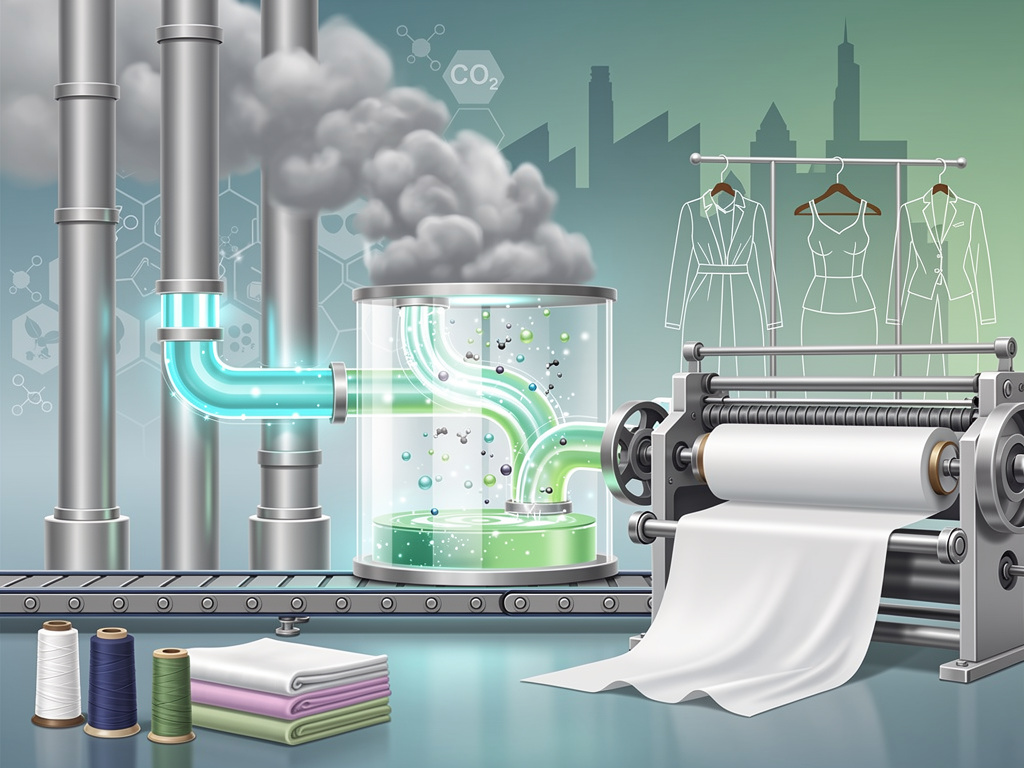
H&M is betting that the future of fashion starts with carbon dioxide. The Swedish retail giant has partnered with a startup called LanzaTech to develop a supply chain that converts industrial CO2 emissions into polyester — the synthetic fiber that makes up more than half of all textiles produced globally.
The announcement, reported by TechCrunch, signals one of the most ambitious attempts yet by a major fashion brand to decarbonize its materials pipeline. Not through offsets. Not through vague pledges. Through actual chemistry.
From Smokestacks to Polyester: The Science Behind LanzaTech’s Process
LanzaTech, headquartered in Skokie, Illinois, has spent years developing a gas fermentation platform that uses proprietary microbes to consume carbon-rich waste gases — the kind belched out by steel mills, refineries, and other heavy industry. Those microbes convert the CO2 into ethanol, which can then be processed into monoethylene glycol (MEG), a key building block of polyester.
The company isn’t new to this. LanzaTech has been operating commercial-scale facilities in China and Belgium, and its technology has already been used to produce sustainable aviation fuel and packaging materials. But clothing represents a massive new market. Polyester production alone accounts for roughly 1.1 billion metric tons of CO2 equivalent annually, according to the Textile Exchange. So even marginal displacement of virgin polyester with CO2-derived alternatives could move the needle on fashion’s carbon footprint.
H&M’s interest makes strategic sense. The company has committed to using only recycled or sustainably sourced materials by 2030, a target that requires more than just scaling up mechanical recycling of plastic bottles. It requires entirely new feedstocks.
And CO2 is nothing if not abundant.
Why H&M Is Making This Move Now
Fast fashion has a credibility problem. Consumers and regulators alike have grown skeptical of sustainability claims from brands that produce billions of garments per year. The EU’s proposed Green Claims Directive, expected to tighten rules around environmental marketing, has put pressure on companies to back up their rhetoric with verifiable science.
H&M has faced its share of criticism. In 2022, the company was hit with a class-action lawsuit alleging its environmental scorecards on products were misleading — a case that underscored how risky greenwashing has become. Partnering with LanzaTech gives H&M something tangible: a traceable, novel material with a clear carbon story.
“We see carbon capture and utilization as a critical pathway to reducing our dependence on fossil-based virgin materials,” an H&M spokesperson said, per TechCrunch. The company plans to introduce pilot collections featuring the CO2-derived polyester, though it hasn’t disclosed specific timelines or volumes.
LanzaTech CEO Jennifer Holmgren has been vocal about the need for demand signals from major brands. “The technology works,” Holmgren has said in previous interviews. “What we need is market pull.” H&M provides exactly that.
But there are real questions about scale. Converting CO2 to ethanol to MEG to polyester involves multiple processing steps, each with its own energy requirements and yield losses. Critics point out that unless the entire chain runs on renewable energy, the lifecycle emissions savings could be modest. A 2023 analysis by the journal Nature found that carbon utilization technologies vary enormously in their net climate benefit depending on energy source and process efficiency.
There’s also cost. Virgin polyester is cheap — roughly $1 per kilogram. CO2-derived polyester currently costs significantly more, though LanzaTech has been working to close that gap through partnerships and government incentives, including funding from the U.S. Department of Energy.
Still, the direction is clear. India’s Reliance Industries, one of the world’s largest polyester producers, has also invested in LanzaTech. So has Brookfield Renewable Partners. The capital is flowing.
What This Means for the Industry
For textile manufacturers and brand executives watching this space, a few things matter. First, carbon-derived materials are no longer theoretical. They’re entering commercial supply chains. Second, regulatory pressure — particularly from the EU — is accelerating adoption faster than market economics alone would dictate. Third, the competitive dynamics of sustainable sourcing are shifting. Brands that lock in partnerships with companies like LanzaTech early may gain both supply security and marketing advantages as consumer expectations evolve.
The bigger picture is this: fashion’s decarbonization won’t come from any single technology. Recycled content, bio-based feedstocks, carbon capture — all of these will play roles. What H&M and LanzaTech are doing is proving that one of those pathways can work at the scale the industry demands.
Whether it works economically at that scale is the next question. And it’s the one that matters most.


 WebProNews is an iEntry Publication