
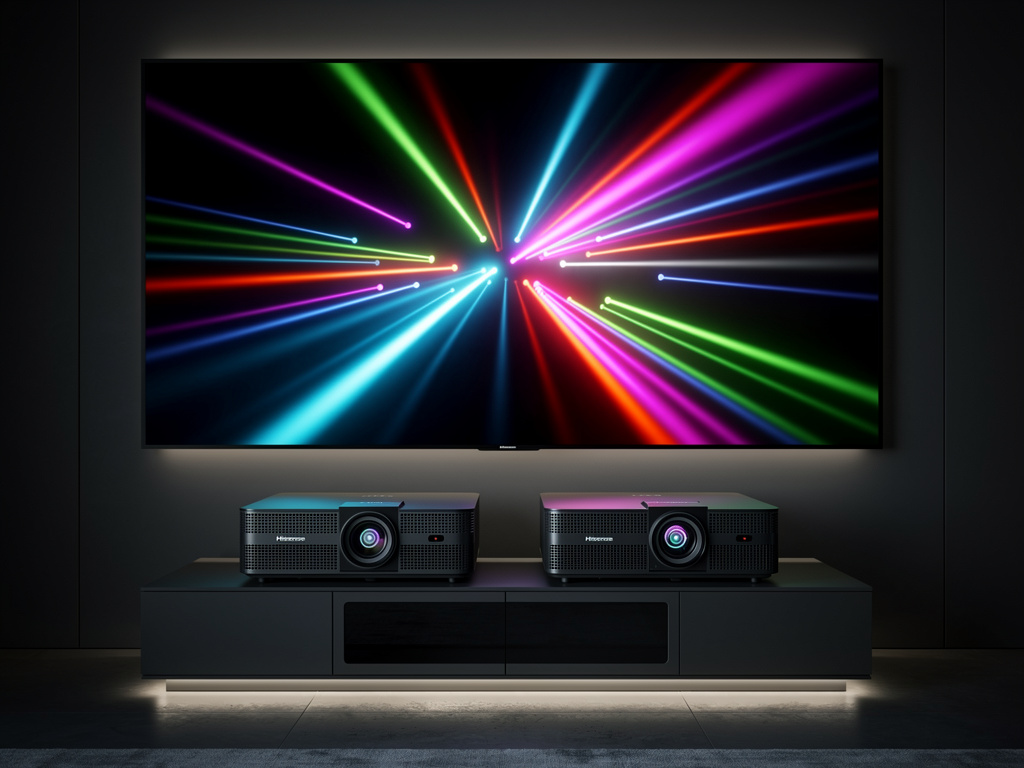
Hisense’s Laser Revolution: How the XR10 and PX4-Pro Are Poised to Eclipse Traditional TVs
In the ever-evolving realm of home entertainment technology, Hisense is making waves with its latest announcements ahead of CES 2026. The company has previewed two groundbreaking laser projectors, the XR10 and the PX4-Pro, which promise to push the boundaries of what’s possible in immersive viewing. Drawing from recent reports, these devices are not just incremental updates but significant advancements that could challenge the dominance of high-end OLED televisions. As consumers increasingly seek larger, more flexible display options, Hisense’s focus on laser projection technology highlights a shift toward scalable, high-performance solutions that blend cinema-quality visuals with everyday usability.
The XR10 stands out as the flagship model, boasting capabilities that cater to enthusiasts demanding the utmost in picture quality and size. According to details shared in a recent piece from Android Authority, this projector can deliver images up to a staggering 300 inches, powered by a tri-laser system that achieves up to 6,000 lumens of brightness. This level of luminosity ensures vibrant, clear projections even in well-lit environments, a common pain point for traditional projectors. Hisense has integrated advanced features like IMAX Enhanced certification, Dolby Vision, and HDR10+ support, making it a versatile choice for movies, gaming, and sports.
Complementing the XR10 is the PX4-Pro, an ultra-short-throw model designed for seamless integration into modern living spaces. This projector can produce screens from 90 to 150 inches with a throw ratio as low as 0.2:1, meaning it can be placed mere inches from the wall. Insights from CEPRO emphasize its 3,000 lumens brightness and enhanced contrast ratios, which are bolstered by an innovative IRIS system for dynamic light control. Both models run on the VIDAA U9 operating system, offering smart features like voice control and app integration, positioning them as smart home hubs beyond mere display devices.
Pushing Brightness and Color Boundaries
Hisense’s engineering prowess shines through in the XR10’s ability to cover 110% of the BT.2020 color gamut, a feat that surpasses many current televisions. This expanded color reproduction, as noted in coverage from Tom’s Guide, allows for more lifelike hues and deeper blacks, rivaling the performance of premium OLED panels without the risk of burn-in. The projector’s 6,000 nits peak brightness is particularly noteworthy, enabling it to combat ambient light effectively and deliver punchy highlights in HDR content. Industry insiders point out that this could make the XR10 a go-to for home theaters where flexibility in screen size is paramount.
On the audio front, both projectors incorporate high-fidelity sound systems. The XR10 features a built-in 100W Harman Kardon setup with Dolby Atmos support, creating an enveloping audio experience that matches its visual grandeur. The PX4-Pro, while slightly more compact, doesn’t skimp on sound, offering a 50W system that supports spatial audio. These elements, combined with low-latency modes for gaming, make the devices appealing to a broad audience, from cinephiles to gamers. Recent posts on X from users and tech enthusiasts echo this excitement, with many praising Hisense’s track record in laser tech as seen in predecessors like the PX3-Pro.
Pricing and availability remain key factors for adoption. While official figures haven’t been released, speculation based on similar models suggests the XR10 could retail around $5,000 to $6,000, with the PX4-Pro potentially under $3,000. This positions them competitively against large-screen TVs, where costs can escalate quickly for sizes over 100 inches. As per details in Projector Central, Hisense plans full unveilings at CES 2026, with launches expected in the first half of the year, giving integrators and retailers time to prepare for demand.
Innovations in Ultra-Short-Throw Design
The PX4-Pro’s ultra-short-throw capability is a game-changer for space-constrained environments. By projecting massive images from close range, it eliminates the need for ceiling mounts or dedicated rooms, making high-end projection accessible to apartments and smaller homes. Reports from Residential Systems highlight its AI-driven image optimization, which automatically adjusts focus, keystone, and color based on the environment, reducing setup hassles. This smart calibration is powered by Hisense’s proprietary algorithms, ensuring optimal performance without manual tweaks.
Connectivity is another strong suit, with both models featuring HDMI 2.1 ports that support 4K at 120Hz, eARC, and variable refresh rates—essential for next-gen consoles and PCs. The inclusion of Wi-Fi 6E and Bluetooth 5.2 further enhances streaming and peripheral integration. Industry analysts note that these features align with the growing trend toward hybrid entertainment systems, where projectors serve as alternatives to fixed-panel displays. Feedback from X discussions underscores user interest in how these projectors handle real-world scenarios, like variable lighting and wall textures.
Hisense’s commitment to sustainability is evident in the laser engines’ longevity, rated for over 25,000 hours of use, minimizing replacement needs and environmental impact. Unlike lamp-based projectors, these laser models avoid mercury and offer consistent performance over time. This durability, combined with energy-efficient operation, appeals to eco-conscious consumers and aligns with broader industry pushes toward greener tech.
Competitive Positioning and Market Impact
Comparing these projectors to rivals like Sony’s VPL-XW5000ES or Epson’s LS12000 reveals Hisense’s value proposition. While premium brands offer stellar quality, Hisense undercuts on price without sacrificing key specs, as evidenced by the XR10’s superior brightness and gamut coverage. A review snippet from Android Headlines praises the XR10 for its scalability from 65 to 300 inches, a flexibility that traditional TVs can’t match. This adaptability could disrupt markets where consumers prioritize immersion over permanence.
The integration of IMAX Enhanced technology sets these projectors apart, ensuring content is displayed as filmmakers intended, with optimized aspect ratios and sound. For industry professionals, this certification means easier recommendations for clients seeking authentic cinematic experiences at home. Moreover, the PX4-Pro’s IRIS system, which dynamically adjusts aperture for better contrast, addresses a common criticism of laser projectors—namely, washed-out blacks in bright scenes.
Looking ahead, Hisense’s announcements signal a broader movement in display technology, where lasers challenge LEDs and OLEDs in brightness and size. Posts on X from tech influencers suggest strong anticipation, with some speculating on potential bundles with screens or soundbars to enhance out-of-box appeal. As CES 2026 approaches, these projectors could redefine expectations for home cinema, blending innovation with affordability.
Technical Deep Dive: Laser Engine Advancements
At the heart of both the XR10 and PX4-Pro is Hisense’s tri-chroma laser engine, which uses red, green, and blue lasers for precise color mixing without a color wheel. This eliminates rainbow effects and boosts efficiency, as detailed in early information from HEIMKINOWELTEN.DE. The result is a native contrast ratio exceeding 3,000:1, with dynamic modes pushing it higher, rivaling mid-tier OLEDs. For insiders, this tech represents a maturation of laser projection, where previous limitations in color accuracy are now historical footnotes.
Processing power comes from a robust chipset supporting AI upscaling, which enhances lower-resolution content to near-4K quality. This is particularly useful for streaming services, where compression can degrade visuals. The VIDAA U9 platform, an evolution of Hisense’s smart OS, includes personalized recommendations and voice assistants like Alexa and Google Assistant, streamlining user interactions.
Maintenance and longevity are bolstered by dust-proof designs and automatic lens shifts, reducing downtime. Industry veterans appreciate how these features lower total ownership costs, making the projectors viable for commercial installations like bars or conference rooms, beyond residential use.
Consumer Adoption and Future Prospects
Early buzz on X indicates that consumers are drawn to the projectors’ versatility, with many expressing interest in replacing bulky TVs. One common thread is the appeal for outdoor or portable setups, thanks to the XR10’s robust build and high brightness. However, challenges like ambient light rejection and screen material compatibility remain topics of discussion, prompting Hisense to recommend ambient light-rejecting (ALR) screens for optimal results.
From a market perspective, these launches come at a time when projector sales are surging, driven by remote work and streaming booms. Hisense’s strategy of previewing ahead of CES builds hype, allowing for refinements based on feedback. Analysts predict that if priced aggressively, the XR10 and PX4-Pro could capture significant share in the premium segment, pressuring competitors to innovate further.
Ultimately, Hisense’s latest offerings underscore a pivotal moment in visual technology, where laser projectors are no longer niche but mainstream contenders. By combining cutting-edge specs with user-friendly design, they invite a reevaluation of what constitutes the ideal home entertainment setup, promising experiences that are larger, brighter, and more engaging than ever before. As more details emerge from CES, the industry will watch closely to see if these devices live up to their bold promises.


 WebProNews is an iEntry Publication