
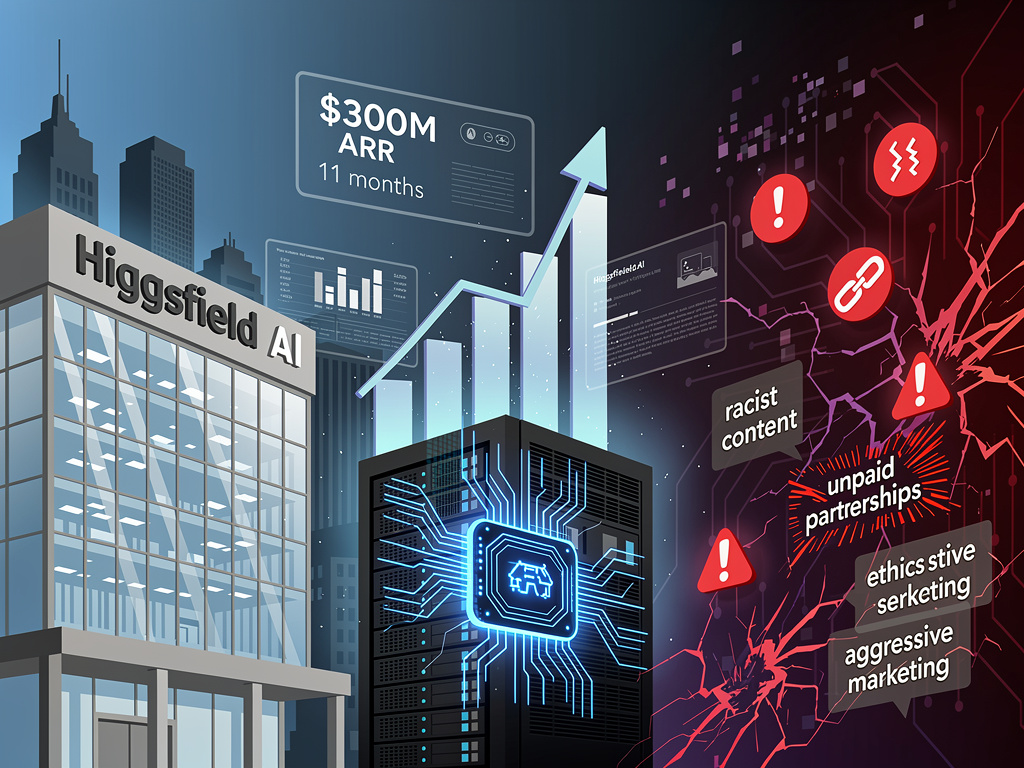
In the annals of Silicon Valley hypergrowth, few stories are as breathtaking — or as troubled — as that of Higgsfield AI. The mobile-first artificial intelligence video startup, cofounded in 2023 by CEO Alex Mashrabov, an entrepreneur originally from Uzbekistan, rocketed to $300 million in annual recurring revenue within just 11 months of launch. It was the kind of trajectory that venture capitalists dream about and competitors dread. But behind the staggering numbers lies a darker narrative: one of racist AI-generated content, unpaid creators, aggressive marketing tactics that shocked even hardened industry observers, and a growing revolt among the very users who fueled the company’s ascent.
Higgsfield positioned itself as a “ChatGPT for video” — a mobile application that allowed anyone to generate polished, AI-produced video clips with simple text prompts. The premise was irresistible in an era when short-form video dominates social media platforms. Users could create everything from Valentine’s Day greetings to product advertisements in seconds, bypassing the need for cameras, actors, or editing software. The app’s viral adoption, particularly on TikTok and Instagram, propelled it into the upper echelons of the AI startup world at a pace that few could have predicted.
A Growth Engine Built on Virality and Controversy
According to a detailed investigation by Forbes, Higgsfield’s meteoric rise was not merely the product of a superior algorithm or a well-timed launch. The company employed an aggressive, sometimes shocking, marketing strategy that deliberately courted controversy to generate attention. Internal communications reviewed by Forbes revealed that the company’s growth team prioritized “engagement at all costs,” a philosophy that extended to tolerating — and in some cases amplifying — provocative and offensive AI-generated content on social media platforms.
The Forbes investigation documented numerous instances of racist and ethnically stereotypical videos created using Higgsfield’s tools that circulated widely on TikTok and X (formerly Twitter). Some of these videos depicted harmful racial caricatures, while others placed real public figures into fabricated and demeaning scenarios. Critics argued that Higgsfield’s content moderation systems were either woefully inadequate or deliberately lax, allowing such material to proliferate because it drove downloads and user engagement. The company’s terms of service technically prohibited hateful content, but enforcement appeared minimal at best, according to multiple creators and digital rights advocates interviewed by Forbes.
Creators Cry Foul Over Payment Disputes and Broken Promises
The ethical concerns extend well beyond content moderation failures. A significant portion of the backlash against Higgsfield has come from the creator community itself — the very people the platform depends on for content generation and viral distribution. As reported by Forbes, dozens of creators who participated in Higgsfield’s affiliate and ambassador programs have alleged that the company failed to honor payment agreements. Some creators claimed they were owed thousands of dollars for promotional campaigns that generated millions of views, only to have their invoices ignored or disputed after the fact.
One creator, who spoke to Forbes on condition of anonymity, described the experience as “a bait and switch on a massive scale.” The creator said Higgsfield’s partnership team had promised generous revenue-sharing arrangements to incentivize early adoption and promotion, but that once the app achieved critical mass, the company became unresponsive to payment inquiries. “They used us to get big, and then they ghosted us,” the creator said. Multiple similar accounts have surfaced on social media, with the hashtag #HiggsfieldScam gaining traction on X and TikTok in recent weeks.
The Blurring Line Between Real and AI-Generated Content
Higgsfield’s troubles arrive at a moment when the broader AI video industry is grappling with fundamental questions about authenticity and trust. A recent feature by Tom’s Guide highlighted just how difficult it has become for ordinary consumers to distinguish between real footage and AI-generated video. The publication presented readers with a series of Valentine’s Day-themed videos — some filmed by humans, others produced entirely by AI tools — and challenged them to identify the fakes. The results were sobering: most readers struggled to reliably tell the difference, underscoring how rapidly the technology has advanced.
This blurring of the real and the synthetic has profound implications not just for media literacy, but for trust in digital communication itself. When platforms like Higgsfield make it trivially easy to produce convincing video content, the potential for misuse — from deepfake harassment to political disinformation — grows exponentially. The Tom’s Guide experiment demonstrated that even savvy tech consumers can be fooled, raising urgent questions about whether existing disclosure requirements and watermarking standards are sufficient to protect the public.
TikTok’s Embrace of Generative AI Adds Fuel to the Fire
Compounding the complexity is the fact that major social platforms are not merely tolerating AI-generated video — they are actively integrating generative AI tools into their ecosystems. As reported by B&T, Australian AI company Fabulate recently inked a deal with TikTok to bring generative AI capabilities directly onto the platform. The partnership aims to give brands and creators access to AI-powered video production tools natively within TikTok’s interface, further lowering the barrier to entry for synthetic content creation.
While Fabulate’s arrangement with TikTok is focused on branded content and advertising — a more controlled use case than Higgsfield’s open-ended consumer app — the deal signals a broader industry shift toward normalizing AI-generated video across social media. For critics of Higgsfield, this trend is alarming. If platforms are simultaneously making it easier to create AI video and struggling to moderate the results, the conditions are ripe for the kind of abuses that have already plagued Higgsfield’s ecosystem.
Inside Higgsfield: A Culture of Speed Over Safety
Former employees who spoke to Forbes painted a picture of a company where speed was the supreme value and safety was an afterthought. Engineers described being pressured to ship features as quickly as possible, with content moderation and safety reviews treated as obstacles to growth rather than essential functions. One former engineer told Forbes that internal requests to strengthen the platform’s content filtering systems were repeatedly deprioritized in favor of features designed to boost user acquisition and retention.
CEO Mashrabov, who previously worked in mobile gaming before pivoting to AI, has cultivated a reputation as a relentless operator. Colleagues describe him as charismatic and intensely focused on metrics, particularly download numbers and revenue milestones. His background in the hyper-competitive mobile gaming industry — where aggressive user acquisition tactics and monetization strategies are standard practice — appears to have shaped Higgsfield’s corporate culture in ways that are now drawing scrutiny. The company declined to make Mashrabov available for an interview, but in a statement provided to Forbes, a Higgsfield spokesperson said the company “takes content safety seriously” and is “investing in additional moderation resources.”
Investor Enthusiasm Meets Regulatory Uncertainty
Despite the mounting controversy, Higgsfield continues to attract investor interest. The company’s $300 million ARR figure, achieved in under a year, places it among the fastest-growing AI startups in history — a distinction that has not gone unnoticed on Sand Hill Road. Multiple reports indicate that Higgsfield is in discussions for a new funding round that could value the company at several billion dollars, though the ongoing backlash may complicate those negotiations.
Regulators, meanwhile, are watching closely. In the United States, the Federal Trade Commission has signaled increased interest in AI-generated content and the potential for consumer deception. The European Union’s AI Act, which is being phased in over the coming years, imposes specific transparency requirements on AI systems that generate synthetic media. Whether Higgsfield’s current practices would survive regulatory scrutiny in either jurisdiction remains an open question — and one that could have material consequences for the company’s valuation and growth trajectory.
A Cautionary Tale for the AI Video Industry
Higgsfield’s story is, in many ways, a microcosm of the tensions that define the current moment in artificial intelligence. The technology is advancing at a pace that outstrips the ability of companies, platforms, and regulators to manage its consequences. The allure of rapid growth and massive revenue can create perverse incentives that prioritize engagement over ethics, speed over safety, and scale over accountability.
For the creators who helped build Higgsfield’s audience — and who now feel exploited and discarded — the lesson is painfully personal. For the broader industry, the question is whether Higgsfield’s experience will serve as a wake-up call or merely a cautionary footnote in the relentless march toward AI-generated everything. As generative AI video tools become increasingly embedded in the fabric of social media — from standalone apps like Higgsfield to native integrations like Fabulate’s TikTok partnership — the stakes for getting content moderation, creator compensation, and ethical guardrails right have never been higher. The industry’s response to Higgsfield’s turbulent rise may well set the tone for the next chapter of AI-powered media.


 WebProNews is an iEntry Publication