
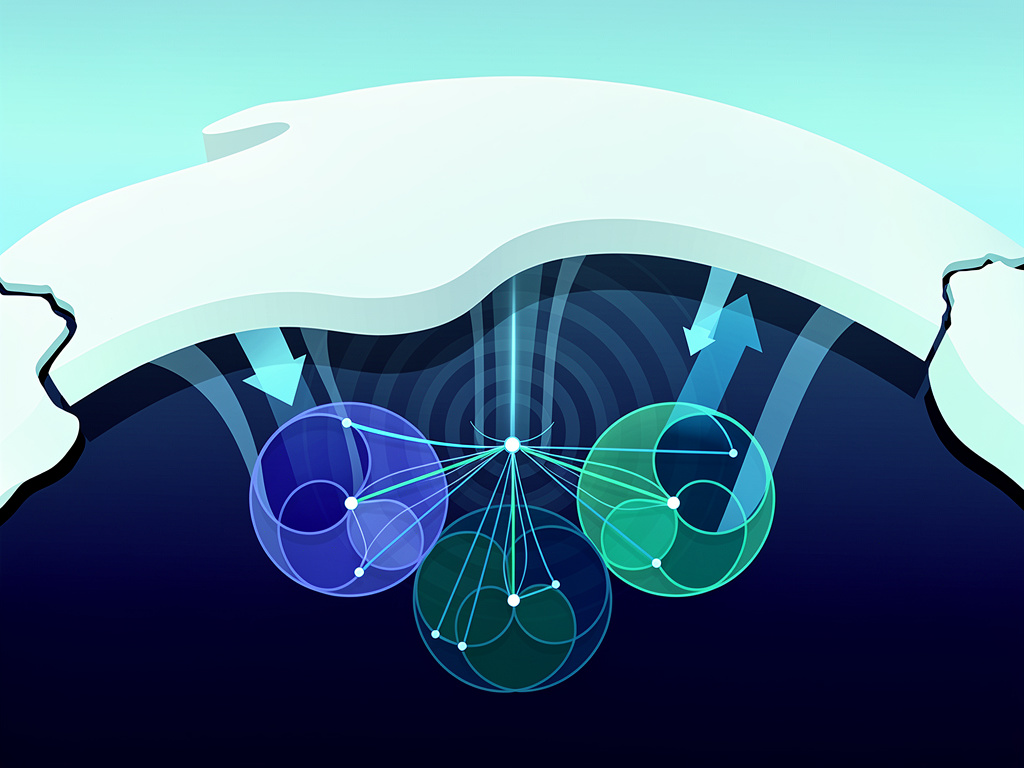
Buried under miles of Antarctic ice sits a geological feature so vast it spans a continent. Scientists have now connected the dots. What once appeared as separate subglacial basins scattered across East Antarctica form one coherent, fan-shaped province stretching from a pivot point near the South Pole.
The discovery reframes how researchers understand the frozen continent’s bedrock. It ties together famous landmarks like the Wilkes Basin, the Aurora Basin and the deep trough holding Lake Vostok. All belong to the newly named East Antarctic Fan-Shaped Basin Province. Nature Geoscience published the findings on June 3, 2026.
Lead author Egidio Armadillo of the University of Genoa spearheaded the international team. Colleagues from Switzerland, Germany, the United Kingdom and Italy contributed seismic records, gravity measurements and bedrock topography data. They combined decades of airborne radar surveys with satellite observations. The result? A radial pattern too organized to ignore. Basins fan outward like ribs from a central hinge. Short. Clean. Telling.
But how did this form? The team points to distributed rotational extension. Picture the continental crust pulling apart from a single pivot, much like fingers spreading on an open hand. This stretching happened long before Gondwana broke apart. It left a zone of thinned, weakened crust. That weakness, the researchers argue, later guided the split between Antarctica and Australia.
The structure’s scale impresses. Individual basins plunge beneath ice thicker than three kilometers in places. The whole province covers an area comparable to major portions of the East Antarctic Ice Sheet. Its origins trace back some 175 million years or more, predating the modern configuration of continents. And yet its influence lingers. The fan-shaped troughs channel ice flow today. They shape where the ice sheet moves fastest and where it might prove most vulnerable to warming seas.
Earlier coverage captured the surprise. Gizmodo first highlighted the hidden scale. Subsequent reports added texture. ScienceDaily, drawing from Durham University, emphasized that previously distinct features now form one massive geological unit. The basins do not sit in isolation. They share geometry, crustal thinning patterns and a common radial arrangement pointing back toward the South Pole.
ScienceAlert delved further into the mechanics. The radial layout matches rotational extension better than rifting or other tectonic models. Crust spreads outward from a focal point. Triangular gaps open between extending arms. Those gaps became the basins. One of the largest known examples of this process on any continent, the authors conclude.
Recent coverage reinforces the timing. Nautilus noted on June 8, 2026, that the formation is older than the current continents in their present positions. It predates the final breakup of Gondwana. The structure may have even steered that breakup, creating a preexisting line of weakness that tectonic forces later exploited.
Phys.org echoed the Durham University release. The province incorporates some of Antarctica’s best-known subglacial features. Lake Vostok’s basin now appears as one spoke in the fan. The Wilkes and Aurora systems align as others. The coherence surprised investigators who had mapped these features piecemeal over years.
Data collection spanned multiple campaigns. Airborne radar pierced the ice. Seismic stations measured wave propagation through the crust. Satellite gravity missions detected mass anomalies tied to thinner crust beneath the basins. Bedrock topography reconstructions, some derived from inverting ice surface velocities, completed the picture. No single method sufficed. Only their integration revealed the fan.
Implications stretch beyond pure geology. Ice sheets don’t flow over uniform beds. Channels and troughs guide streaming ice. The fan-shaped province likely focuses faster flow toward certain margins of the East Antarctic Ice Sheet. In a warming world, that matters. Subglacial lakes within these basins, including Vostok, hold ancient water. Their interaction with the overlying ice remains a subject of active study. Any change in geothermal heat or ice thickness could alter hydrology here.
Yet the finding also calms some speculation. No lost civilizations. No mysterious anomalies defying explanation. Just ancient tectonics, preserved under ice. The structure formed through slow, patient stretching of continental crust. Rotational. Distributed. Intraplate. Terms that now carry new weight in Antarctic research.
Armadillo and colleagues stop short of claiming they have solved every puzzle. They propose the EAFBP as a single physiographic unit. Future work will test whether similar patterns exist elsewhere on the continent or in once-adjacent landmasses like Australia. The Gondwana connection invites fresh plate reconstructions.
Mapping efforts continue. New satellite missions promise sharper views. Ice-penetrating radar improvements will refine bedrock models. Each dataset adds resolution to this hidden world. What seems clear today may gain nuance tomorrow. The fan remains. Its story unfolds slowly, one radar pass at a time.
Researchers have spent decades piecing together Antarctica’s sub-ice geology. This latest synthesis marks a step change. It shows how isolated observations, when viewed together, reveal continent-scale architecture. The East Antarctic Fan-Shaped Basin Province now joins the short list of major features that define the continent’s foundation. Hidden. Ancient. And suddenly, unmistakable.


 WebProNews is an iEntry Publication