
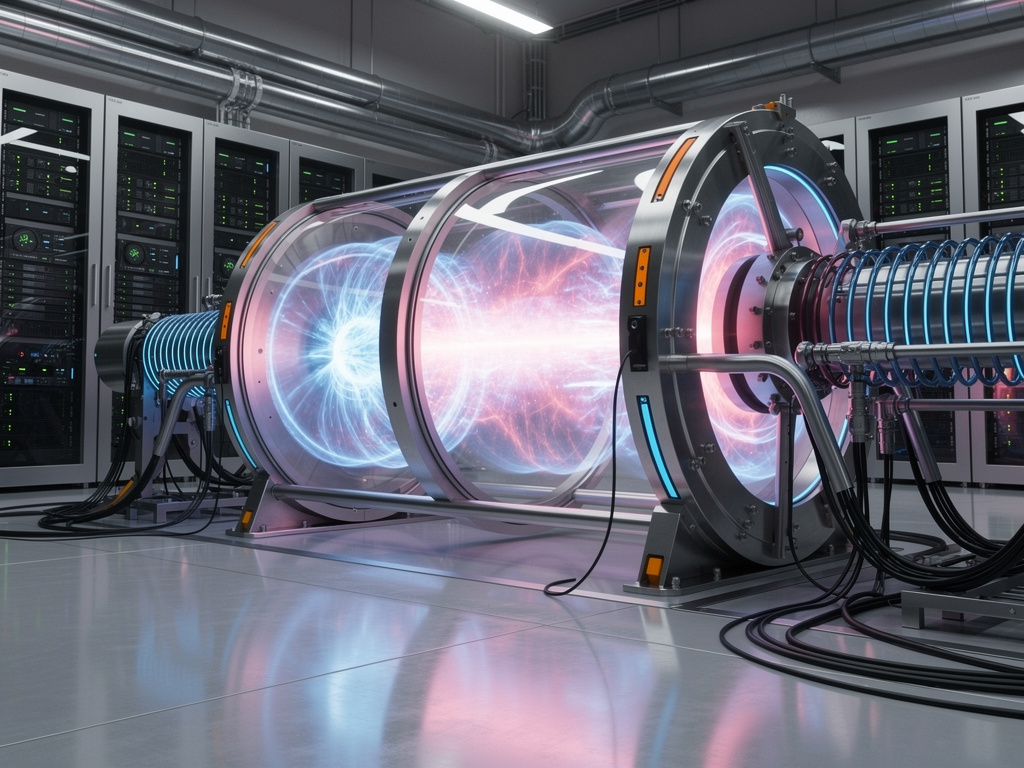
In a windowless facility in Everett, Washington, a startup backed by some of Silicon Valley’s most prominent investors has just achieved something that puts it in rarefied company among the world’s fusion energy ventures. Helion Energy announced that its sixth-generation prototype, Trenta, has reached plasma temperatures exceeding 150 million degrees Celsius — roughly ten times hotter than the core of the sun — marking what the company calls a critical milestone on its path to delivering commercial fusion electricity by 2028.
The achievement, disclosed in late June 2026, represents a significant leap from the 100-million-degree threshold that Helion had previously surpassed and places the company’s field-reversed configuration (FRC) technology at the forefront of a global race to harness the same process that powers stars. As GeekWire reported, the milestone was reached through iterative upgrades to Trenta, which has been operating since 2020 and has now completed more than 14,000 high-power plasma shots.
Inside the Machine: How Helion’s Approach Differs From the Pack
Unlike the tokamak designs favored by government-funded megaprojects such as ITER in France, Helion employs a pulsed, magneto-inertial fusion approach. Two rings of superheated plasma — composed of deuterium and helium-3 fuel — are accelerated to over one million miles per hour from opposite ends of a linear accelerator and slammed together at the center. The resulting compression heats the merged plasma to fusion-relevant temperatures, and the expanding plasma then pushes back against the magnetic field, directly generating electricity through electromagnetic induction — a process not unlike a piston in a combustion engine, but operating at stellar temperatures.
This direct energy recovery mechanism is one of Helion’s key differentiators. Traditional fusion concepts envision using the heat from fusion reactions to boil water and spin turbines, much like a conventional nuclear or coal plant. Helion’s system, by contrast, is designed to convert the kinetic energy of expanding plasma directly into electricity, which the company argues will be far more efficient and compact. As CEO David Kirtley has explained in previous interviews, the approach allows for a power plant that could fit on roughly one acre of land — a fraction of the footprint required by most energy generation facilities.
The Road to Polaris: Helion’s Seventh-Generation Prototype Takes Shape
While Trenta continues to serve as a workhorse for testing and optimization, the company’s primary engineering focus has shifted to Polaris, its seventh-generation machine currently under construction in Everett. Polaris is designed to be the first Helion system to demonstrate net electricity generation from fusion — meaning it will produce more electrical energy than it consumes to initiate and sustain the fusion process. According to GeekWire, Helion has stated that the lessons learned from pushing Trenta to 150 million degrees are being directly incorporated into the Polaris design.
The company’s timeline is aggressive by any measure. Helion has a power purchase agreement with Microsoft, signed in 2023, to supply fusion-generated electricity by 2028. That deal, which was the first of its kind in the fusion industry, sent shockwaves through both the energy and technology sectors. Microsoft co-founder Bill Gates is not involved in the deal, but OpenAI CEO Sam Altman — who has personally invested $375 million in Helion — has been a vocal champion of the company’s vision. Altman’s investment, made in 2021, valued Helion at $3.2 billion pre-money at the time, making it one of the most richly valued private fusion companies in the world.
Why 150 Million Degrees Matters — And What Still Lies Ahead
Reaching 150 million degrees Celsius is not merely a vanity metric. Fusion reactions between deuterium and helium-3 — Helion’s chosen fuel cycle — require significantly higher temperatures than the more commonly pursued deuterium-tritium reaction. The D-He3 reaction demands temperatures well above 100 million degrees to achieve meaningful fusion rates, but it offers a profound advantage: it produces almost no neutrons, meaning the reactor structure suffers far less radiation damage over time, and the reaction products are charged particles that can be directly converted to electricity.
However, reaching the necessary temperature is only one piece of the puzzle. The plasma must also be held at sufficient density for a long enough duration — a set of conditions described by the Lawson criterion. Helion has been methodical about tackling these parameters one at a time. The company has previously demonstrated that Trenta can confine plasma for the millisecond-scale durations relevant to its pulsed approach, and has shown increasing fusion reaction rates with each round of upgrades. The 150-million-degree milestone addresses the temperature leg of the tripod; density and confinement time must continue to improve in tandem as Polaris comes online.
A Crowded Field With Billions at Stake
Helion is far from alone in its pursuit. The Fusion Industry Association’s most recent survey identified more than 40 private fusion companies worldwide, collectively attracting more than $7 billion in private investment. Commonwealth Fusion Systems, a Massachusetts-based spinout from MIT, has raised over $2 billion and is building its own demonstration plant, SPARC, using high-temperature superconducting magnets in a compact tokamak design. TAE Technologies in California has also reported plasma temperatures exceeding 70 million degrees using a beam-driven FRC approach. In the United Kingdom, Tokamak Energy and First Light Fusion are pursuing their own distinct pathways.
Government support has also accelerated. The U.S. Department of Energy’s milestone-based fusion development program has awarded funding to multiple companies, and the Biden and subsequent Trump administrations have both signaled support for streamlining regulatory frameworks for fusion energy. The Nuclear Regulatory Commission has moved to classify fusion devices separately from fission reactors, a distinction that could significantly reduce the licensing burden for commercial fusion plants.
The Microsoft Deal and the Commercial Calculus
The power purchase agreement with Microsoft remains one of the most closely watched contracts in the energy sector. Microsoft’s appetite for carbon-free electricity has grown voracious as the company expands its data center infrastructure to support artificial intelligence workloads. The tech giant has also signed deals for nuclear fission power, including a controversial agreement to restart a unit at the Three Mile Island plant in Pennsylvania. Fusion, if it can be delivered on schedule and at competitive cost, would represent an even cleaner and more scalable solution.
Helion has stated that it aims to produce electricity at a cost competitive with natural gas — roughly $0.04 to $0.06 per kilowatt-hour — though independent analysts have noted that such projections remain speculative until a working commercial plant is operational. The company’s business model envisions selling electricity directly to customers rather than selling reactors, at least initially, which would allow Helion to retain control over operations and maintenance while building a track record.
Skeptics and the Scientific Community Weigh In
Not everyone is convinced that Helion — or any private fusion company — can deliver on such ambitious timelines. Fusion has been famously described as being “30 years away” for the past 60 years, and the history of the field is littered with overpromising and underdelivering. Some plasma physicists have expressed skepticism about whether the D-He3 fuel cycle can be made practical, noting that even at 150 million degrees, the reaction cross-section is lower than D-T fusion, meaning more energy input is needed to sustain the reaction.
Others point to the engineering challenges that lie beyond plasma physics. Building magnets, power supplies, and containment systems that can withstand millions of high-energy pulses without degradation is a materials science challenge of the first order. Helion’s claim that Trenta has completed over 14,000 pulses is encouraging, but a commercial plant would need to sustain millions of pulses per year for decades. The gap between prototype and power plant remains vast.
What the 2028 Deadline Really Means for the Fusion Industry
Regardless of whether Helion meets its 2028 target to the month, the company’s progress has had an undeniable catalytic effect on the broader fusion enterprise. The Microsoft PPA established a commercial framework that other fusion companies are now seeking to replicate. Helion’s fundraising success has helped legitimize fusion as an investable technology category, drawing capital from venture firms, sovereign wealth funds, and strategic corporate investors who might otherwise have stayed on the sidelines.
The 150-million-degree milestone, achieved on a machine that cost a fraction of what government fusion projects typically spend, also challenges long-held assumptions about the minimum scale and budget required to make meaningful progress in fusion science. If Polaris can demonstrate net electricity in the next two to three years, it would represent not just a scientific breakthrough but a commercial proof point that could unlock tens of billions of dollars in follow-on investment across the industry.
For now, the plasma in Everett burns hotter than the sun, and the clock toward 2028 continues to tick. The question is no longer whether private companies can do serious fusion science — it is whether they can do it fast enough to matter in a world that desperately needs new sources of clean, abundant energy.


 WebProNews is an iEntry Publication