
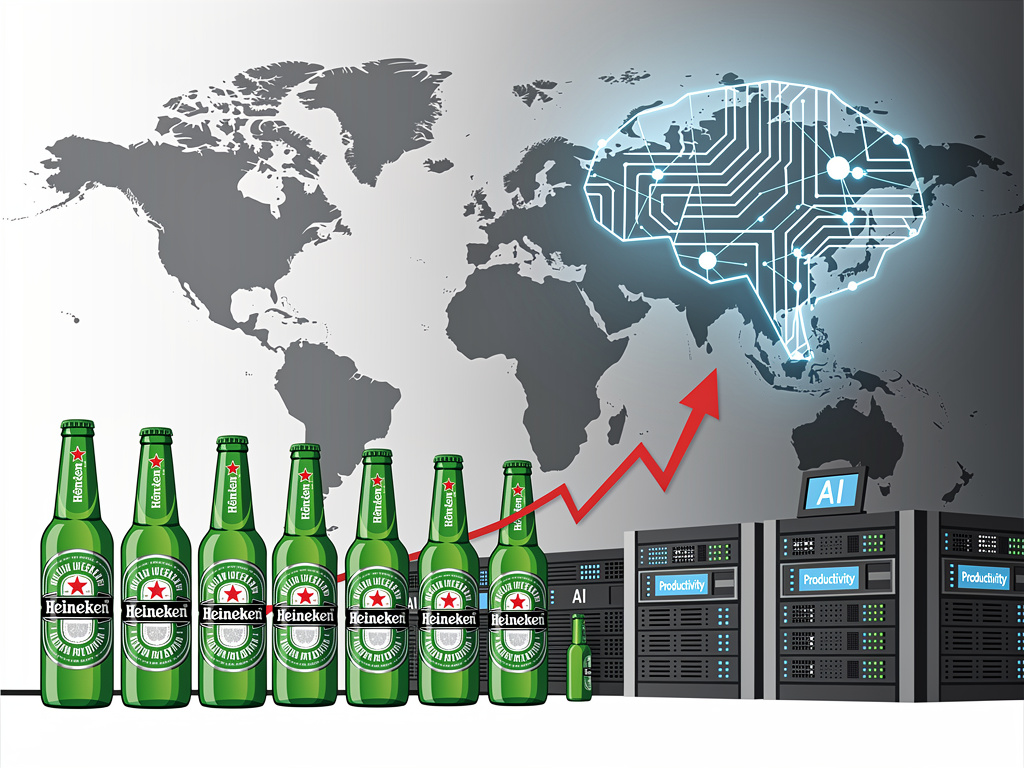
The world’s second-largest brewer is making a sweeping strategic pivot. Heineken N.V. announced plans to eliminate up to 6,000 positions worldwide as part of a broad restructuring effort that leans heavily on artificial intelligence and automation to drive what the company’s leadership calls “productivity savings.” The move comes as the Dutch brewing giant grapples with softening beer demand across key markets and mounting pressure from investors to protect margins in an increasingly competitive global beverage industry.
Heineken CEO Dolf van den Brink told CNBC that AI will play an “important part of ongoing productivity savings” as the company seeks to streamline operations and reduce overhead. The job cuts, which represent a significant portion of Heineken’s global workforce of approximately 85,000 employees, are expected to be phased in over the coming years as the company deploys new technologies across its supply chain, administrative functions, and commercial operations.
A Brewing Giant Faces a Sobering Reality in Global Beer Markets
The restructuring announcement arrives at a particularly challenging moment for the global beer industry. Consumer preferences have been shifting steadily, with younger demographics increasingly gravitating toward spirits, ready-to-drink cocktails, and non-alcoholic alternatives. In several of Heineken’s core European markets, volumes have been under pressure as inflation-weary consumers trade down to cheaper brands or reduce alcohol consumption altogether. The trend is not unique to Heineken — rivals including AB InBev and Carlsberg have also reported softer volumes in recent quarters — but the Dutch brewer’s exposure to certain emerging markets has compounded the challenge.
Heineken’s latest financial results underscored the urgency behind the restructuring. The company reported that beer volumes declined in several regions, with particularly notable weakness in parts of Africa and Asia where macroeconomic headwinds, currency depreciation, and regulatory changes have dampened consumer spending. In Vietnam, once one of Heineken’s fastest-growing markets, a government crackdown on drunk driving led to a sharp and sustained drop in on-premise beer consumption. Meanwhile, in Nigeria, currency devaluation has eroded purchasing power and made imported ingredients significantly more expensive.
Van den Brink’s AI Playbook: From Brewing Floors to Back Offices
In his remarks to CNBC, van den Brink outlined a vision in which artificial intelligence and machine learning tools are embedded across nearly every layer of Heineken’s operations. The CEO described a multi-pronged approach that includes using AI to optimize brewing processes, improve demand forecasting, automate procurement workflows, and enhance marketing targeting. He emphasized that the company is not simply cutting headcount for the sake of cost reduction, but rather fundamentally rethinking how work gets done in a modern consumer goods enterprise.
“This is about building a leaner, more agile organization that can compete effectively for the next decade,” van den Brink said, according to the CNBC report. The CEO noted that AI-driven tools are already being piloted in several Heineken breweries, where algorithms analyze real-time production data to reduce waste, improve energy efficiency, and maintain consistent product quality. On the commercial side, the company is experimenting with generative AI tools that can produce localized marketing content at scale, reducing the need for large regional marketing teams.
The Human Cost: Where the Cuts Will Fall Hardest
While Heineken has not disclosed a precise breakdown of where the 6,000 job losses will occur, industry analysts expect the heaviest reductions to fall in administrative and support functions — areas such as finance, human resources, IT, and procurement where AI and automation tools can most readily replace routine tasks. Corporate headquarters in Amsterdam and regional hubs in London, Singapore, and Mexico City are likely to see significant restructuring.
However, the cuts are also expected to reach into operational roles. Heineken operates more than 160 breweries across roughly 70 countries, and the company has signaled that it intends to consolidate certain production facilities while investing in smart manufacturing capabilities at its most strategically important plants. Workers in smaller, less efficient breweries may face the prospect of redundancy as production is centralized and automated systems take on a larger share of the workload.
Wall Street and Amsterdam React: Investors Cautiously Optimistic
The market response to Heineken’s announcement was mixed but leaned positive. Shares of Heineken on the Euronext Amsterdam exchange ticked up modestly in the sessions following the news, as investors weighed the near-term restructuring costs against the promise of improved long-term margins. Analysts at several major investment banks issued notes characterizing the move as overdue, arguing that Heineken had been slower than some competitors to embrace the kind of aggressive cost-cutting and technological investment that has become standard in the consumer staples sector.
“Heineken has historically been a company that prioritized organic growth and brand building over hard-nosed efficiency,” wrote one analyst in a note to clients. “This restructuring signals a meaningful shift in philosophy — one that the market has been waiting for.” Others cautioned that the success of the plan would depend heavily on execution, noting that large-scale AI deployments in complex, multinational organizations have a mixed track record and often take longer and cost more than initially projected.
AI in the Beverage Industry: Heineken Joins a Growing Trend
Heineken’s embrace of AI as a central pillar of its restructuring strategy places it alongside a growing cohort of major consumer goods companies that are betting on technology to offset sluggish top-line growth. AB InBev, the world’s largest brewer, has invested heavily in AI-powered supply chain optimization and direct-to-consumer digital platforms. PepsiCo has deployed machine learning tools to improve route-to-market efficiency. Unilever has used AI to accelerate product development cycles. The common thread is a recognition that in an era of tepid volume growth, operational efficiency and technological leverage are the most reliable paths to earnings improvement.
For Heineken specifically, the AI push also represents an opportunity to address longstanding criticisms about the company’s organizational complexity. With operations spanning dozens of countries and a portfolio that includes more than 300 beer and cider brands, Heineken has long been viewed as a sprawling enterprise that could benefit from greater standardization and centralization. AI tools that enable real-time visibility across the supply chain and automate decision-making at the local level could help the company operate more cohesively without sacrificing the local market responsiveness that has been a hallmark of its strategy.
Labor Unions and Regulatory Scrutiny Loom Large
The announcement has not been without controversy. Labor unions in the Netherlands and several other European countries have already signaled their intention to push back against the scale of the proposed cuts. In the Netherlands, where employee protections are robust and works councils wield significant influence, Heineken will be required to engage in extensive consultation processes before any layoffs can be finalized. The Dutch trade union FNV has publicly called on Heineken to provide detailed plans for retraining and redeployment of affected workers, arguing that the company has a social responsibility that extends beyond shareholder returns.
Across Europe more broadly, the use of AI to justify mass layoffs is becoming an increasingly sensitive political issue. The European Union’s AI Act, which is being phased into implementation, imposes new requirements on companies that use AI systems in employment-related decisions. While the regulation primarily targets AI used in hiring and performance evaluation rather than broader restructuring decisions, the political climate around AI and employment is charged, and Heineken can expect scrutiny from lawmakers and regulators as it proceeds with its plans.
What Comes Next for the World’s Second-Largest Brewer
Heineken’s restructuring is ultimately a bet that technology can compensate for structural headwinds in the global beer market. The company is wagering that by investing in AI and automation now, it can build a cost structure lean enough to generate attractive returns even in a world where beer volumes grow slowly — or not at all. It is a calculated gamble, and one that will be closely watched by competitors, investors, and policymakers alike.
For van den Brink, the challenge will be to execute the transformation without undermining the brand equity and local market relationships that have made Heineken one of the most recognized beer brands on the planet. Cutting 6,000 jobs is a blunt instrument; the art will be in ensuring that the remaining organization is not just smaller, but genuinely smarter and more capable. If Heineken gets it right, the restructuring could become a template for the broader consumer goods industry. If it stumbles, it will serve as a cautionary tale about the limits of replacing human judgment with algorithmic efficiency.
The coming quarters will be telling. As Heineken begins to detail the specific AI initiatives, cost savings targets, and timeline for the workforce reductions, the market will be watching closely for signs that this is a well-conceived transformation rather than a reactive cost cut dressed up in the language of innovation. In an industry where brand loyalty is everything and execution at the local level can make or break a market, the stakes could hardly be higher.


 WebProNews is an iEntry Publication