
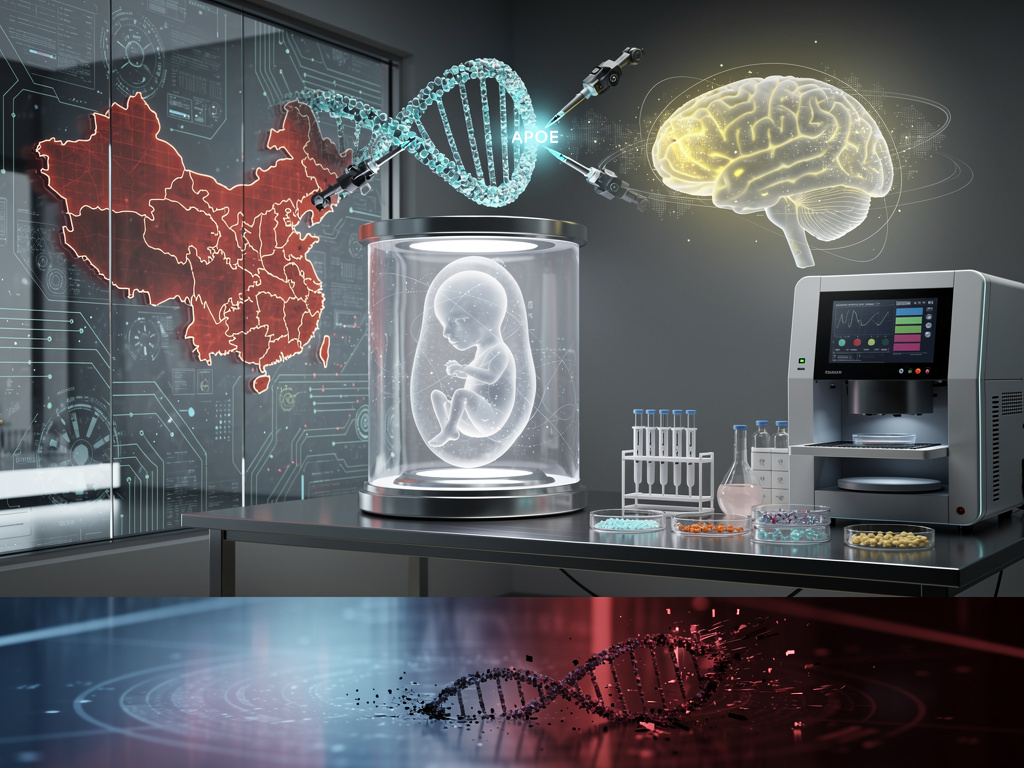
The Rogue Scientist’s Return: He Jiankui’s Audacious Bid to Conquer Alzheimer’s Through Gene Editing
In the shadowed corridors of genetic research, few figures cast as long and controversial a shadow as He Jiankui. The Chinese scientist, who stunned the world in 2018 by announcing the birth of the first gene-edited babies, is back in the spotlight. After serving three years in prison for violating medical regulations, He has reemerged with a provocative new mission: using CRISPR technology to combat Alzheimer’s disease. His latest proposals, detailed in recent interviews and public statements, aim to edit human embryos to introduce mutations that could protect against this debilitating form of dementia. This move not only reignites debates over the ethics of germline editing but also positions He as a defiant pioneer in a field fraught with moral quandaries.
He’s approach centers on the APOE gene, specifically targeting variants linked to Alzheimer’s risk. He proposes editing embryos to incorporate a protective mutation, drawing inspiration from rare genetic cases where individuals remain cognitively sharp despite high-risk factors. In a recent WIRED interview, He expressed unapologetic pride in his past work and outlined plans to conduct trials without implanting edited embryos for pregnancy—at least initially. This cautious framing comes amid global scrutiny, yet He’s determination suggests he believes societal attitudes toward gene editing are evolving.
Critics, however, remain wary. Bioethicists argue that He’s history of bypassing ethical norms—evidenced by his 2018 experiment where he edited embryos to confer HIV resistance, resulting in the birth of three children—undermines his credibility. That episode led to international condemnation, with many viewing it as a reckless breach of scientific protocols. Now, as He sets up labs in Beijing and seeks collaborations, questions linger about oversight in China’s research environment.
Ethical Echoes from a Scandalous Past
Recent reports highlight He’s unrepentant stance. In an article from The Guardian, He described himself as “proud” of his previous achievements and predicted that human embryo gene editing will eventually gain acceptance. This optimism contrasts sharply with the backlash he faced post-2018, when he was fined and imprisoned by Chinese authorities. Upon release in 2022, He quietly resumed work, focusing on genetic diseases, but his Alzheimer’s ambitions mark a bold escalation.
Public sentiment, as gleaned from posts on X (formerly Twitter), reflects a mix of intrigue and outrage. Some users hail He as a visionary willing to push boundaries for medical breakthroughs, while others decry him as a modern-day Frankenstein, echoing concerns about eugenics. One prominent post from 2025, attributed to He himself, boasted of successful gene-editing experiments approved by a Shenzhen hospital ethics committee and affirmed his lack of regret. Such statements fuel discussions on platforms where opinions range from supportive to vehemently oppositional, underscoring the polarized views in the scientific community.
He’s critics point to procedural flaws in his earlier work. For instance, investigations revealed that the 2018 edits were not entirely successful, yet embryos were implanted anyway—a detail highlighted in commentary from geneticists like Adam Rutherford on X. This history raises alarms about potential off-target effects in Alzheimer’s research, where editing the APOE gene could inadvertently introduce other health risks.
Global Reactions and Silicon Valley’s Shadow
Internationally, He’s plans have drawn pointed criticism, particularly from Western researchers. In the WIRED piece, He accused Silicon Valley entrepreneurs of conducting what he termed a “Nazi eugenic experiment” through their investments in genetic enhancement technologies. This jab targets figures like those backing companies focused on designer babies or longevity, positioning He as a counter-narrative from the East. Yet, his own work invites similar accusations, as editing for Alzheimer’s prevention could be seen as a step toward selective human improvement.
A New York Times report from early 2026 notes that Chinese authorities appear to view He as an asset amid technological rivalries with the West. With China advancing in biotech, He’s unfettered activities suggest tacit support, allowing him to operate labs in Beijing and Hainan. This contrasts with stricter regulations in the U.S. and Europe, where germline editing remains largely prohibited for ethical reasons.
On X, discussions amplify these geopolitical tensions. Posts from journalists and scientists question whether He’s freedom signals a broader shift in China’s bioethics stance, with some speculating on collaborations with cryptocurrency entrepreneurs who support relaxed gene-editing rules. A 2024 post from STAT News highlighted growing pressure to ease embryo editing restrictions, influenced by figures like Ryan Shea, illustrating how financial interests intersect with scientific ambition.
Scientific Promise Amid Perilous Risks
At the core of He’s proposal is the science of Alzheimer’s prevention. Research shows that certain APOE variants, like APOE2, offer protection against the disease, which affects millions worldwide. He’s plan involves using CRISPR to introduce such mutations in embryos, potentially creating a generation resistant to cognitive decline. This builds on studies, such as those reported in TIME, where He proposed testing these mutations without full implantation, emphasizing observational studies first.
Recent advancements bolster the plausibility of this approach. A 2025 ScienceDaily article detailed how scientists reversed Alzheimer’s in mice by restoring brain energy balance, suggesting that genetic interventions could complement such therapies. Similarly, a Guardian piece from early 2026 advocated targeting APOE variants in drug development, aligning with He’s focus. These developments indicate a maturing field where gene editing might transition from taboo to therapeutic tool.
However, risks abound. Off-target edits could lead to unforeseen mutations, and the long-term effects on edited individuals remain unknown. Bioethicists warn that prioritizing Alzheimer’s prevention might open doors to editing for non-medical traits, blurring lines between treatment and enhancement. He’s past, including allegations of inadequate informed consent in 2018, heightens these concerns.
China’s Biotech Ambitions and Oversight Gaps
In China, the regulatory environment for gene editing is evolving but remains opaque. While the government cracked down on He in 2019, his post-prison activities suggest a selective leniency. A Reuters report from January 2026 announced BGI Genomics and Roche’s rollout of Alzheimer’s diagnostic tests in China, signaling investment in dementia research. This backdrop could enable He’s work, as national priorities emphasize technological self-reliance.
X posts from users like Dr. Li-Meng Yan criticize this as CCP-orchestrated, alleging that He’s “punishment” was performative. Such sentiments portray He as a state-backed innovator, potentially accelerating China’s lead in CRISPR applications. Industry insiders note that while Western firms face ethical hurdles, Chinese researchers like He operate with fewer constraints, fostering rapid progress.
Comparisons to global efforts reveal stark differences. In the U.S., initiatives like those from MIT Technology Review, which interviewed He in 2024, emphasize caution. The review’s coverage highlighted his hopes for embryo editing’s future acceptance, yet underscored ongoing ethical debates.
Pushing Boundaries: Allies and Adversaries
He’s network is expanding, with support from unexpected quarters. A STAT News article from 2024 detailed backing from a U.S. cryptocurrency entrepreneur, indicating cross-border interest in his research. This alliance reflects a growing coalition advocating for liberalized gene-editing policies, driven by potential profits in personalized medicine.
Conversely, adversaries abound. Posts on X from science communicators like Chris Said draw parallels to other research scandals, warning of data fabrication risks in high-stakes fields. These critiques question the integrity of He’s Alzheimer’s project, especially given his history.
Looking ahead, He’s work could redefine Alzheimer’s treatment. If successful, it might validate germline editing for hereditary diseases, shifting global norms. Yet, without robust international oversight, the perils of unintended consequences loom large.
The Human Cost and Future Horizons
The human element in He’s saga is profound. The three gene-edited children from 2018 live with uncertain futures, their genomes altered in ways that may manifest later in life. For Alzheimer’s, editing embryos raises similar dilemmas: Who decides which traits to “fix,” and at what cost to individual autonomy?
Recent news, including a New York Times piece, suggests He perceives a thawing in attitudes, with increasing tolerance for boundary-pushing research amid U.S.-China tensions. This view is echoed in X discussions, where some praise his courage against a backdrop of Western hypocrisy.
Ultimately, He’s quest embodies the dual-edged sword of genetic innovation—promising relief from diseases like Alzheimer’s while challenging the ethical foundations of science. As he forges ahead, the world watches, weighing progress against principle in an era where editing life itself hangs in the balance.


 WebProNews is an iEntry Publication