
Engineers at Beihang University, a military-linked institution known as one of China’s ‘Seven Sons of Defense,’ turned to nature to simulate drone swarm combat. Observing hawks selecting prey, they trained defensive drones to target vulnerable enemy aircraft, while attackers mimicked doves to evade. In a five-on-five test, the hawk-trained drones destroyed all opponents in 5.3 seconds, earning a patent in April 2024. This work exemplifies Beijing’s push to embed animal-inspired AI into autonomous weapons, as detailed in The Wall Street Journal.
Patent filings, procurement tenders and research papers show the People’s Liberation Army intensely pursuing AI for swarms of drones, robot dogs and other systems to overwhelm foes with minimal human oversight. Chinese military theorists declared in October 2024 that the AI era brings ‘a new style of warfighting driven by algorithms, with unmanned systems as the main fighting force and swarm operations as the primary mode of combat.’ China’s factories churn out over a million cheap drones yearly, dwarfing U.S. output of tens of thousands at higher prices.
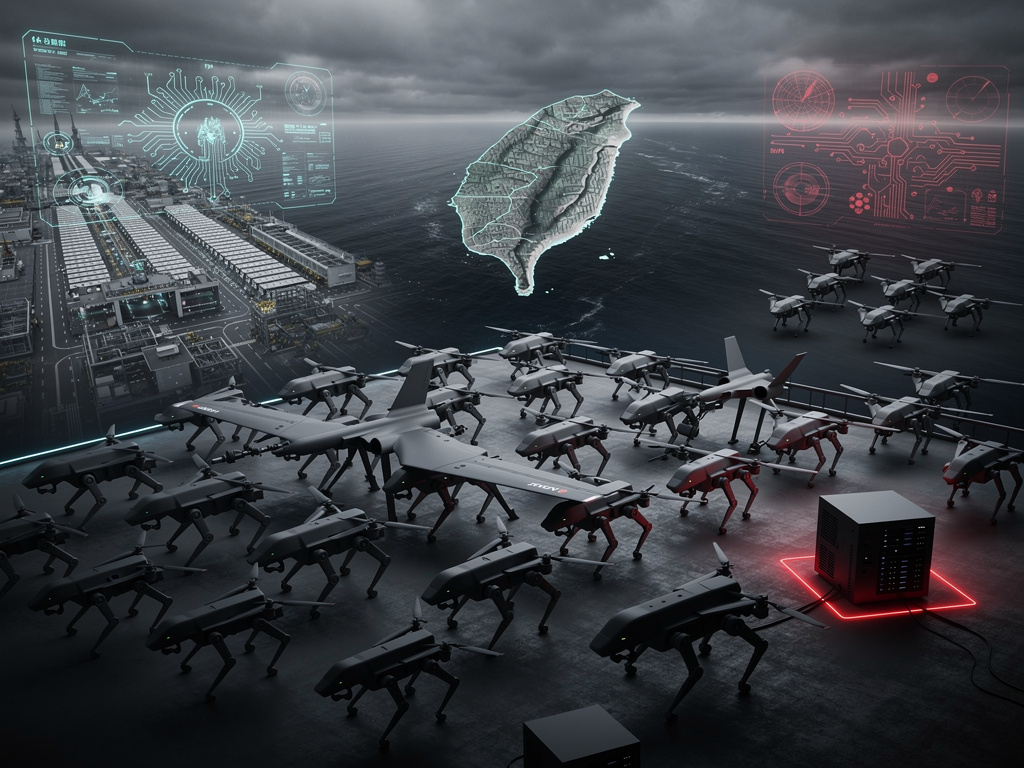
Flaunting this edge, state media in 2024 showcased Swarm 1, a truck system launching 48 fixed-wing drones, scalable to 200 for reconnaissance, strikes and deception. The Jiutian mothership drone completed its maiden flight in December 2024, designed to release smaller swarms. In September 2024, the PLA paraded ‘robot wolves’—weaponized robot dogs—from China South Industries Group, aiming to integrate them with aerial swarms for collaborative combat.
Bio-Inspired Swarm Tactics Emerge
Sunny Cheung, an open-source intelligence expert at the Jamestown Foundation, noted, ‘At a tactical level, for concrete missions, there’s a growing consensus [in Chinese military writings] that autonomous systems have the potential to perform better than humans.’ This addresses PLA concerns over soldier competence, untested since the 1970s. Ukraine’s battlefield, where jamming forces drone autonomy, reinforces Beijing’s focus, per analysts.
Procurement platforms reveal ambitions like a 2024 tender for a mobile cognitive warfare system with AI deepfakes broadcast via laser, robot dogs for reconnaissance and a ‘consciousness intervention system’ using near ear-rupturing sound. Sam Bresnick of Georgetown University’s Center for Security and Emerging Technology called it a ‘fever dream’ of AI goals, signaling scaled production interests.
Since 2022, Chinese entities filed at least 930 swarm intelligence patents, versus 60 in the U.S., many by Chinese filers. Beihang professor Duan Haibin discussed eagle and fruit fly eye simulations at a July 2024 Beijing conference to fix drone perception gaps.
DeepSeek Powers Battlefield Autonomy
By 2025, the PLA integrated DeepSeek AI into weapons, from Norinco’s P60 autonomous vehicle at 50 km/h to drone swarms targeting ‘low, slow, small’ threats, per a Beihang patent cited in Reuters. A November 2024 tender sought AI robot dogs for pack scouting and hazard clearance. DeepSeek appeared in a dozen 2025 PLA tenders, outpacing rivals like Alibaba’s Qwen, with Jamestown noting Huawei Ascend chip reliance.
Xi’an Technological University claimed DeepSeek evaluated 10,000 scenarios in 48 seconds, versus 48 hours for humans. Unitree robot dogs demonstrated stair-climbing in March 2025 Hangzhou drills. The Center for a New American Security’s Stacie Pettyjohn said China prioritizes ‘smart, small drones’ due to its 80% global production dominance.
In August 2025, PLA urban warfare drills tested drone swarms and robot wolves with human-machine teams, per CNA. September 2025 exercises featured ISR swarms for amphibious ‘island-blocking’ mimicking Taiwan.
Single Operator, Massive Swarms
On January 23, 2026, PLA’s National University of Defense Technology broadcast a soldier supervising over 200 autonomous drones in 99 seconds for urban combat, shifting to ‘effect-based control’ resistant to jamming, as reported by Ground News and AI CERTs News. The Jiu Tian mothership, with 82-foot wingspan, deploys swarms, per The National Interest.
U.S. efforts lag: Pentagon’s $35,000 kamikaze drone deploys, Auterion demoed seven quadcopters in Hawaii November 2024 with pixel-lock strikes, but Anduril’s Lattice failed Navy tests in May. Justin Bradley of North Carolina State University warned, ‘We don’t have good-enough perception on these vehicles for them to know where each other are,’ relying on jammable radio.
A December 2025 Pentagon report highlighted PLA’s military-civil fusion accelerating AI via academia and commerce. Georgetown’s CSET analyzed 2,800+ 2023-2024 PLA AI contracts to civilians for algorithms and autonomy.
Taiwan Scenario Looms Large
In a Taiwan conflict, swarms could loiter 50 miles out post-rocket barrage, scanning for jets or defenses, attacking or marking for missiles, per Pettyjohn. Counter-swarm research shows dual offense-defense focus. Risks abound: wartime failures, uncontrolled decisions or ‘algorithm black box’ excuses, as National Defense University’s Zhu Qichao warned: ‘Once an artificial intelligence weapon system produces safety hazards, the ‘algorithm black box’ may become a rationalized excuse.’
Retired PLA colonel Zhou Bo stated, ‘AI’s military applications are burgeoning, so its consequences have yet to be fully discovered.’ Global calls for limits persist, but testing precedes rules.
U.S. aims for thousands of autonomous drones by end-2025 to counter China, per Reuters. China’s supply chain edge and patent surge position it to redefine combat through massed, intelligent machines.


 WebProNews is an iEntry Publication