
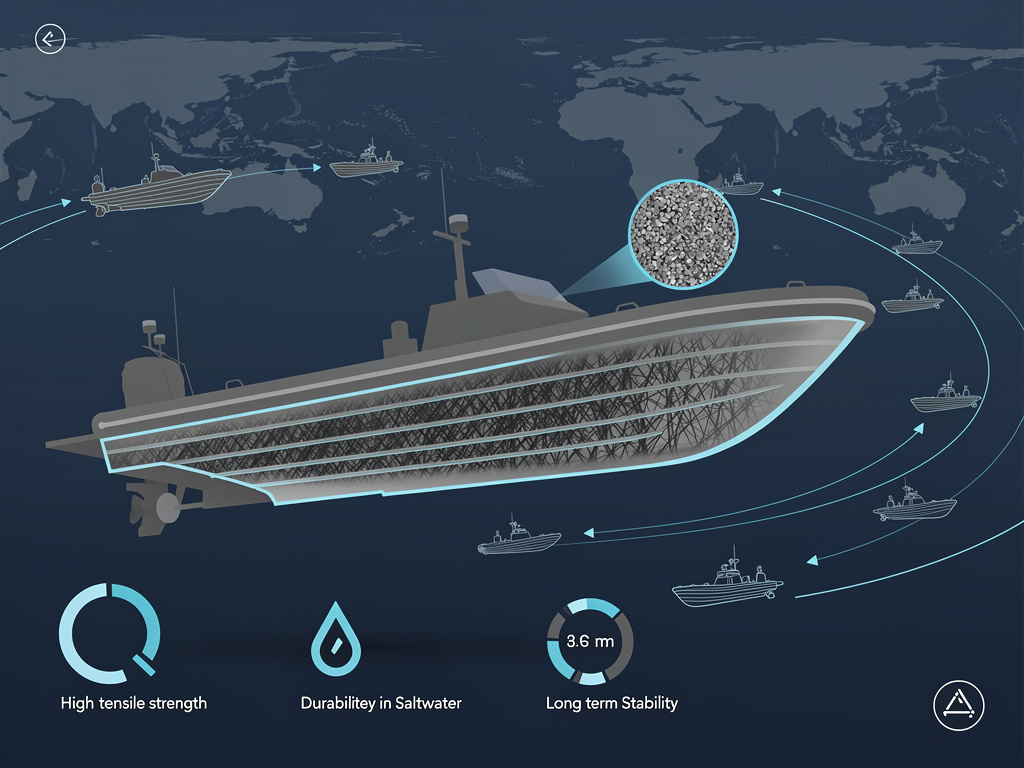
Sam Young saw the problem clearly. Traditional naval boat construction demands molds, fiberglass, skilled labor, fixed shipyards and weeks of production time. A damaged vessel in the vast Indo-Pacific might sit idle for months awaiting replacement from distant facilities. Voltage Vessels, the company he founded and leads in Hawaii, offers a stark alternative. Print the hull on demand. Send a digital file. Use local power, a large-format printer and material drawn from the islands themselves.
The six-meter rigid-hull inflatable boat hull now under evaluation by U.S. maritime defense programs emerged from exactly that process. No factory. No long supply chain. Just additive manufacturing and a proprietary composite called Eclipse X9. Defence Blog first detailed how the company printed the hull on a CEAD system and submitted it for assessment, including potential use in autonomous naval programs.
Eclipse X9 combines recycled PETG thermoplastic with chopped basalt fiber. Basalt, the volcanic rock abundant across Hawaii, brings natural resistance to corrosion, compression and marine degradation. Testing at the University of Maine Advanced Structures and Composites Center confirmed tensile strength near 108 MPa in the print direction. That figure approaches pressures found at the bottom of the Mariana Trench, some 11 kilometers down. Bending strength outperformed common wood-filled PETG benchmarks. After more than 24 months of saltwater immersion the material retained over 90 percent of its structural integrity while absorbing less than 0.4 percent water. Interesting Engineering reported these exact metrics alongside the company’s comparison to existing additive-manufacturing composites.
Such performance matters for vessels operating far from home ports. Yet the material’s electromagnetic properties may prove equally significant. Basalt fiber is non-conductive and exhibits low dielectric constants. Unlike aluminum, it avoids interfering with radio-frequency systems, sensors or communications gear on unmanned surface vessels. Evaluation continues on specific frequencies. The transparency could give autonomous platforms cleaner operation in contested waters where electronic warfare grows more sophisticated by the month.
Traditional shipbuilding concentrates risk. A single yard hit or supply disruption halts output. Voltage Vessels proposes distributed composite manufacturing. Print closer to the action. Move files and feedstock rather than finished hulls. In the Indo-Pacific that shift compresses replacement timelines from weeks of cargo or airlift to days. A printer, electricity and regional material suffice. Hawaii serves as the pilot node. The company envisions scaling U.S. compounding capacity toward 15,000 metric tons of material per year. Regional partnerships across Pacific territories would create additional nodes, each capable of local production. TechRadar examined how this model aligns with Pentagon interest in distributed maritime operations.
Recyclability adds another layer. PETG thermoplastics melt and re-extrude repeatedly with minimal degradation. Damaged or retired structures can be shredded and fed back into new prints. The approach creates a circular process rare in naval hull construction. Voltage Vessels claims the full system reaches 100 percent recyclable content when both fiber and matrix are considered in closed loops. Independent defense laboratories have yet to complete long-term operational validation. Until those results arrive, questions linger about fatigue under repeated wave loading, fire behavior and full-scale structural certification.
Recent coverage shows the concept gaining attention. VoxelMatters noted the hull submission specifically for assessment in autonomous naval programs, reinforcing the focus on unmanned systems. Discussions on X in recent days highlighted the absence of molds or fiberglass and the potential for on-demand printing anywhere with power and filament. One defense-focused account observed that the material’s origin in local volcanic rock gives Hawaii a natural feedstock advantage few other regions can match.
Challenges remain. Large-format printers must maintain precision over hours or days of continuous deposition. Material consistency across batches matters when lives depend on hull integrity. Certification pathways for additively manufactured marine structures are still maturing within Navy and Coast Guard standards. Young and his team positioned Eclipse X9 as superior to current benchmarks, yet real-world deployment will test those claims under operational loads, not just lab immersion tanks.
The broader picture extends beyond one startup. Navies worldwide face aging fleets, budget pressure and the need for faster innovation cycles. Additive manufacturing has already shown value in rapid prototyping and spare parts. Voltage Vessels pushes the boundary toward primary structures at meaningful scale. A six-meter RHIB marks an early step. Success here could open doors to larger hulls, modular components or even full vessels printed in theater.
So the Navy tests. Engineers measure. Program managers weigh logistics against risk. If the data holds, a small Hawaiian company may help shift shipbuilding from centralized yards to dispersed digital factories. The hull sits in evaluation now. Its performance will speak louder than any press release. And if the printed boat meets the demands of contested seas, the rules could change faster than many expect.


 WebProNews is an iEntry Publication