
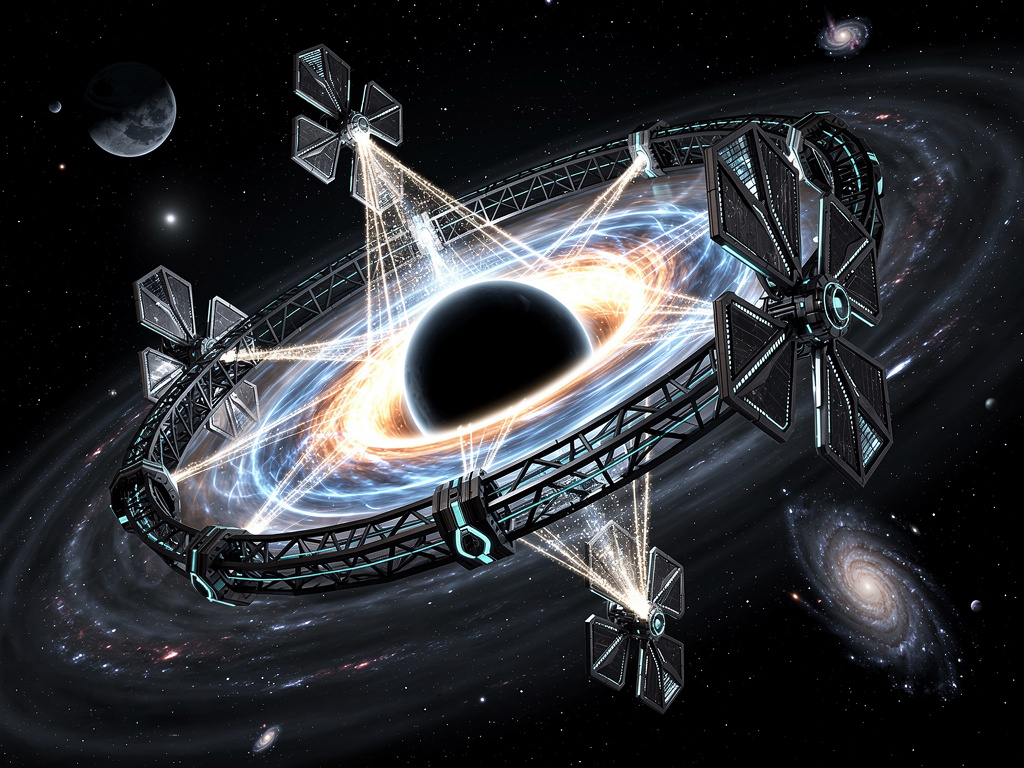
In what sounds like science fiction becoming reality, researchers have outlined a theoretical framework for extracting enormous amounts of energy from black holes—a concept that bears striking resemblance to the Death Star’s planet-destroying power source in Star Wars. According to Daily Mail, physicists have developed mathematical models demonstrating how advanced civilizations could potentially tap into the rotational energy of black holes, converting it into usable power on a scale that dwarfs anything currently achievable on Earth.
The theoretical process, known as the Penrose process, was first proposed by physicist Roger Penrose in 1969. It suggests that energy could be extracted from a rotating black hole’s ergosphere—the region just outside the event horizon where spacetime itself is dragged along with the black hole’s rotation. Recent research has refined these calculations, showing that up to 29% of a black hole’s mass could theoretically be converted into energy, making it the most efficient power source conceivable under known physics. This efficiency rate dramatically exceeds nuclear fusion, which converts less than 1% of mass into energy.
The implications of such technology extend far beyond powering spacecraft or planetary civilizations. Scientists suggest that sufficiently advanced extraterrestrial civilizations might already be utilizing this technique, potentially offering a new avenue for detecting intelligent life in the universe. The energy signatures from black hole power extraction would create distinctive electromagnetic patterns that could be observable across vast cosmic distances, providing astronomers with a novel technosignature to search for when looking for advanced alien civilizations.
The Physics Behind Cosmic Energy Extraction
The mechanism for extracting energy from black holes relies on exploiting the unique properties of rotating black holes, also known as Kerr black holes. Unlike their non-rotating counterparts, these cosmic objects possess an ergosphere where the fabric of spacetime is twisted so severely that nothing can remain stationary—everything must rotate with the black hole. Within this region, particles can have negative energy relative to an outside observer, creating a theoretical pathway for energy extraction.
The process works through a phenomenon called frame-dragging, where the black hole’s rotation literally drags spacetime around with it. If an object enters the ergosphere and splits into two parts—with one part falling into the black hole carrying negative energy and the other escaping—the escaping fragment can carry away more energy than the original object possessed. This seemingly paradoxical result stems from the strange geometry of spacetime near rotating black holes, where conventional notions of energy conservation take on counterintuitive forms.
Recent computational models have expanded on Penrose’s original concept, demonstrating that the process could be made more efficient through careful engineering of the particles or objects sent into the ergosphere. Researchers have calculated that a sufficiently advanced civilization could construct a system of mirrors or electromagnetic fields around a black hole to repeatedly bounce photons or charged particles through the ergosphere, amplifying the energy extraction with each pass through this cosmic power plant.
Engineering Challenges of a Cosmic Power Station
Despite the theoretical soundness of black hole energy extraction, the engineering challenges are staggering. Any civilization attempting to build such a power station would need to position massive infrastructure within the ergosphere—a region where gravitational forces would tear apart any known material. The tidal forces near a stellar-mass black hole would stretch and compress matter with such intensity that even hypothetical materials far stronger than anything in our current technological arsenal would be instantly destroyed.
However, supermassive black holes—the giants lurking at the centers of most galaxies, including our own Milky Way—present a more feasible option. These behemoths, with masses millions or billions of times that of our Sun, have much gentler tidal forces near their event horizons due to their immense size. The supermassive black hole at our galaxy’s center, Sagittarius A*, has an ergosphere large enough that the tidal forces within it would be survivable for appropriately designed structures, at least in theory.
The construction of such a facility would require materials and technologies far beyond our current capabilities. Engineers would need to develop structures capable of withstanding intense radiation, extreme gravitational gradients, and the chaotic environment near a black hole’s accretion disk. Additionally, any power transmission system would need to function across the warped spacetime near the black hole, where conventional electromagnetic communication and energy transfer methods might behave unpredictably.
Alternative Methods: The Blandford-Znajek Mechanism
Beyond the Penrose process, scientists have identified another potential method for extracting black hole energy: the Blandford-Znajek mechanism. This process, proposed in 1977 by Roger Blandford and Roman Znajek, exploits the interaction between a black hole’s magnetic field and its rotation. When a rotating black hole is immersed in a magnetic field—typically generated by the accretion disk of material spiraling into it—the twisting of magnetic field lines can extract rotational energy and convert it into powerful electromagnetic radiation and particle jets.
Nature may already be demonstrating this process on a cosmic scale. The spectacular jets of matter and energy that shoot out from the poles of some active galactic nuclei, extending for millions of light-years, are believed to be powered by the Blandford-Znajek mechanism. These jets carry enormous amounts of energy, equivalent to the output of billions of stars, providing observational evidence that black holes can indeed serve as cosmic power plants. An advanced civilization might find ways to harness and direct this naturally occurring process for their own purposes.
The Blandford-Znajek mechanism offers certain advantages over the Penrose process. Rather than requiring objects to enter and exit the ergosphere, this method could potentially be managed from a safer distance by manipulating magnetic fields. However, it also presents its own challenges, including the need to generate and maintain enormous magnetic fields in the harsh environment near a black hole, and the difficulty of capturing and converting the extracted energy into a usable form.
Implications for the Search for Extraterrestrial Intelligence
The possibility of black hole energy extraction has profound implications for the search for extraterrestrial intelligence (SETI). Astronomers have traditionally focused on detecting radio signals or other deliberate communications from alien civilizations. However, the energy signatures from black hole power stations would represent a technosignature—an unintentional byproduct of advanced technology that could be detected across interstellar distances.
A civilization extracting energy from a black hole would likely create distinctive patterns in the electromagnetic spectrum surrounding the black hole. The process might alter the natural radiation from the accretion disk, create unusual periodicities in the emitted light, or produce other anomalies that would stand out against the background of natural astrophysical phenomena. These signatures would be particularly distinctive because they would show evidence of engineering and control that natural processes cannot produce.
Some researchers have suggested that certain observed astronomical phenomena might already be evidence of black hole energy extraction by advanced civilizations. Unusual patterns in the radiation from some active galactic nuclei, or unexplained variations in the behavior of certain black hole systems, could potentially be attributed to artificial manipulation rather than natural processes. While such interpretations remain highly speculative, they provide a framework for investigating these cosmic objects with fresh eyes.
The Kardashev Scale and Cosmic Engineering
The concept of extracting energy from black holes fits naturally into the Kardashev scale, a method of measuring a civilization’s technological advancement based on the amount of energy it can harness. Proposed by Soviet astronomer Nikolai Kardashev in 1964, the scale ranges from Type I civilizations that can utilize all the energy available on their home planet, to Type II civilizations that can harness the entire output of their star, to Type III civilizations that can access the energy of their entire galaxy.
A civilization capable of extracting energy from black holes would likely be well into Type II or approaching Type III status on the Kardashev scale. The energy available from a single supermassive black hole could power an entire galactic civilization, providing more than enough energy for any conceivable purpose, from powering interstellar spacecraft to terraforming planets or even creating artificial habitats in space. Such a civilization would have transcended the energy limitations that currently constrain human technological development.
The comparison to Star Wars’ Death Star, while popularized in media coverage, actually undersells the potential of black hole energy extraction. The fictional Death Star’s superlaser, powerful enough to destroy planets, would require energy outputs comparable to a star. A black hole power station, by contrast, could theoretically provide energy outputs exceeding those of thousands or millions of stars, making it capable of powering not just one superweapon, but an entire fleet of them—or more constructively, an entire civilization spanning multiple star systems.
Current Research and Future Directions
While practical implementation of black hole energy extraction remains firmly in the realm of theoretical physics, researchers continue to refine the mathematical models and explore the boundaries of what might be possible. Advanced computer simulations are helping scientists understand the complex dynamics of matter and energy near black holes, providing insights that could one day inform actual engineering efforts—albeit likely centuries or millennia in the future.
Recent developments in gravitational wave astronomy have provided new tools for studying black holes in unprecedented detail. The detection of gravitational waves from merging black holes by LIGO and other observatories has confirmed many theoretical predictions about these objects and demonstrated that they can be studied through multiple observational channels. Future gravitational wave detectors might be sensitive enough to detect the subtle changes in a black hole’s rotation rate that would result from energy extraction, providing another potential technosignature to search for.
The theoretical framework for black hole energy extraction also has implications for fundamental physics. Understanding how energy can be extracted from black holes helps physicists probe the boundaries between quantum mechanics and general relativity, two theories that have proven notoriously difficult to reconcile. The quantum effects that occur near black hole event horizons, including Hawking radiation, interact with the classical general relativistic description of black holes in ways that are not yet fully understood. Research into energy extraction mechanisms contributes to this broader understanding of how the universe works at its most extreme scales.
Practical Steps Toward Distant Possibilities
For humanity, currently struggling to transition from fossil fuels to renewable energy sources, the idea of extracting power from black holes might seem absurdly distant. Yet the theoretical work being done today lays the groundwork for technologies that future generations might develop. The path from theoretical physics to practical engineering is often long and unpredictable, but history shows that today’s wild speculation can become tomorrow’s routine technology.
More immediately, the study of black hole energy extraction provides valuable insights for other areas of physics and engineering. The extreme conditions near black holes push our understanding of materials science, energy conversion, and fundamental physics to their limits. Solutions to the theoretical challenges of building structures in these environments might inspire innovations in more mundane applications, from more efficient energy conversion systems to stronger materials for use in terrestrial applications.
The research also serves as a reminder of the vast scales and possibilities that exist in the universe beyond our current technological reach. While humanity currently derives its energy primarily from chemical reactions and nuclear fission, with fusion power still in development, the existence of far more powerful energy sources in the cosmos suggests that our current energy challenges are ultimately solvable. The universe contains enough energy to power civilizations far more advanced than our own—the question is whether we will develop the wisdom and capability to access it responsibly.


 WebProNews is an iEntry Publication