
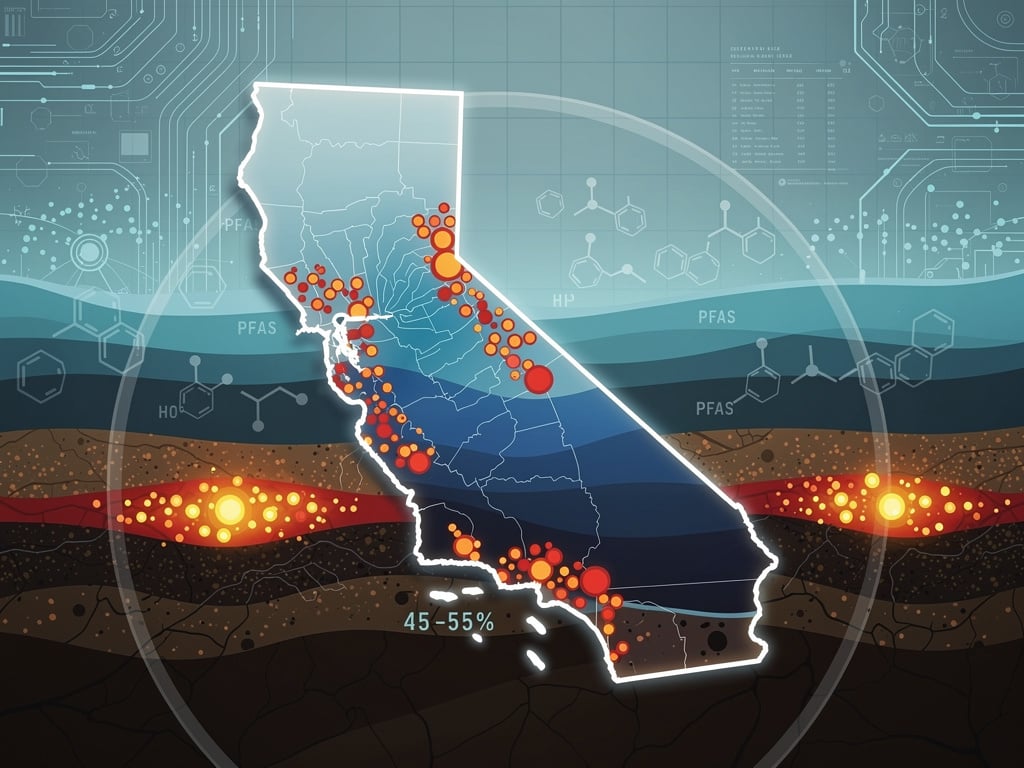
California’s water supplies face a stubborn threat. Around half of the state’s tested surface waterways now carry detectable levels of PFAS from pesticides. The compounds persist for generations. They accumulate in sediment. They enter the bodies of millions who drink from affected sources.
But the contamination runs deeper than rivers and streams. Decades of industrial use, military activity and everyday consumer products have left traces across groundwater and treated drinking water. Up to 25 million Californians rely on systems where PFAS have been detected at some point, according to an updated review of state data from 2019 to 2023 by the Natural Resources Defense Council.
The latest findings hit especially hard. A fresh Environmental Working Group examination of state and federal records reveals that up to 50 percent of surface water samples contain PFAS tied to pesticides. Sediment samples show contamination between 45 and 55 percent of the time. At least 60 percent of approved pesticide active ingredients qualify as PFAS or break down into them. These aren’t legacy pollutants alone. Farmers still apply them.
The Pesticide Pipeline
Pesticides now stand out as a major ongoing contributor. Fungicides, herbicides and insecticides laced with the compounds wash off fields during rain. They seep into streams that double as drinking water sources for communities downstream. The pattern shows up statewide. Rural areas. Urban edges. Places already burdened by other pollutants.
Earlier work from UC Berkeley researchers highlighted disparities. Public wells near communities of color, often Latinx and rural, face higher risks from PFAS-contaminated pesticides. The study, published in Environmental Science & Technology Water, was the first to connect these dots in California’s agroecosystems. It called for expanded monitoring exactly where regulators have been slow to look.
And the human toll mounts. A 2025 study from the Keck School of Medicine at USC linked PFAS in drinking water to higher rates of rare cancers. Residents in contaminated districts saw up to a 33 percent increase in incidence for certain types. The work, funded by the National Institutes of Health and published in the Journal of Exposure Science and Environmental Epidemiology, offered the first U.S.-wide examination of this cancer connection.
Even low concentrations matter. Southern California adults whose public water systems showed detectable PFAS had measurably higher levels in their blood, a separate analysis in the same journal found last year. The Journal of Exposure Science & Environmental Epidemiology study drew on biomonitoring data from hundreds of participants. It suggested that current regulatory thresholds may not protect against bioaccumulation.
So what does half-contaminated mean in practice? The EWG analysis, released in late May 2026, pulled from systematic reviews of California’s surface water and sediment testing. Results appeared in a Guardian article published days later. Bernadette Del Chiaro, EWG senior vice president, didn’t mince words. “If we’re seeing PFAS pesticides show up this often even in limited surface water and sediment tests, the true scale of this contamination is almost certainly even greater. We need to stop deliberately spraying these toxic chemicals on our crops.”
Her call echoes years of warnings. Firefighting foams at military bases. Industrial discharges. Landfills leaching into aquifers. Wastewater plants that concentrate rather than destroy the molecules. The state’s own water board lists these as primary sources. Yet pesticides add a diffuse, continuous load that proves harder to control.
California has responded with rules. Notification levels for several PFAS compounds tightened in late 2025. The Division of Drinking Water issued a general order requiring broader testing through 2026. Free sampling targets thousands of wells in disadvantaged communities under Assembly Bill 178. Still, enforceable maximum contaminant levels lag for some compounds. And federal protections remain under debate. An Environmental Working Group review from May 2025 warned that nearly 19 million Californians could lose safeguards if the EPA weakens its limits.
Testing continues to reveal more. The Unregulated Contaminant Monitoring Rule has delivered fresh data nationwide. In California, hundreds of systems exceed advisory thresholds. Disadvantaged neighborhoods shoulder a disproportionate share. Up to 8.9 million residents in those areas may face exposure, the NRDC analysis showed.
Remediation costs run high. Treatment technologies exist. Granular activated carbon, ion exchange, even emerging destruction methods. But small systems struggle. Rural districts lack funds. The chemicals resist breakdown. They travel long distances. Once in groundwater, they stay.
Policy efforts aim higher. Bills in the state legislature seek to restrict nonessential uses. Lawsuits against manufacturers seek cleanup dollars. Settlements with water systems have begun to flow. Yet production of certain PFAS continues elsewhere. Imports carry them in products. The cycle persists.
Scientists keep documenting harm. Immune suppression. Liver effects. Developmental issues. Cancer links. The list grows with each cohort study. Nearly all Americans show traces in blood serum. Californians near hotspots carry more.
The EWG findings add urgency. Surface waters feed reservoirs. They recharge aquifers. Sediment acts as a long-term reservoir itself, releasing compounds slowly. Half the tested waterways. That figure should alarm anyone who turns on a tap or eats produce from the Central Valley.
Regulators promise more data. Expanded monitoring under new orders will test for 25 PFAS compounds using sensitive methods. Results will feed public dashboards. Communities can track their risk. But data alone solves nothing. Action on the front end, curbing new applications, offers the only realistic path to lower future burdens.
Because these molecules don’t vanish. They don’t dilute away completely. They accumulate. In fish. In soil. In people. California’s experiment with widespread PFAS use has delivered a predictable result. Contaminated water on a massive scale. The question now is how quickly leaders close the tap on new sources while cleaning what they can.


 WebProNews is an iEntry Publication