
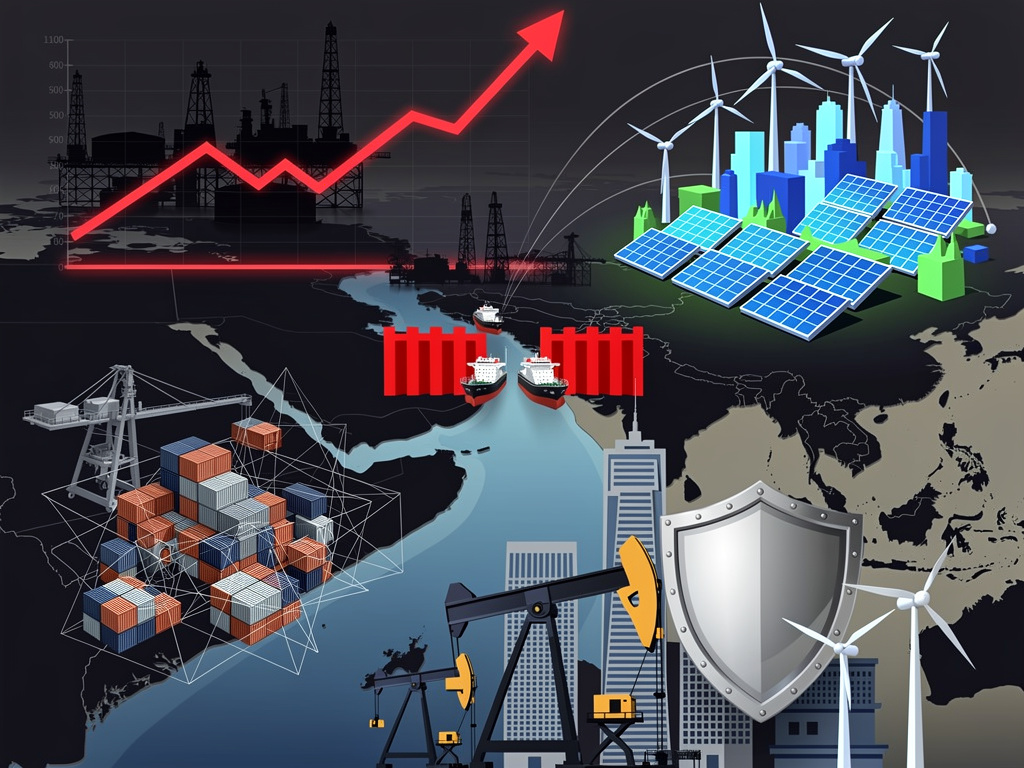
The war between the U.S., Israel and Iran has delivered the largest shock to global oil markets in history. Nearly 20% of the world’s crude and LNG flows halted at the Strait of Hormuz. Production across the Persian Gulf plunged. Prices surged past $100 a barrel. Yet one unexpected outcome now takes shape. Gulf governments accelerate multi-billion-dollar bets on solar, wind and batteries overseas. They seek energy security at home while monetizing oil faster abroad.
Attacks on infrastructure from Ras Laffan in Qatar to Saudi facilities at Khurais and Manifa forced immediate cuts. Kuwait saw exports drop sharply. Qatar declared force majeure on LNG. Saudi Arabia and the UAE rerouted some volumes through Red Sea and Gulf of Oman pipelines. Those routes cover only a fraction of normal traffic. Storage tanks filled. Fields shut in. The International Energy Agency called it unprecedented. Fortune reported the blockade triggered the sharpest supply disruption ever recorded.
Repair bills will run between $34 billion and $58 billion. Some fields could take years to restart. Rystad Energy put the figure at that range in analyses cited across outlets. Meanwhile Gulf sovereign wealth funds redirect capital. They chase stable returns in renewables far from the conflict zone. The logic is cold. Oil remains vital for revenue today. But dependence on a single chokepoint invites repeated risk.
In April Abu Dhabi’s Masdar signed a binding deal with France’s TotalEnergies. The $2.2 billion joint venture merges onshore renewable operations across nine Asian countries. Weeks later Mubadala Investment Company took a minority stake in Power Factors, a San Francisco software firm used by most of the world’s top renewable producers. It also committed $325 million to Ørsted’s Hornsea 3 offshore wind project in the U.K. When complete with its sister farms the site will exceed 5 GW. Masdar itself reached 65 GW of global renewable capacity in January. It aims for 100 GW by 2030 and plans to deploy another $30 billion to $35 billion this decade.
“A lot of these projects are long-laid plans.” Robin Mills said that. He leads Qamar Energy, a Dubai advisory firm. “There is also an acceleration taking place due to Gulf countries increasingly considering their domestic energy security.” Current events improve the investment case for overseas portfolios. Diversification becomes strategic. Mills told Fortune the UAE wants to monetize oil resources faster ahead of eventual peak demand. That frees associated gas for its industrial plans and AI ambitions.
The UAE left OPEC in April. It now targets 5 million barrels per day of oil capacity by 2027, up from 3.4 million earlier this year. The move signals a split within the cartel. Saudi Arabia maintains higher ambitions yet faces its own constraints. Iranian drones hit its facilities. Output fell. Revenue took a hit despite elevated prices. The Wall Street Journal described clear winners and losers in oil’s new order. The U.S. exports climbed. Non-Gulf producers gained share. Gulf neighbors absorbed direct losses. The Wall Street Journal noted Asia suffered most given its heavy reliance on Middle East supply.
At CERAWeek in Houston executives framed the shift in security terms. Geoffrey Pyatt, former U.S. assistant secretary of state for energy resources, observed that wind, solar and batteries offer a compelling economic choice. Countries pursue them for access and security. Not solely as climate policy. Jeff Currie of Carlyle predicted the conflict would turbocharge the energy transition. Ditte Juul Jørgensen, the European Commission’s director general for energy, called for ramped-up clean investments to escape volatile global markets. Anders Opedal, CEO of Equinor, stressed solving diversity of supply at the country level for security, affordability and sustainability together. Reuters captured those exchanges in late March.
Yet the same war complicates domestic buildouts. Solar PV imports to the Gulf collapsed in March. UAE volumes fell from 767 MW to 160 MW. Saudi Arabia dropped from 704 MW to 80 MW. Oman recorded none. Freight rates from Shanghai to the Gulf and Red Sea jumped from $980 to over $4,100 per container. That exceeds even the worst Covid peaks. Rystad Energy now forecasts delays of three to 12 months across the region’s renewable pipeline. Oman presses ahead with a 2.7 GW hybrid project pairing wind, solar and storage. It aims for 30% renewable electricity by 2030. Supply chain friction tests those goals. Christopher Gooding, an analyst at Cornucopia Capital, told Fortune that capital flows toward more stable overseas environments while uncertainty lingers at home. Duration of the Hormuz disruption will decide how severe the delays become.
Gulf investors show no sign of abandoning foreign renewable commitments. A Clean Air Task Force report tallied more than $101.9 billion directed to African clean energy from UAE, Saudi, Qatari and other Gulf sources through the end of 2024. Much landed in North and Southern Africa. Analysts expect that pace to hold. Long-term demand for power, minerals and manufacturing supply chains outweighs near-term shocks. The Los Angeles Times reported steady funding despite the war. The Los Angeles Times highlighted strategic attraction beyond immediate energy prices.
Saudi Arabia eyes 130 GW of renewable capacity by 2030 to reach half its electricity generation. Its clean-energy firms committed $17 billion to solar and wind. The UAE targets 100 GW by the same date and positions itself as an AI compute hub. Those plans predate the conflict. The war adds urgency. Distributed generation gains appeal. Centralized plants and pipelines proved vulnerable. Executives now speak of homegrown power reducing exposure to distant shocks.
Europe draws its own lessons. Ursula von der Leyen called the crisis a stark reminder of regional dependence. She urged more nuclear alongside renewables. Gas stockpiles sit low after years of replacing Russian pipeline supplies. Qatar’s offline LNG worsened the strain. Higher prices ripple into diesel, jet fuel and fertilizer. Global consumers feel it at the pump and in grocery aisles. But the Gulf’s response stands apart. Oil exporters themselves invest in the very technologies that could one day erode their core revenue.
That tension defines the moment. Short-term repair costs compete with long-term diversification spending. Sovereign funds review portfolios. Some projects face deferral. Others advance faster. Masdar’s global push continues. Mubadala backs software and offshore wind. Oman builds hybrids. Saudi scales solar procurement. The conflict did not create these strategies. It sharpened them. Energy security now sits beside fiscal return in every calculation.
Analysts debate duration. If the strait reopens soon, markets may stabilize within months. Infrastructure restarts will still demand tens of billions and careful sequencing. If closure drags into late 2026, delays compound. GDP hits mount. Qatar faces contractions near 15%. Kuwait, Bahrain and others see sharp drops. The IMF and UNDP forecast regional losses between $120 billion and $194 billion. Those figures exceed recent growth. Fiscal realism takes hold. Vision 2030 priorities shift toward AI, domestic industry and resilient supply chains.
Renewables offer one hedge. They generate power immune to tanker routes and missile strikes. They attract foreign capital and technology partnerships. They burnish diversification credentials with global investors. For Gulf leaders the math favors acceleration even amid disruption. Robin Mills captured the view. Domestic security improves when oil revenue funds projects that stand apart from oil itself. The war exposed fragility. The response builds options.
Markets watch closely. U.S. exports rose a third to 5.2 million barrels a day in April. Russia and Brazil ship more. Non-OPEC supply fills gaps. Yet the Persian Gulf holds the cheapest barrels and the largest spare capacity when functional. Its partial return will weigh on prices eventually. Until then elevated costs spur efficiency, electric vehicles and alternative supply chains. Renewables gain on pure economics in many regions. Security adds another decisive factor.
The Gulf’s multi-billion-dollar moves signal a deeper acknowledgment. No single commodity or route can anchor an economy forever. Diversification was policy. The Hormuz blockade made it necessity. Masdar, Mubadala and their peers execute that shift in real time. They buy stakes in platforms, sign joint ventures in Asia, fund massive wind farms in Europe. They keep commitments in Africa. At home they accept delays but refuse retreat. The conflict hammered oil infrastructure. It simultaneously hardened the case for everything that follows oil.
So the transition accelerates not from climate targets alone but from lived vulnerability. Executives at industry gatherings say it plainly. Policymakers echo the logic in capitals from Abu Dhabi to Riyadh. The war will end. Markets will normalize. The capital deployed today will generate power for decades. That power will flow independent of any strait. For an industry insider the pattern is clear. Risk revealed. Strategy adapted. Investment redirected. The Gulf is not abandoning oil. It is hedging against its limits.


 WebProNews is an iEntry Publication