
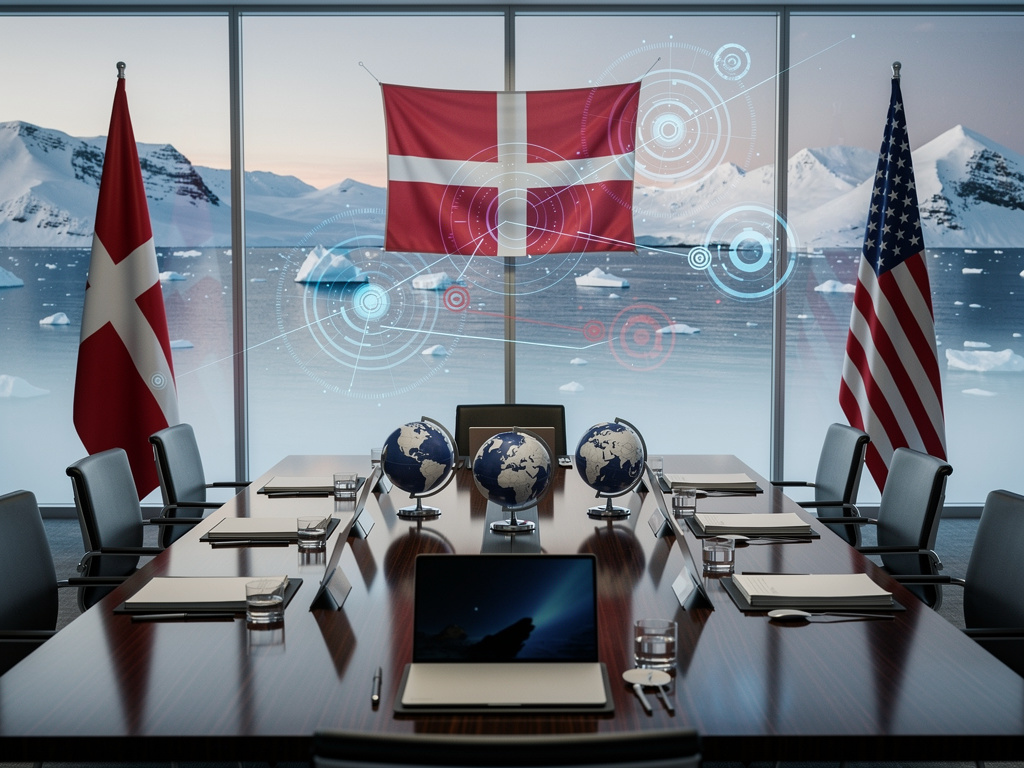
Denmark’s Foreign Minister Lars Løkke Rasmussen emerged from an EU meeting in Brussels on Thursday declaring high-level talks with the U.S. over Greenland “very constructive,” a marked shift from weeks of escalating rhetoric that threatened to fracture NATO alliances. “Things were escalating but now we are back on track,” Rasmussen told reporters, referencing discussions in Washington the previous day involving U.S., Danish, and Greenlandic officials. The meeting, aimed at resolving President Donald Trump’s aggressive push for control of the strategically vital Arctic island, signaled a potential de-escalation in a crisis that had prompted tariff threats and military posturing.
Trump’s renewed interest in Greenland, first floated during his first term in 2019, intensified after a U.S. military operation captured Venezuelan President Nicolás Maduro on January 3, 2026. The president framed the island as essential for national security, citing threats from Russia and China in the melting Arctic. A 1951 defense agreement already grants the U.S. broad access, including the Pituffik Space Base with about 200 personnel, but Trump demanded more—potentially full sovereignty or expanded mineral rights. Polls show Greenlanders overwhelmingly oppose U.S. control, favoring independence from Denmark instead, according to Verian Group.
From Tariff Threats to Framework Deals
By mid-January, tensions boiled over. Trump threatened 10% tariffs on Denmark, Norway, Sweden, France, Germany, the UK, the Netherlands, and Finland—escalating to 25% by June unless Denmark yielded Greenland. He mocked Danish defenses as “two dogsleds” on Truth Social, prompting Denmark to deploy elite arctic troops, including Army Chief General Peter Harling Boysen, to the island. European allies rallied: France, Germany, and Norway pledged forces for multinational exercises around Greenland, as reported by The Guardian.
Denmark’s Prime Minister Mette Frederiksen warned that a U.S. attack would end NATO, stating “the world order as we know it is over.” Greenland Prime Minister Jens-Frederik Nielsen echoed her, calling sovereignty a “red line” and noting public fears: “What we are dealing with as a government is trying to push back from outside and handle our people who are afraid and scared,” he said at a Paris event, per CNBC.
The pivot came at Davos on January 21. Trump backed off tariffs and force, touting a “framework of a future deal” with NATO Secretary-General Mark Rutte involving U.S. mineral rights and NATO Arctic boosts. “We’re in a good place right now… a process that is going to bring us to a good outcome,” U.S. Secretary of State Marco Rubio told lawmakers on January 28, emphasizing national security, according to Military.com.
NATO’s Arctic Awakening
Rutte and Frederiksen agreed NATO must enhance Arctic security, including a potential “Arctic Sentry” mission modeled on Baltic operations to counter Russia and China. “Everybody in NATO agrees… we need a permanent presence from NATO in the Arctic region, including around Greenland,” Frederiksen said en route to a Brussels summit, as covered by Euronews. Rutte aimed for implementation “early in 2026,” per Reuters.
Denmark surged defenses: On January 20, it sent dozens of soldiers to Kangerlussuaq for exercises like Operation Arctic Endurance. NATO discussions now center on updating the 1951 pact for expanded U.S. presence without sovereignty transfer. Greenland’s Nielsen stressed, “Nobody other than Greenland and the Kingdom of Denmark have the mandate to make deals,” highlighting self-determination amid melting ice opening shipping routes and mineral riches.
Frederiksen visited Nuuk on January 23, embracing Nielsen in a show of unity. The leaders toured European capitals—Berlin, Paris—securing ally backing. German Chancellor Friedrich Merz called Arctic defense a “common transatlantic interest.” Yet skepticism lingers: Denmark insists no land cession, rejecting ideas like sovereign U.S. bases floated in The New York Times.
Strategic Stakes in the Melting North
Greenland’s position—bridging Atlantic and Arctic—anchors missile defense, surveillance, and emerging routes slashing Asia-Europe shipping times. U.S. concerns focus on Russian and Chinese inroads; Denmark notes no current threats but agrees more surveillance is needed. Trump’s “Golden Dome” missile plan entered talks, with Frederiksen open to cooperation, per CNBC.
Rasmussen’s optimism post-Washington: “It’s not that things are solved but… I am slightly more optimistic today than a week ago.” Technical talks continue, but red lines hold: no sale, no force. Markets rebounded after Trump’s retreat, easing trade war fears that hammered Wall Street.
Public sentiment hardened. Protests in Copenhagen and Nuuk waved Greenland flags with “Make America Go Away.” Danes, once pro-U.S., rallied behind Frederiksen, boosting her polls. A Greenlandic hunter told BBC: “We are a colony under Denmark… but I don’t have time for Trump.”
Path Forward Amid Fragile Trust
The January 28 Washington session marked progress, with Rubio confirming “technical level meetings.” Yet Trump’s history—2019 purchase bid ridiculed by Frederiksen as “absurd”—fuels caution. Wikipedia’s Greenland crisis entry details the saga: from post-WWII U.S. protection to today’s NATO scramble.
Europe eyes diversification; EU leaders mulled Washington ties review. NATO’s Arctic focus shifts from regional to core, with Denmark leading. As Rasmussen noted, prior Washington agreements resume post-detour. For insiders, the real test: translating frameworks into pacts securing Arctic without upending alliances forged post-WWII.


 WebProNews is an iEntry Publication