
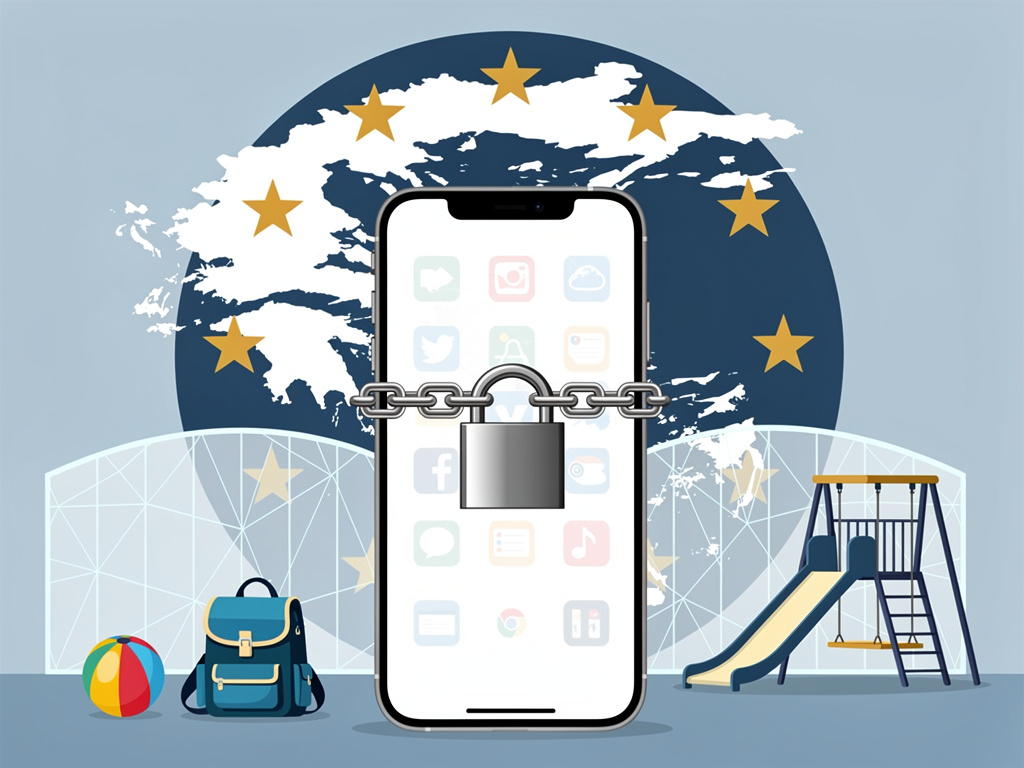
Greece just did what a growing number of Western democracies have been threatening to do for years. It banned children under 15 from social media entirely.
Prime Minister Kyriakos Mitsotakis announced the policy on Tuesday, making Greece one of the first European Union nations to impose a blanket prohibition on minors accessing platforms like TikTok, Instagram, and Snapchat. The law, which takes effect later this year, will require social media companies to enforce age verification for Greek users and block access for anyone who doesn’t meet the threshold. According to Engadget, the Greek government plans to build a centralized digital identification system to verify users’ ages — a technical undertaking that raises its own set of thorny questions about privacy, implementation, and efficacy.
This is not a suggestion. Not a guideline. A ban.
Mitsotakis framed the decision in strikingly personal terms during a televised address, describing social media’s effect on children as one of the defining public health challenges of the era. He cited rising rates of anxiety, depression, and attention disorders among Greek youth, and pointed to mounting evidence that algorithmic feeds are particularly damaging to developing brains. The prime minister didn’t mince words: he called the platforms “a threat to childhood itself.”
The timing isn’t accidental. Greece’s move comes amid a broader wave of legislative action across the Western world aimed at limiting minors’ access to social platforms. Australia passed a law in late 2024 banning social media for children under 16, becoming the first major democracy to impose such a sweeping restriction. That law, which is set to take effect later this year, requires platforms to take “reasonable steps” to prevent underage access, though enforcement details remain somewhat vague. France and Spain have both floated similar proposals, and the European Union itself has been inching toward a continent-wide framework through its Digital Services Act, which already imposes heightened obligations on platforms regarding minors but stops short of an outright ban.
In the United States, the debate has followed a different, more fractured path. More than a dozen states have passed or proposed laws restricting minors’ use of social media, but federal action remains stalled. The Kids Online Safety Act, which passed the Senate in 2024 with broad bipartisan support, has languished in the House. Meanwhile, U.S. Surgeon General Vivek Murthy issued an advisory in 2023 warning that social media poses a “profound risk” to children’s mental health — a statement that carried moral weight but no legal force. Florida’s law requiring parental consent for users under 16 was signed by Governor Ron DeSantis but immediately faced legal challenges on First Amendment grounds. Utah’s similar law met the same fate. The constitutional terrain in America makes European-style bans extraordinarily difficult to implement.
Greece doesn’t have that problem. Or at least, not in the same way.
European privacy frameworks, particularly the General Data Protection Regulation, already establish a legal basis for restricting how companies collect and process data from minors. The GDPR sets 16 as the default age of digital consent across the EU, though member states can lower it to as young as 13. Greece had previously set its threshold at 15, which neatly aligns with the new social media ban. What Mitsotakis has done, in effect, is take an existing data protection standard and extend it into an access prohibition — a move that legal scholars say is on firmer constitutional ground in Europe than it would be in the U.S.
But the devil, as always, is in the implementation.
Age verification on the internet is a notoriously slippery problem. Self-reported birthdates are trivially easy to fake. More rigorous systems — government ID checks, biometric scans, third-party verification services — raise serious concerns about surveillance and data security. Greece’s proposed centralized digital ID system would, in theory, allow citizens to verify their age without revealing other personal information to platforms. The government has described it as a privacy-preserving architecture, though details remain scarce. Critics, including digital rights organizations like Access Now, have warned that any system requiring users to prove their identity to access online services risks creating a chilling effect on free expression — not just for children, but for everyone.
There’s also the question of whether bans actually work. Australia’s experience is instructive, though still early. When Canberra announced its under-16 ban, tech companies pushed back hard, arguing that age gates would be ineffective and that determined teenagers would simply use VPNs or fake credentials to circumvent restrictions. Meta, TikTok, and Snap all issued statements expressing concern about the approach, though none outright refused to comply. Early reporting from Australian media suggests that platform compliance has been uneven at best, with enforcement mechanisms still being developed months after the law’s passage.
Greece appears to be betting that a government-run verification system will be harder to game than platform-side age checks. That’s a reasonable bet. It’s also an expensive one. Building and maintaining a national digital identity infrastructure requires sustained investment, technical expertise, and political will — none of which are guaranteed over the long term. And if the system fails or is breached, the political fallout could be severe.
The social media companies themselves have been notably quiet in the immediate aftermath of the Greek announcement. Meta, which owns Instagram and Facebook, declined to comment specifically on the Greek law but pointed to its existing age verification tools and parental supervision features. TikTok issued a brief statement saying it was “committed to the safety of younger users” and would “engage with Greek authorities” on implementation. Snap did not respond to requests for comment. None of these responses should be mistaken for acquiescence. The platforms have a long track record of publicly supporting child safety while privately lobbying against specific regulatory measures that would constrain their user growth.
And user growth is the core issue. Children and teenagers represent a critical demographic pipeline for social media companies. Losing access to users under 15 in a country of 10 million people won’t dent Meta’s bottom line. But if Greece’s ban becomes a template — if France, Germany, and Italy follow suit — the financial implications become real. The EU’s combined population of roughly 450 million people includes tens of millions of users under 15. Locking them out, even temporarily, would affect engagement metrics, advertising revenue, and long-term platform stickiness.
This is why the industry’s response to youth bans has been to promote its own solutions — parental controls, time limits, content filters — rather than accept externally imposed age restrictions. Meta launched its “Family Center” suite of tools in 2023. TikTok introduced screen time limits for users under 18. YouTube created a supervised experience for younger viewers. These efforts are real, but they’re also voluntary, inconsistent, and designed to keep users on the platform rather than off it. The fundamental business model — attention capture, algorithmic engagement, ad delivery — doesn’t change.
Mitsotakis seems to understand this. In his address, he explicitly rejected the idea that parental controls alone are sufficient, arguing that the burden of protecting children should not fall entirely on families. “We cannot ask parents to fight an algorithm,” he said. That line resonated widely on social media — an irony not lost on commentators.
The mental health evidence supporting restrictions on youth social media use has grown substantially in recent years, though it remains contested in academic circles. Jonathan Haidt’s 2024 book The Anxious Generation synthesized much of the research and argued forcefully that smartphones and social media are the primary drivers of a global youth mental health crisis that began around 2012. Haidt’s work has been enormously influential among policymakers, and Mitsotakis reportedly referenced it in private discussions with advisors. But other researchers, including Andrew Przybylski at the Oxford Internet Institute, have cautioned that the causal links between social media use and mental health outcomes are weaker and more complicated than popular accounts suggest. Correlation is abundant. Causation is harder to pin down.
What isn’t in dispute is that children are spending more time on social media than ever, and that the platforms are engineered to maximize that time. A 2023 report from the U.S. Centers for Disease Control and Prevention found that nearly 60 percent of teenage girls in America reported persistent feelings of sadness or hopelessness — a record high — and that heavy social media users were significantly more likely to report such feelings. The European Commission’s own surveys have found similar trends across EU member states. Whether social media causes these problems or merely amplifies them is, for many parents and policymakers, a distinction without a practical difference.
Greece’s ban will almost certainly face legal challenges, both domestically and at the EU level. The European Court of Justice has historically been protective of free expression rights, and digital rights advocates are likely to argue that a blanket ban on minors’ access to social platforms is disproportionate — a key legal standard under EU law. The Greek government will need to demonstrate that less restrictive measures were insufficient, and that the ban is narrowly tailored to achieve a legitimate aim. Given the strength of the public health evidence and the existing GDPR framework, legal experts say Greece has a plausible case, though the outcome is far from certain.
There’s a deeper philosophical question lurking beneath the legal and technical debates. Should governments decide when a child is ready to participate in online public life? Parents have traditionally held that authority, but the scale and sophistication of modern platforms have arguably overwhelmed individual parental capacity. A 13-year-old with a smartphone has access to the same algorithmic content machine as a 30-year-old. No amount of “family settings” changes that fundamental reality.
Some advocates have proposed a middle path: rather than banning minors outright, require platforms to offer a fundamentally different experience for younger users — one without algorithmic recommendations, targeted advertising, or infinite scroll. The UK’s Age Appropriate Design Code, which took effect in 2021, moves in this direction by requiring platforms to default to the highest privacy settings for users likely to be children. But enforcement has been uneven, and the code doesn’t address the core engagement mechanics that make social media so compelling — and so potentially harmful — for young people.
Greece has opted for the blunter instrument. Whether it proves effective will depend on execution, enforcement, and the willingness of successive governments to sustain the effort. Political winds shift. Technical systems degrade. Children grow up and find workarounds. But the signal Mitsotakis has sent is unmistakable: the era of treating children’s access to social media as a default right, rather than a privilege to be earned, may be ending in Europe.
And the platforms know it. For years, Silicon Valley has operated on the assumption that regulatory threats would remain just that — threats. Australia changed the calculus. Greece is reinforcing it. If the EU moves toward a harmonized ban at the continental level, which several MEPs have already called for, the industry will face a choice it has long avoided: redesign the product, or lose the market.
Neither option is painless. Both are overdue.
For those of us who grew up in an era when the biggest screen in the house was a 27-inch TV in the living room, the speed at which social media has colonized childhood is staggering. I got my first computer in rural Illinois and spent hours on it — but the internet I encountered was a slow, text-heavy, largely anonymous place that bore almost no resemblance to the hyper-personalized, dopamine-optimized feeds that today’s kids carry in their pockets. My parents didn’t need to fight an algorithm. They just had to yell at me to come to dinner. The world Mitsotakis is trying to protect children from is fundamentally different, and the old tools aren’t working.
Greece’s bet is a big one. It may fail. But the fact that a European democracy is willing to make it — and that others are watching closely — tells you everything about where this debate is headed.


 WebProNews is an iEntry Publication