
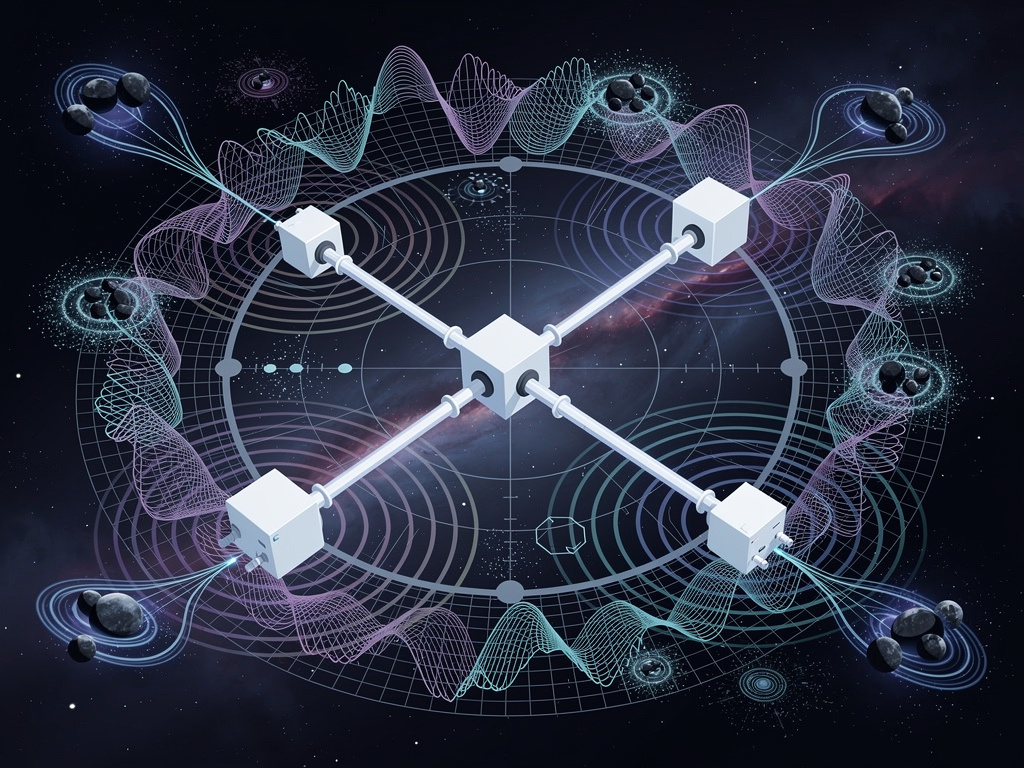
The LIGO-Virgo-KAGRA collaboration has released its largest catalog of gravitational wave events to date, nearly doubling the number of confirmed detections of black hole and neutron star mergers. The fourth observing run, known as O4a, added 152 new candidate events to the existing catalog, bringing the total to roughly 300. That’s a staggering increase from the single detection that started the field in 2015. But what does it actually mean for physics?
More than you might think. And less than some headlines suggest.
The new catalog, reported by Slashdot and detailed in papers submitted to the arXiv preprint server, covers observations from May 2023 to January 2024. The detectors picked up signals at a rate of roughly one every two days during this stretch — a pace that would have seemed absurd a decade ago when the first binary black hole merger, GW150914, took the physics world by storm. The improvement comes from hardware upgrades to the LIGO detectors in Hanford, Washington, and Livingston, Louisiana, as well as the Virgo detector in Italy, which increased their sensitivity to gravitational wave strain by measurable margins.
The numbers matter because gravitational wave astronomy is fundamentally a statistical science at this stage. Individual detections are interesting. Populations are where the real physics lives. With 300 events, researchers can start to map the mass distribution of merging black holes with enough resolution to test competing formation models — whether these binaries form from pairs of massive stars that lived and died together, or from random encounters in dense stellar environments like globular clusters.
Here’s what the data is already showing. The mass distribution of black holes isn’t smooth. There’s a clear pileup of events around 35 solar masses and a sharp drop-off above roughly 45 solar masses, consistent with predictions from pair-instability supernova theory, which says very massive stars should leave a gap in the black hole mass spectrum. The O4a data reinforces this feature with better statistics. There’s also growing evidence for black holes in the so-called “lower mass gap” between about 3 and 5 solar masses — a range where neither neutron stars nor black holes were traditionally expected to exist. Several O4a events fall squarely in this range, as noted by LIGO Caltech.
So the catalog is genuinely useful. But skeptics should keep a few things in mind.
First, the detection rate increase is partly a function of improved sensitivity, not just a richer universe. The detectors can now see farther, which means they’re sampling a larger volume of space. The rate of mergers per unit volume per unit time — the astrophysically meaningful quantity — hasn’t changed as dramatically as the raw event count implies. The collaboration estimates a local binary black hole merger rate of roughly 17 to 45 per cubic gigaparsec per year, broadly consistent with previous estimates but now pinned down with tighter error bars.
Second, most of these events are binary black hole mergers. The catalog includes only a handful of neutron star–black hole mergers and even fewer binary neutron star mergers. That’s a sensitivity issue — neutron star systems produce weaker signals because the objects are less massive. The famous GW170817 binary neutron star event, which produced a spectacular electromagnetic counterpart observed across the spectrum, remains somewhat of an outlier. The O4a run didn’t deliver another event of that caliber with confirmed multi-messenger observations, according to reporting from Nature.
Third, and this is the part that doesn’t get enough attention: the false alarm rate. Not every candidate event in the catalog is a confirmed detection. The collaboration uses a threshold of false alarm rate less than one per year, but that still means some fraction of the 152 new events could be noise artifacts. The collaboration is transparent about this. The catalog includes probabilities for each event, and some sit uncomfortably close to the threshold. Industry insiders who’ve worked with signal processing know that doubling your catalog doesn’t double your knowledge if the marginal events carry substantial uncertainty.
None of this diminishes the achievement. Ten years ago, gravitational wave detection was a theoretical possibility backed by a billion-dollar bet. Now it’s routine observational science producing population-level statistics. The LIGO-Virgo-KAGRA team, comprising over 1,500 scientists across dozens of institutions, has built something that works and keeps getting better.
The real test comes next. The O4b observing run continued through mid-2025, and early indications suggest the detection rate held steady or increased further. The fifth observing run, O5, is expected to begin in 2027 with another significant sensitivity upgrade, potentially tripling the observable volume again. At that point, the collaboration could be logging thousands of events, enough to probe questions about the expansion rate of the universe using gravitational wave sources as “standard sirens” — an independent check on measurements from the cosmic microwave background and Type Ia supernovae that currently disagree with each other at a statistically troubling level, as discussed by Quanta Magazine.
The bottom line: doubling the catalog is a milestone, not a breakthrough. The physics payoff from gravitational wave astronomy has always been cumulative. Each event adds a data point. Each data point tightens a constraint. The field is doing exactly what it promised — building a new way to observe the universe, one merger at a time. The hype around individual detections has cooled, replaced by the slower, harder work of population statistics and precision measurement.
That’s not exciting in a press-release sense. But it’s exactly how observational science is supposed to mature.


 WebProNews is an iEntry Publication