
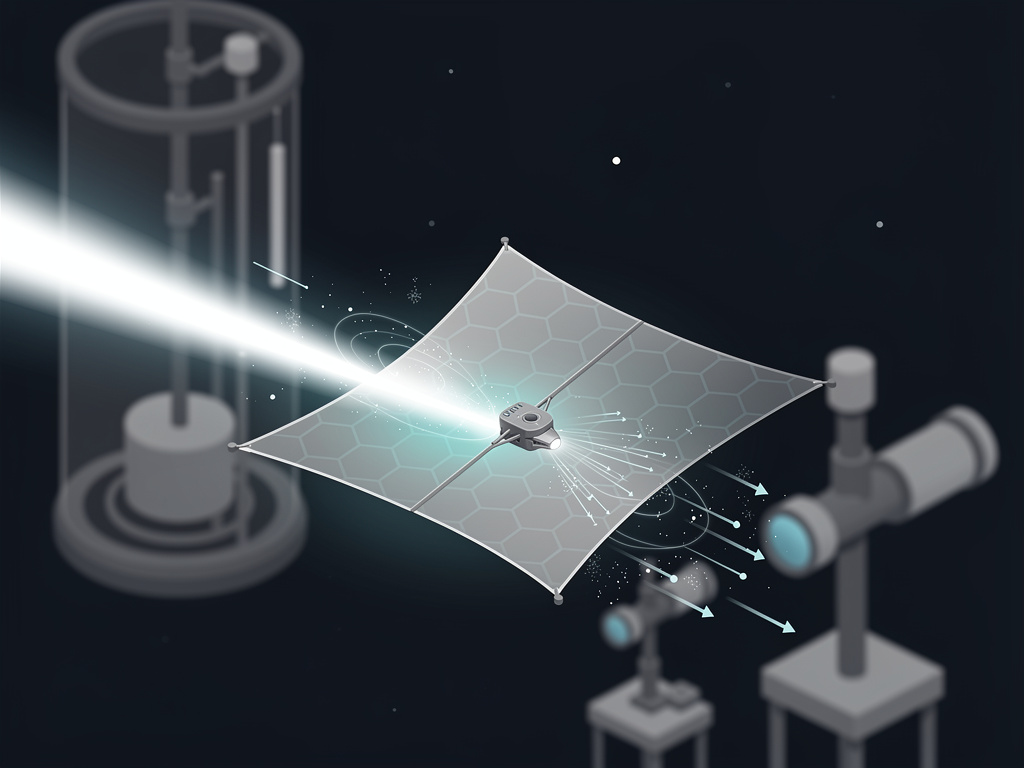
A spacecraft with no engine. No propellant tanks. No chemical combustion of any kind. Just a sheet of carbon atoms, one layer thick, catching a beam of light fired from the ground — and accelerating to speeds that would make conventional rockets look quaint.
That’s not science fiction anymore. It’s a laboratory result.
Researchers at Delft University of Technology in the Netherlands have demonstrated, for the first time, that laser light can propel freestanding graphene membranes in a vacuum. The experiment, published in the journal Acta Astronautica, offers the most tangible evidence yet that light-driven graphene sails could one day carry tiny spacecraft across interstellar distances at a meaningful fraction of the speed of light. The implications for deep-space exploration — and for the broader economics of space travel — are difficult to overstate.
As Gizmodo reported, the team observed graphene sheets accelerating under laser illumination in ways that exceeded what radiation pressure alone could explain. Something else was happening. And that something else may be the key to making interstellar travel feasible within a human lifetime.
The Physics of Pushing Light Against Carbon
The concept of solar sailing isn’t new. The idea dates back over a century, and Japan’s IKAROS probe demonstrated solar radiation pressure propulsion in 2010. But traditional solar sails face a fundamental constraint: the farther you get from the Sun, the weaker the push. For missions beyond our solar system, that’s a dealbreaker.
Laser-driven sails solve this by substituting sunlight with a concentrated, ground-based or orbital laser array. The Breakthrough Starshot initiative, backed by the late Stephen Hawking and investor Yuri Milner, proposed exactly this architecture in 2016 — a 100-gigawatt laser array pushing gram-scale “StarChips” attached to ultra-thin sails toward Alpha Centauri at roughly 20% the speed of light. The trip would take about 20 years. By comparison, NASA’s Voyager 1, the fastest object humans have ever launched on an escape trajectory from the solar system, would need roughly 73,000 years to cover the same distance.
The problem has always been the sail material. It needs to be extraordinarily light, extraordinarily strong, and extraordinarily good at reflecting or absorbing photon momentum without melting. Graphene — a single-atom-thick lattice of carbon — checks most of those boxes. It’s the strongest material ever measured, at roughly 200 times the tensile strength of steel. It weighs almost nothing. And it absorbs about 2.3% of visible light per layer, which is remarkably high for something you can essentially see through.
But until the Delft experiment, nobody had actually shown that laser light could accelerate a freestanding graphene membrane in vacuum conditions relevant to spaceflight.
The research team, led by Santiago Cartamil-Bueno, suspended graphene membranes inside a vacuum chamber and hit them with laser pulses. The membranes moved. More than that, they moved faster than the math for pure radiation pressure predicted. The team measured accelerations on the order of meters per second squared — modest in absolute terms, but extraordinary given the minuscule mass involved and the relatively low laser power used.
The excess acceleration points to a phenomenon beyond simple photon momentum transfer. The researchers believe thermal or photomechanical effects in the graphene — potentially including the rapid desorption of adsorbed molecules from the surface when heated by the laser — contribute additional thrust. This is significant because it means graphene sails might be more efficient than purely reflective sails, extracting more momentum per photon than theory would suggest for a material that mostly transmits light.
“The fact that we’re seeing acceleration beyond radiation pressure is genuinely surprising,” Cartamil-Bueno has noted in discussions of the work. If the effect scales, it changes the engineering calculus for interstellar sail design considerably.
From Lab Bench to Light-Year Distances
There’s an enormous gap between accelerating a micrometer-scale graphene flake in a vacuum chamber and pushing a functional spacecraft to 20% of light speed. The challenges are stacked deep.
First, the laser array. Breakthrough Starshot’s baseline design calls for a phased array of lasers generating 100 gigawatts of coherent, focused power — roughly the total electrical output of a mid-sized country — concentrated on a sail just a few meters across, from a distance that will quickly grow to millions of kilometers. No such laser system exists. The most powerful directed-energy systems currently operational, such as the U.S. Navy’s shipboard laser weapons, top out in the hundreds of kilowatts. Scaling by a factor of a million is not a minor engineering exercise.
Second, beam focusing. Diffraction limits how tightly a laser beam can be focused over distance. To keep the beam on a meter-scale sail at distances of millions of kilometers requires an emitter array kilometers in diameter, with interferometric precision across its entire aperture. The adaptive optics required would need to compensate for atmospheric turbulence in real time, or the array would need to be placed in space — adding orders of magnitude to the cost.
Third, the sail itself. Graphene is strong, but fabricating large, defect-free sheets remains a manufacturing challenge. Current production methods can yield centimeter-scale sheets of reasonable quality. A Starshot-class sail would need to be meters across, atomically thin, and capable of surviving the thermal shock of absorbing terawatts of laser power per square meter during the acceleration phase, which would last only minutes. The Delft results suggest graphene can handle significant laser flux without immediate destruction, but the power densities envisioned for interstellar acceleration are several orders of magnitude higher than anything tested so far.
And then there’s the payload. A gram-scale spacecraft needs to carry a camera, a communication system (likely a small laser transmitter of its own), navigation sensors, and a power source — all miniaturized beyond anything currently available. The electronics would need to survive decades of exposure to cosmic radiation and the interstellar medium, including impacts from dust grains at relativistic speeds that would carry the kinetic energy of small explosions.
These are hard problems. But none of them violate known physics.
That distinction matters. Unlike warp drives or wormholes, laser-propelled sails operate entirely within classical electrodynamics and materials science. The challenges are engineering challenges, not theoretical ones. And engineering challenges, given sufficient funding and time, tend to get solved.
Recent developments suggest momentum is building. The Breakthrough Starshot program continues to fund research into sail materials, laser array design, and spacecraft miniaturization. In parallel, NASA’s Near-Earth Object Surveyor and other missions are advancing the broader infrastructure for space-based laser systems, even if their primary purpose isn’t propulsion. The European Space Agency has funded studies on laser-propelled deorbiting of space debris, which shares key technical elements with sail propulsion.
Meanwhile, graphene manufacturing is improving rapidly. Chemical vapor deposition techniques can now produce graphene films of increasing size and quality, and companies like Graphene Flagship partners in Europe are pushing toward industrial-scale production. The cost per square centimeter has dropped by orders of magnitude over the past decade.
The Delft experiment also opens a new line of inquiry: optimizing the anomalous thrust mechanism. If the excess acceleration observed in graphene under laser illumination can be understood and engineered — perhaps by tailoring surface chemistry or layering graphene with other two-dimensional materials — it might be possible to design sails that extract significantly more momentum from each photon than a perfect mirror would. That would reduce the required laser power, shrink the ground array, and bring the entire concept closer to feasibility.
Why It Matters Beyond Alpha Centauri
Even if interstellar missions remain decades away, laser-sail propulsion has nearer-term applications that could reshape space operations. Fast transit to Mars — weeks instead of months — becomes conceivable for small payloads. Rapid-response missions to outer solar system targets, like the plumes of Enceladus or the subsurface ocean of Europa, could be launched on timelines that align with scientific discovery rather than orbital mechanics. Space debris removal, satellite repositioning, and asteroid deflection all benefit from propellantless propulsion concepts.
So the Delft result isn’t just an interstellar curiosity. It’s a proof of concept for an entire class of propulsion technology that eliminates the tyranny of the rocket equation — the exponential relationship between payload mass and required fuel that has constrained spaceflight since Tsiolkovsky first wrote it down in 1903.
Every kilogram of propellant a spacecraft carries requires additional propellant to accelerate that propellant, which requires still more propellant, and so on. This is why the Saturn V rocket weighed 2,800 metric tons at launch but delivered only 47 metric tons to the Moon. Laser sails break this cycle entirely. The energy source stays on the ground. The spacecraft carries nothing but payload and sail.
The economics follow directly. If you don’t need to launch fuel, you don’t need to pay to launch fuel. At current launch costs of roughly $2,000 to $5,000 per kilogram to low Earth orbit — even with SpaceX’s Falcon 9 driving prices down — eliminating propellant mass from the spacecraft translates to enormous cost savings for any mission beyond Earth orbit.
There are also strategic dimensions. A nation or consortium that controls a sufficiently powerful ground-based laser array would possess the ability to project force — or at least presence — across the solar system on short timescales. The dual-use implications of high-power directed-energy systems are not lost on defense planners, and funding for laser technology development flows from military as well as civilian sources.
But the most compelling argument for laser-sail development may be the simplest one. It’s the only known technology that could carry human-made instruments to another star system within a human lifetime. Not in theory. Not in principle. In practice, given sufficient engineering investment. The physics works. A lab in the Netherlands just showed that the materials work too.
The distance to Alpha Centauri is 4.37 light-years — about 41 trillion kilometers. At 20% of light speed, that’s a 22-year flight. Add a few years for data transmission back to Earth at light speed, and you’re looking at first images of an exoplanetary system within roughly 25 to 30 years of launch. If development of the laser array and sail technology takes another 20 to 30 years, the first data could arrive within the lifetimes of people alive today.
That timeline is aggressive. It may slip. But it’s no longer absurd.
What the Delft team has done is remove one of the key question marks: whether graphene, subjected to laser illumination in vacuum, actually accelerates in a manner consistent with propulsion. It does. And it does so more efficiently than the simplest models predicted. The next steps — scaling the sail area, increasing laser power, testing in space-like thermal environments, characterizing the anomalous thrust mechanism — are already being planned.
The age of interstellar exploration won’t begin with a thunderous launch from a coastal pad. It’ll begin quietly, in a vacuum chamber in Delft, with a flake of carbon riding a beam of light.


 WebProNews is an iEntry Publication