
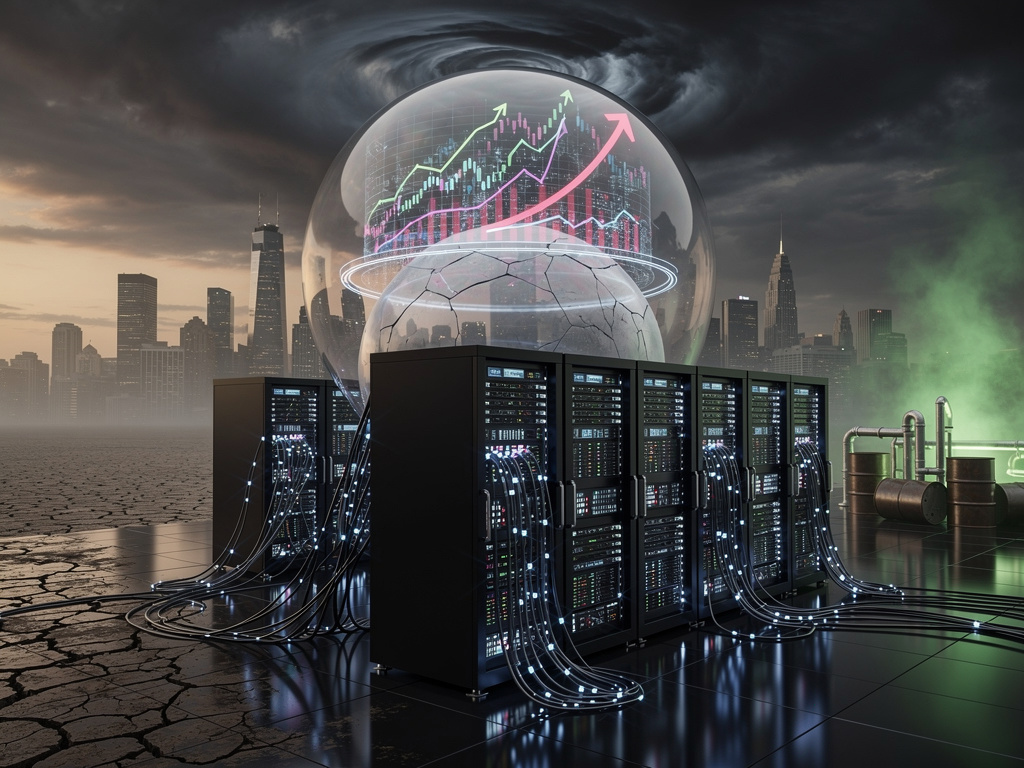
Jeremy Grantham has watched markets inflate and implode for decades. He flagged trouble in Japan. He rang alarms ahead of the dot-com collapse. He warned on housing before the 2008 crisis. Now the GMO co-founder points to artificial intelligence as both savior and trap for the U.S. economy and stock market.
Without the surge in AI-related capital spending, Grantham believes the United States would have slipped into recession in 2023. The market would have fallen another 25 percent from its already bruised levels. “My guess is that in 2023 we would have moved into a recession and the market would have gone down another 25%. And AI headed it off,” he told Business Insider in comments published Tuesday.
That spending comes heavy from the biggest tech names. Amazon, Google, Meta and Microsoft alone have committed around $725 billion in capital expenditures for 2025. Much of it targets AI infrastructure. The figure equals roughly 2 percent of U.S. GDP. Remove it, and GDP growth would have hovered near zero two years ago. The economy needed the crutch.
Yet Grantham sees danger in this dependence. “We’re in terra incognita,” he said. Never before has the U.S. leaned so heavily on one technology’s investment to drive growth. The reliance creates fragility. A shock to those plans could ripple fast.
The broader picture looks even more strained. Grantham describes the current situation as “a bubble forming out of a bubble that was only halfway completed, only halfway deflated, and then resuscitated.” The 2022 bear market had begun its work. The S&P 500 dropped 25 percent at one point. Growth stocks fell harder. Then ChatGPT launched in late 2022. The Magnificent Seven stocks lifted the index and ignited fresh speculation.
This pattern fits historical precedents that Grantham has studied closely. In a January 2026 paper from GMO, he and co-author Edward Chancellor outlined how major innovations spark investment manias. Railroads in 1840s Britain drew massive capital. Promises of transformed commerce and society drove valuations sky high. When reality set in, stocks plunged 65 percent. The internet boom of the late 1990s showed similar traits. Extravagant claims. Overbuilt infrastructure. Nasdaq eventually lost 80 percent of its value.
“The probability … that AI [bubble] will not bust are slim to none; it meets every condition of the railroads and the internet,” Grantham said in a Merryn Talks Money podcast interview referenced across multiple reports including i3-invest.com.
His GMO analysis defines a bubble clearly. Prices must diverge two standard deviations above their long-term real trend. The U.S. market has lingered in that zone since the 2021 peak. Classic signals appeared. Meme stock frenzy. Quality stocks outperforming. Speculative excess. But the full reset never came. AI postponed it. And in doing so, it inflated the problem further.
Valuations tell the story. The cyclically adjusted price-to-earnings ratio sits near 40. That exceeds most historical peaks except briefly in 2000. Price-to-book measures and other metrics match extremes seen before the crashes of 1929, 1972 and 2000. Each time, painful corrections followed. Grantham expects something similar when confidence finally cracks. “When investor confidence sooner or later reaches its limits, the deflating of the AI bubble will lead to a major stumble for the economy, a plunge in profits, and a severe decline in valuations,” the GMO paper states.
Current spending levels raise questions about returns. Hyperscalers plan more than $300 billion in AI capital expenditures in 2025 alone. That equals 1.3 percent of GDP, projected to climb to 1.6 percent next year. AI revenue remains under $50 billion against more than $1 trillion in cumulative investment so far. OpenAI forecasts losses of $35 billion by 2027. An MIT study found just 5 percent of corporate AI pilots delivered measurable gains in revenue or profit.
Grantham acknowledges AI’s potential. The technology could prove transformative in biotechnology, materials science or energy. Yet he cautions against extrapolating today’s hype indefinitely. Large language models still hallucinate. They fabricate information with false confidence. Productivity gains may arrive, but likely after the shakeout. History shows great inventions often become costs of business rather than perpetual profit machines. Winners emerge. Many others fail.
The market’s focus stays narrow. It piles high multiples on already strong profit margins. It ignores longer cycles. Grantham points to forces building outside Wall Street’s horizon. Demographic trends look troubling. Fertility rates have collapsed in South Korea to 0.7 births per woman. Japan has seen its young adult population halve from peak levels. Similar patterns spread across China, Europe and eventually the U.S. “If they’re going to conquer anyone, they’d better get it over with fast, because anyone falling in population at that speed is not going to do much of anything,” Grantham told Fortune in April.
Resource constraints add pressure. Copper ore grades have fallen from 4 percent to 0.6 percent or lower. Key metals for data centers and electrification grow scarce. The International Energy Agency and other forecasters warn of shortages within a decade. Data center electricity demand pushes prices higher. Components like DRAM have surged 172 percent year-over-year in recent quarters.
Even more unsettling, Grantham highlights a toxicity crisis. Sperm counts have dropped more than two-thirds since the 1970s according to meta-analyses he has funded research into. Endocrine disruptors in plastics, pesticides and other chemicals appear responsible. Effects may span generations. Parkinson’s rates double near certain high-pesticide areas like golf courses, he notes.
These issues receive little attention from investors chasing quarterly AI updates. The market “is constitutionally incapable of looking further than the present moment,” Grantham observed in the Fortune interview. It extrapolates today’s conditions forward. Optimism feels hardwired. Over hundreds of thousands of years, pessimism offered little survival value. So humans tilt toward hope, even when data suggests caution.
His new memoir, The Making of a Permabear: The Perils of Long-Term Investing in a Short-Term World, reflects on these tensions. Co-written with historian Edward Chancellor, it recounts lessons from calling multiple bubbles. Grantham rejects the pure permabear label. Data drives his views. He has seen mean reversion play out repeatedly. High prices today mean lower returns tomorrow. Or a sharp correction first.
Recent comments add fresh triggers to watch. A sharp rise in oil prices could tip the economy into recession. The U.S. has never experienced a major crude spike without one following. Geopolitical risks, de-globalization and climate pressures compound the challenges. All clash with record valuations.
As of early May, Grantham described the U.S. market as in one of the biggest bubbles ever, though he remained unsure of exact timing for the pop. A Telegraph report from May 3 captured his ongoing vigilance. Other voices echo elements of his analysis. Yet few match his historical framing or willingness to highlight uncomfortable long-term realities.
Portfolio managers face hard choices. Many cannot afford to sit out the AI trade. Career risk looms large. Grantham has felt that pressure before. He admits being early at times. His pandemic-era trades did not pay as hoped, he has said. Still, the data patterns hold. Bubbles form. They burst. Leaders often fall hardest. Nvidia and its peers may lead the descent, he has suggested in past discussions.
What comes after remains uncertain. A severe bear market could reset valuations toward historic norms. Profits would likely plunge. Investment would contract. Some AI infrastructure might sit idle, creating bargains for patient capital. True productivity gains could surface once the excess clears. But the transition would sting.
Grantham offers no easy answers for individuals or institutions. He urges attention to valuation discipline. He stresses long horizons over short-term noise. And he keeps pointing to the numbers. They have guided him through five decades of market cycles. They suggest this episode, like those before it, carries significant downside. The crutch of AI spending bought time. It did not erase the underlying imbalances. Sooner or later, the accounts come due.


 WebProNews is an iEntry Publication