
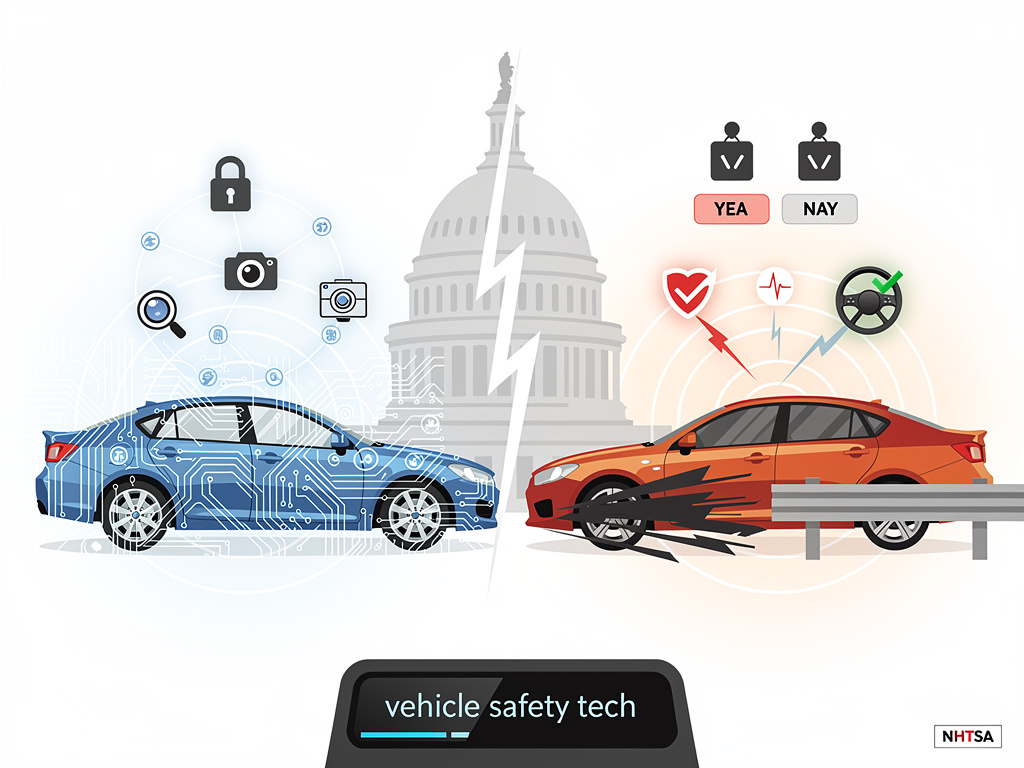
In a stark display of intraparty discord, 57 House Republicans voted alongside Democrats on January 22, 2026, to defeat Rep. Thomas Massie’s amendment aimed at defunding the Biden-era mandate for advanced impaired driving prevention technology in new vehicles. The amendment failed 164-268, preserving Section 24220 of the 2021 Infrastructure Investment and Jobs Act, which directs the National Highway Traffic Safety Administration to establish standards for systems that passively monitor drivers and limit operation if impairment is detected.
The vote, part of a larger $1.2 trillion spending package for departments including Transportation, ignited immediate backlash from conservative figures. Rep. Massie posted on X: “Unfortunately, the amendment I offered to defund the federally mandated automobile kill switch did not pass. 57 Republicans joined 211 Democrats to defeat it. Check the roll call to see how your Representative voted: https://clerk.house.gov/Votes/202643.” Florida Gov. Ron DeSantis decried the outcome, writing on X: “The idea that the federal government would require auto manufacturers to equip cars with a ‘kill switch’ that can be controlled by the government is something you’d expect in Orwell’s 1984, and yet…” (Fox News).
Rep. Keith Self, R-Texas, labeled the defection “Unbelievably disturbing,” asserting that the 57 Republicans ensured “the government can shut off your car whenever it wants” (Fox News).
The Mandate’s Origins and Technical Scope
Enacted in November 2021 as part of the bipartisan infrastructure law, Section 24220 requires NHTSA to prescribe a federal motor vehicle safety standard mandating “advanced drunk and impaired driving prevention technology” in all new passenger vehicles. The systems must “passively and accurately monitor driver performance to detect impairment or passively and accurately measure driver blood alcohol concentration (BAC) (or both in combination) and prevent or limit vehicle operation if impairment is detected,” per the law’s text (Federal Register).
NHTSA issued an Advance Notice of Proposed Rulemaking in January 2024 but missed its November 2024 deadline for a final rule, citing challenges in distinguishing intoxication from fatigue, distraction, or medical conditions. No standard exists today, and implementation could begin as early as model year 2026 if finalized (Carscoops).
Potential technologies include cameras tracking eye movements, steering sensors, or touch-based BAC detectors, operating locally without cloud connectivity or government access, according to supporters. Critics warn of false positives stranding drivers and future expansions for surveillance (NewsNation).
Privacy Hawks Versus Safety Advocates
Massie argued the technology positions “your dashboard [as] judge, jury, and executioner,” questioning appeal processes if a vehicle shuts down erroneously. He highlighted NHTSA’s delays as evidence of unworkability (Carscoops). Rep. Harriet Hageman, R-Wyo., previously called it “a massive and likely unconstitutional rule and an invasion of privacy on a greater scale than we are used to seeing from our government” (IBTimes UK).
On the other side, Rep. Debbie Dingell, D-Mich., dismissed surveillance fears as “blatantly false,” emphasizing the law mandates no tracking or remote shutdowns mid-road. Proponents cite over 13,000 annual impaired driving deaths, positioning the tech as a passive evolution from post-DUI interlocks (Carscoops).
The divide pits libertarian-leaning “privacy hawks” like Massie, Chip Roy, and Scott Perry against moderates prioritizing road safety. Costs could add $500-$2,000 per vehicle, per automaker estimates, amid rising new car prices averaging $48,000 (CBT News).
Vote Breakdown and Conservative Backlash
Of the 164 “aye” votes for Massie’s amendment: 160 Republicans and 4 Democrats. The 268 “no” votes included 57 Republicans and 211 Democrats. The full roll call is at clerk.house.gov/Votes/202643 (Carscoops). No comprehensive public list of the 57 Republicans has circulated widely, but the tally exposed GOP fractures, with some Trump-endorsed members reportedly among them.
Rep. Marjorie Taylor Greene noted many defectors carry Trump endorsements, contrasting Massie’s outsider status. The spending package passed 341-88, funding NHTSA’s ongoing work without interruption (AOL).
X posts amplified outrage, with users sharing the roll call and decrying a “uniparty” enabling federal overreach. Massie has led prior fights, including a 2023 amendment failing 201-229 (NewsNation).
Legislative Pushback and NHTSA’s Path Forward
H.R. 1137, the No Kill Switches in Cars Act, sponsored by Rep. Scott Perry, R-Pa., seeks outright repeal of the mandate. Introduced February 7, 2025, it remains referred to the House Energy and Commerce Committee with no further action (Congress.gov). A 2022 Senate companion stalled in committee.
NHTSA reports “diligent” progress but faces hurdles in accuracy and public acceptance. Mothers Against Drunk Driving pushes for swift implementation, projecting 10,100 lives saved annually (MADD). Fact-checkers like AP note no police “kill switch” access exists in the law (AP News).
As 2026 models approach production, automakers test driver-monitoring systems. Privacy advocates warn of “kill switch jail”—lockouts without reset protocols—while supporters stress lifesaving potential without remote control (Blaze Media).
Broader Implications for Auto Industry and Drivers
For Detroit and global suppliers, compliance looms amid supply chain strains. Tech like Qualcomm’s in Rep. Mike Garcia’s district may influence moderate GOP votes. Insurance firms eye data access, raising misuse fears (Car Coach Reports).
Drivers face potential stranding on highways from glitches, no mandated appeals, and higher costs. Conservatives frame it as civil liberties erosion; the vote signals insufficient GOP unity to halt it pre-2026, shifting battles to Senate appropriations or standalone bills (Roll Call).
The episode underscores tensions in a GOP controlling Congress, balancing safety mandates against surveillance risks in an era of connected vehicles.


 WebProNews is an iEntry Publication