
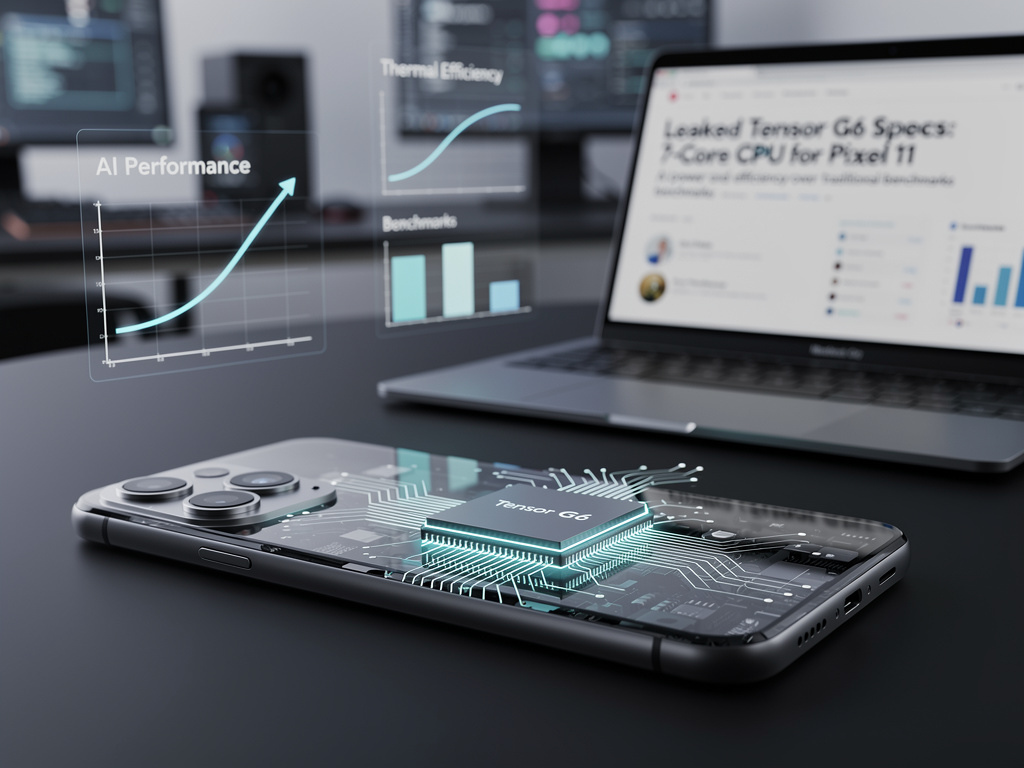
A fresh leak surrounding Google’s next-generation Tensor G6 processor has surfaced, offering the most detailed look yet at the silicon that will power the Pixel 11 series expected later this year. The leaked specifications suggest a 7-core CPU configuration — a notable departure from the 8-core and 9-core designs that have dominated recent smartphone chipsets — raising pointed questions about Google’s strategy for balancing power efficiency, thermal management, and raw performance in its flagship phones.
The information, first reported by MSN, draws on details that appear to have originated from supply chain documentation and benchmark database entries. According to the leak, the Tensor G6 will feature a tri-cluster CPU architecture composed of one high-performance prime core, two mid-tier performance cores, and four efficiency cores. This 1+2+4 arrangement totals seven cores, a configuration that stands apart from Qualcomm’s Snapdragon 8 Elite and MediaTek’s Dimensity 9400, both of which employ eight or more cores.
A Deliberate Break From the Core Count Arms Race
For years, the mobile processor industry has operated under an unspoken assumption: more cores translate to better multitasking and higher benchmark scores. Qualcomm’s latest Snapdragon 8 Elite, for instance, uses an octa-core design with two prime Cortex-X925 cores and six performance cores. MediaTek’s Dimensity 9400 similarly packs in eight cores. Google’s apparent decision to go with seven cores signals that the company is prioritizing something other than headline specifications.
Industry analysts have long noted that Google’s Tensor chips are designed with machine learning and on-device AI workloads as the primary focus, rather than competing directly on CPU benchmarks. The Tensor G4, which powers the current Pixel 9 series, was criticized in some reviews for trailing Qualcomm and Apple in sustained CPU performance. But Google has consistently argued that its custom silicon is optimized for the specific tasks that matter most to Pixel users — photo processing, speech recognition, real-time translation, and increasingly, generative AI features powered by Gemini Nano.
What the 7-Core Layout Might Actually Mean for Users
The 1+2+4 configuration hints at a design philosophy that values thermal headroom and power efficiency over brute-force multi-threaded throughput. By reducing the total core count by one compared to a traditional octa-core layout, Google may be freeing up die space and thermal budget for other components — most likely a larger or more capable tensor processing unit (TPU) or neural processing unit (NPU) dedicated to AI tasks.
This approach would be consistent with Google’s broader corporate strategy. The company has invested heavily in on-device AI capabilities, and the Pixel 11 is expected to ship with an expanded version of Gemini Nano that can handle more complex queries, longer context windows, and multimodal inputs without requiring a cloud connection. A beefier NPU, enabled by the space saved from dropping a CPU core, could be the engineering trade-off that makes those features possible.
The Samsung Foundry Question Looms Large
One of the most closely watched aspects of the Tensor G6 is its manufacturing process. Previous Tensor chips have been fabricated by Samsung Foundry, and the results have been mixed. The Tensor G3 and G4 both suffered from thermal throttling issues that reviewers and users attributed in part to Samsung’s less efficient process nodes compared to TSMC, which manufactures chips for Apple, Qualcomm, and MediaTek.
Reports from earlier this year, including coverage by 9to5Google, indicated that Google has been exploring a potential shift to TSMC for future Tensor generations. However, the timeline for such a transition remains unclear. If the Tensor G6 is still manufactured on Samsung’s 3nm GAA (Gate-All-Around) process, the 7-core design could be a pragmatic response to the thermal constraints of that node. Fewer active cores generating heat at any given time would help keep the chip within its thermal envelope, potentially eliminating the throttling complaints that have dogged previous Pixel flagships.
Benchmark Leaks Paint an Incomplete Picture
Some early benchmark entries that appear to correspond to the Tensor G6 have shown up in databases like Geekbench, though their authenticity has not been independently verified. The numbers suggest modest single-core improvements over the Tensor G4, with more significant gains in multi-core workloads despite the reduced core count. This would imply that the individual cores themselves — likely based on newer Arm Cortex-A or Cortex-X IP — are substantially more powerful than their predecessors.
It is worth contextualizing these leaks carefully. Pre-release benchmark scores are often derived from engineering samples running unfinished software, and they can change significantly before a device ships. Google also tends to tune its chips aggressively through software updates after launch, meaning Day 1 performance may not reflect the chip’s full potential. Still, the early data points suggest that Google is not simply cutting corners by reducing the core count — it appears to be making a calculated engineering decision.
How the Pixel 11 Lineup Could Shape Up
Based on Google’s recent product cadence, the Pixel 11 series is expected to include at least three models: a standard Pixel 11, a Pixel 11 Pro, and a Pixel 11 Pro XL. All three are likely to share the same Tensor G6 processor, as Google has done with previous generations. The differentiation between models will likely come from camera hardware, display size and quality, RAM allocation, and battery capacity.
Recent reporting from Android Authority suggests that the Pixel 11 Pro models may feature upgraded camera sensors and improved video capabilities, areas where the Tensor chip’s image signal processor (ISP) and machine learning accelerators play a significant role. If Google has indeed allocated more die area to AI and media processing at the expense of a CPU core, the camera improvements could be substantial — and that would align with the Pixel brand’s longstanding identity as a computational photography leader.
Google’s Broader AI Hardware Ambitions
The Tensor G6 does not exist in isolation. Google’s hardware division is increasingly intertwined with its AI research efforts, and the Pixel phone serves as a consumer-facing showcase for technologies that also power Google’s cloud services, search products, and enterprise AI tools. The company’s custom TPU chips for data centers have given it deep expertise in designing silicon specifically for machine learning workloads, and that expertise flows directly into the Tensor mobile chip program.
At Google I/O 2025, the company emphasized on-device AI as a key differentiator for its hardware products. Features like Circle to Search, Call Screen, and real-time transcription in the Recorder app all depend on the Tensor chip’s AI processing capabilities. The Tensor G6’s apparent design priorities — favoring AI acceleration over raw CPU core count — suggest that Google plans to double down on these capabilities with the Pixel 11 generation.
What Competitors Are Doing Differently
Apple’s A18 Pro chip, powering the iPhone 16 Pro series, takes a different approach with a 6-core CPU (2 performance + 4 efficiency) paired with a powerful Neural Engine. Apple has long demonstrated that core count alone is a poor predictor of real-world performance, and its chips consistently lead in single-threaded benchmarks despite having fewer cores than many Android competitors. Google may be taking a page from Apple’s playbook by focusing on per-core performance and specialized accelerators rather than raw core count.
Qualcomm, meanwhile, continues to push for maximum CPU performance with its Snapdragon 8 Elite and the upcoming Snapdragon 8 Elite Gen 2. The company’s Oryon custom cores have narrowed the gap with Apple’s designs, and Qualcomm has shown no inclination to reduce core counts. This sets up an interesting competitive dynamic: if Google’s Tensor G6 can deliver a meaningfully better AI experience while trailing in traditional benchmarks, it will test whether consumers value AI features over spec-sheet bragging rights.
The Stakes for Google’s Hardware Division
The Pixel line has grown steadily in market share, particularly in North America and parts of Europe, but it remains a niche player compared to Samsung and Apple. Google’s hardware division does not need to win the specifications war — it needs to offer a compelling, differentiated experience that justifies the Pixel’s existence alongside Android phones from Samsung, OnePlus, and others that use Qualcomm silicon.
The Tensor G6’s 7-core configuration, if confirmed, represents a clear statement of intent: Google is building chips for its own software, not for benchmark charts. Whether that bet pays off will depend on how well the Pixel 11’s AI features perform in daily use, how effectively Google manages thermals and battery life, and whether consumers notice the difference. The phone is expected to launch in the fall of 2025, and more details will likely emerge in the coming months as the supply chain ramps up production.


 WebProNews is an iEntry Publication