
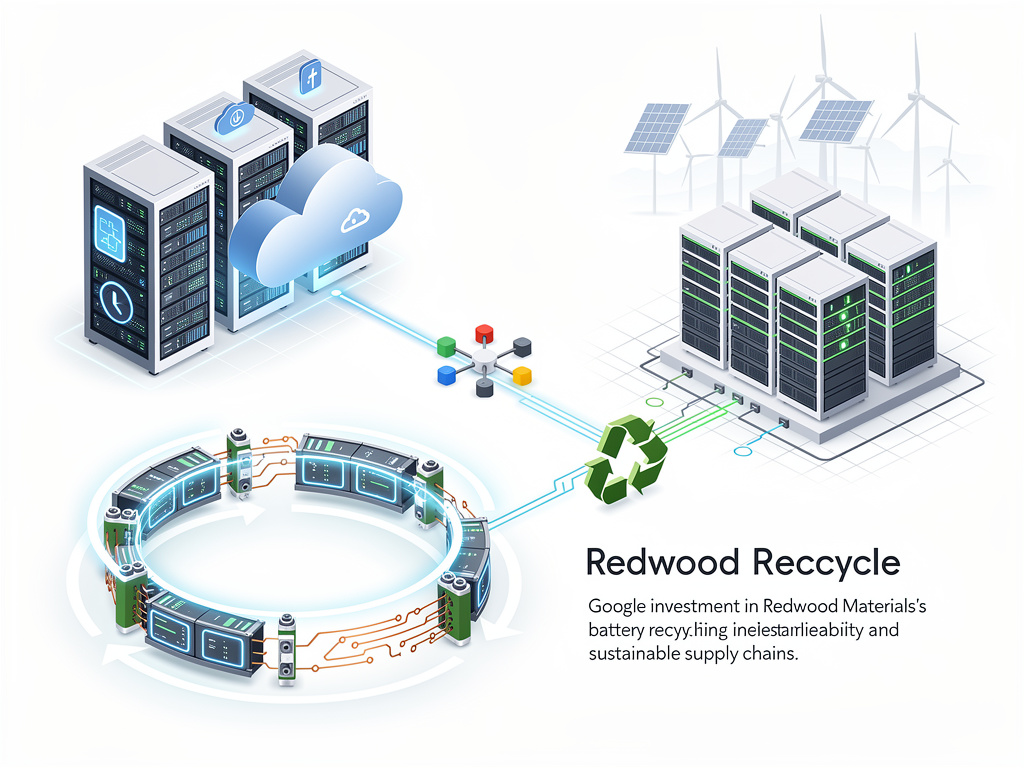
In a move signaling Silicon Valley’s growing commitment to sustainable technology infrastructure, Google has emerged as a key investor in Redwood Materials’ latest funding round, marking a significant convergence between digital technology giants and the circular economy movement. The investment, which positions the search giant alongside traditional venture capital firms in backing battery recycling innovation, represents more than just financial support—it reflects a fundamental shift in how technology companies are addressing their long-term supply chain vulnerabilities and environmental obligations.
According to Business Insider, Google’s participation in Redwood Materials’ 2026 funding round underscores the increasing strategic importance of battery recycling infrastructure as artificial intelligence and cloud computing operations demand ever-greater energy storage capabilities. The investment comes at a critical juncture when technology companies face mounting pressure to secure sustainable sources of critical minerals while simultaneously reducing their carbon footprints.
Redwood Materials, founded by former Tesla co-founder JB Straubel, has positioned itself at the nexus of electric vehicle adoption and renewable energy storage, two sectors experiencing exponential growth. The company’s closed-loop battery recycling process recovers valuable materials including lithium, cobalt, nickel, and copper—elements that are not only expensive but increasingly subject to geopolitical supply constraints. For Google, which operates massive data centers requiring substantial backup power systems and is investing heavily in AI infrastructure, securing a reliable domestic source of battery materials represents both economic prudence and strategic foresight.
The Economics of Battery Recycling and Tech’s Energy Appetite
The financial calculus behind Google’s investment extends beyond simple environmental altruism. Data centers, which form the backbone of Google’s search, cloud, and AI operations, consume enormous amounts of electricity and require sophisticated battery backup systems to ensure uninterrupted service. As the company expands its AI capabilities—particularly with its Gemini platform competing against OpenAI’s offerings—the demand for reliable, sustainable energy storage solutions has intensified dramatically.
Industry analysts estimate that the global battery recycling market will reach $35 billion by 2030, driven primarily by the proliferation of electric vehicles and energy storage systems. Redwood Materials has strategically positioned itself to capture a significant portion of this market by establishing facilities near both battery production plants and end-of-life vehicle processing centers. The company’s Nevada facility, located near Tesla’s Gigafactory, processes thousands of tons of battery materials annually, creating a domestic supply chain that reduces dependence on foreign mineral sources.
Google’s investment thesis likely considers the volatility in critical mineral markets. Lithium prices, for instance, have experienced dramatic fluctuations over the past three years, with spot prices soaring above $80,000 per ton in 2022 before retreating. By securing a stake in Redwood Materials, Google gains indirect exposure to a stabilizing force in battery material supply chains while supporting infrastructure that could eventually service its own operations. The company’s data centers already utilize battery storage systems for backup power, and as renewable energy integration increases, the need for large-scale storage solutions will only grow.
Strategic Alignment with Sustainability Commitments
Google has publicly committed to operating on carbon-free energy by 2030, an ambitious goal that requires not just renewable energy procurement but also sophisticated energy storage and management systems. The Redwood Materials investment aligns perfectly with this objective, providing a pathway to ensure that the batteries powering Google’s operations—from data centers to its growing fleet of autonomous vehicle projects—come from sustainable, circular sources rather than environmentally destructive mining operations.
The environmental credentials of battery recycling are compelling. Redwood Materials claims its process can recover up to 95% of critical minerals from spent batteries, significantly reducing the need for virgin material extraction. Mining operations for lithium and cobalt have faced scrutiny for their environmental impact and, in some cases, questionable labor practices. By investing in recycling infrastructure, Google can credibly argue it’s addressing these concerns while building resilience into its supply chain.
This investment also positions Google favorably within the broader ESG (Environmental, Social, and Governance) framework that increasingly influences corporate valuations and investor sentiment. Technology companies have faced criticism for the environmental impact of their operations, particularly regarding energy consumption. Supporting circular economy initiatives like battery recycling provides tangible evidence of commitment to sustainability beyond carbon offset purchases or renewable energy credits.
The Competitive Implications for Big Tech
Google’s move into battery recycling investment doesn’t occur in isolation. The broader technology sector has awakened to the strategic importance of controlling critical supply chains, particularly as competition in AI and cloud computing intensifies. Amazon, Microsoft, and other tech giants have made similar moves into energy infrastructure, recognizing that computational power increasingly depends on energy availability and storage capacity.
Microsoft, for example, has invested heavily in nuclear energy projects to power its data centers, while Amazon has become the largest corporate purchaser of renewable energy globally. Google’s investment in Redwood Materials represents a complementary approach—rather than just securing energy generation, it’s investing in the storage and recycling infrastructure that makes renewable energy viable at scale. This strategic differentiation could provide competitive advantages as energy costs and availability become more critical factors in AI development and deployment.
The timing of this investment is particularly noteworthy given the ongoing AI arms race. Training large language models and operating AI services requires massive computational resources, which in turn demand reliable power infrastructure. Any advantage in energy costs or reliability translates directly into competitive positioning. By investing in battery recycling, Google is essentially making a long-term bet that control over energy storage supply chains will matter as much as chip design or algorithm development in determining AI leadership.
Regulatory Tailwinds and Policy Alignment
The investment also benefits from favorable regulatory conditions. The Inflation Reduction Act and Infrastructure Investment and Jobs Act have created substantial incentives for domestic battery production and recycling. Redwood Materials has positioned itself to capitalize on these policies, which provide tax credits and grants for facilities that process critical minerals domestically. Google’s investment amplifies its ability to influence and benefit from these policy frameworks.
European regulations are moving even more aggressively toward mandatory battery recycling and circular economy requirements. The EU’s proposed Battery Regulation would require minimum levels of recycled content in new batteries and establish collection and recycling targets. As a global company, Google must navigate these varying regulatory environments, and investment in leading recycling technology provides flexibility and compliance pathways across jurisdictions.
Furthermore, national security considerations around critical mineral supply chains have elevated battery recycling from an environmental issue to a strategic priority. The U.S. government has identified lithium, cobalt, and other battery materials as critical to national security, creating additional policy support for domestic recycling infrastructure. Google’s investment aligns with these priorities, potentially opening doors for government partnerships or preferential treatment in future policy initiatives.
The Broader Implications for Circular Economy Investment
Google’s participation in Redwood Materials’ funding round signals a maturation of circular economy investing. What began as a niche environmental concern has evolved into a mainstream investment thesis backed by some of the world’s most sophisticated capital allocators. When a company of Google’s stature invests in recycling infrastructure, it validates the economic viability of circular business models and potentially catalyzes additional capital flows into the sector.
The investment also highlights how technology companies are expanding their strategic aperture beyond traditional software and hardware concerns. Google’s core business remains advertising and cloud services, yet it’s now directly investing in physical infrastructure for material recovery and processing. This vertical integration impulse reflects lessons learned from supply chain disruptions during the pandemic and ongoing geopolitical tensions that threaten access to critical materials.
For Redwood Materials, Google’s participation brings more than just capital. The tech giant’s operational expertise in logistics, data analytics, and process optimization could prove invaluable as the recycling company scales its operations. Google’s machine learning capabilities, for instance, could potentially optimize sorting and processing operations, while its logistics expertise could improve collection networks. These synergies suggest the relationship may evolve beyond simple financial investment into deeper operational collaboration.
Looking Ahead: The Future of Tech-Backed Sustainability Infrastructure
As technology companies confront the physical limitations of their growth—whether energy availability, material supply, or environmental constraints—investments like Google’s stake in Redwood Materials will likely become more common rather than exceptional. The digital economy ultimately rests on physical infrastructure, and securing sustainable sources of critical materials represents prudent long-term planning.
The success of this investment will be measured not just in financial returns but in its contribution to building resilient, sustainable supply chains for the technology sector. If Redwood Materials can demonstrate that recycled battery materials can compete economically with virgin minerals while providing supply chain security and environmental benefits, it will validate a model that other technology companies will rush to replicate. Google’s early-mover advantage in this space could translate into preferential access to recycled materials, lower costs, and enhanced sustainability credentials that resonate with customers and regulators alike.
The convergence of technology capital and circular economy infrastructure represents a potentially transformative development in how industries address sustainability challenges. Rather than treating environmental concerns as compliance costs or public relations exercises, companies like Google are recognizing that sustainable infrastructure can provide genuine competitive advantages. As the energy demands of AI and cloud computing continue to escalate, those companies that have secured sustainable, resilient supply chains for critical materials will be better positioned to capitalize on growth opportunities while managing regulatory and reputational risks. Google’s investment in Redwood Materials may well be remembered as an early example of this strategic evolution, where sustainability and competitive advantage finally aligned in ways that mobilize serious capital and operational commitment.


 WebProNews is an iEntry Publication