
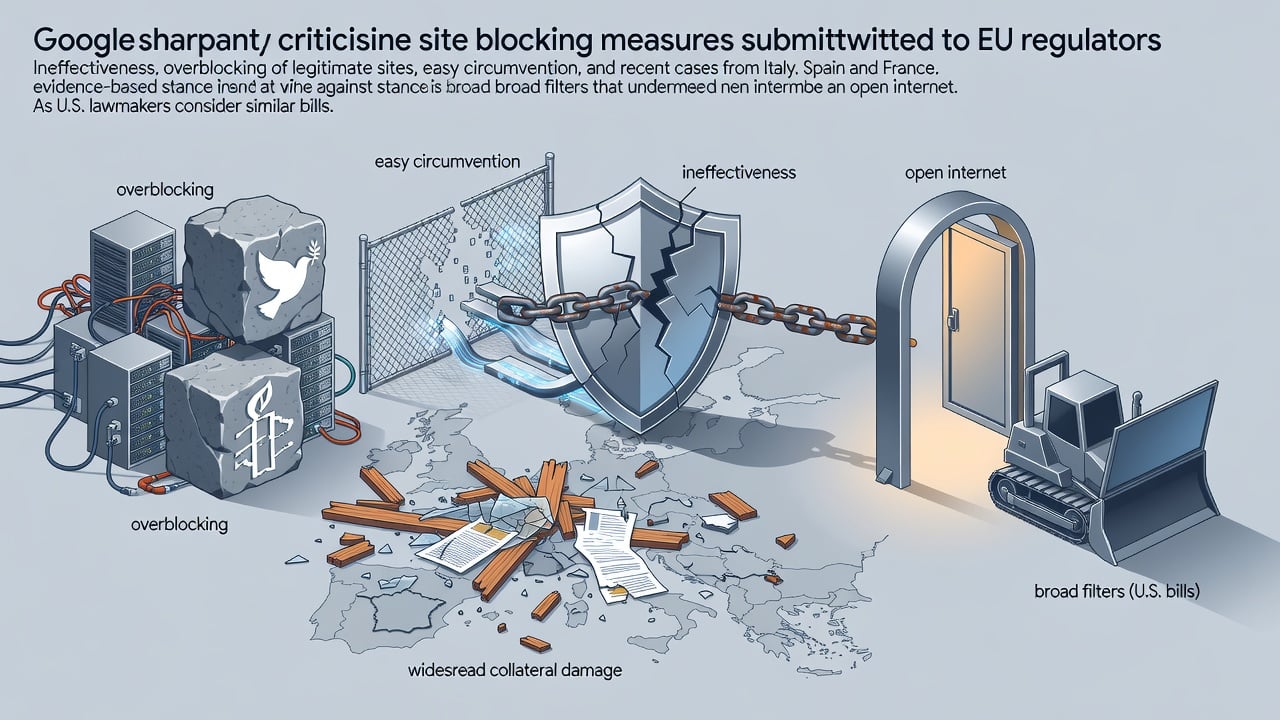
Google has taken a firm position against the growing push for site blocking measures in Europe. The search giant submitted detailed comments to the European Commission’s review of the 2019 Copyright Directive. In those filings, company officials argue that orders requiring DNS resolvers, VPNs or shared IP addresses to block access to piracy sites cause more damage than they prevent.
The timing feels deliberate. Google’s input landed just days before a U.S. House Intellectual Property Subcommittee hearing on June 30, 2025, where lawmakers examined similar enforcement tools. Rep. Darrell Issa, a California Republican, pledged to introduce legislation targeting online piracy through upstream blocks. Yet across the Atlantic, Google sees red flags everywhere.
“Blocking DNS resolvers, IPs, VPNs, is ineffective, as it does not remove content at all and is easily circumvented by using alternative DNS resolvers,” Google stated in the submission, according to TorrentFreak. The company added that such actions prove “disproportionate, catching lawful services, raising extra-territoriality concerns and blocking entire domains.”
Short point. These aren’t abstract worries.
Real cases illustrate the fallout. Italy’s Piracy Shield system blocked Cloudflare IP addresses that hosted more than 42 million domains. It also took down a Google Drive subdomain and disrupted legitimate VPN and content delivery services. French authorities once ordered Cisco to suspend OpenDNS after a court directive. In Portugal back in 2019, blocking a Google virtual IP address interrupted core operations and affected innocent customers across the board.
An independent study by the Open Observatory of Network Interference, or OONI, captured the scale in Spain. After a LaLiga sports rights holder secured an IP block during live broadcasts, more than 554,000 domains became unreachable. The list included Amnesty International, the ACLU, UNICEF, UNHCR, the Australian Senate and even the Stanford Law Review. Lawful speech vanished alongside the intended targets.
Google doesn’t reject every form of enforcement. The company says it supports targeted blocks when they meet strict standards. Courts must treat blocking as a last resort. Orders need transparency, time limits and shared costs between rights holders and intermediaries. Without those guardrails, the measures invite overreach and collateral damage that chills expression and commerce alike.
And here’s where the arguments gain force. Pirates adapt quickly. They shift to new domains, mirror sites or alternative resolvers. Users turn to VPNs or proxy services within minutes. The content stays online. The broader internet takes the hit. Mashable detailed how upstream providers like Google and Cloudflare would need DNS filtering combined with IP and VPN blocks to comply with recent French court orders on illegal streaming sites. Those methods sweep too broadly. They resemble trawling the ocean for minnows and ensnaring dolphins in the process.
Recent developments add urgency. A Spanish court-ordered IP block in the ongoing EU review process disrupted third-party platforms, cloud services, APIs and small business sites, as reported in a July 2026 analysis by PiracyMonitor.org. AI platforms including Anthropic and OpenAI also weighed in on the Copyright Directive consultation. Their focus centered on how automated systems and filters could distort markets for legitimate content.
But consumer behavior tells another story. Google pointed to unmet demand as a primary piracy driver. “In our experience, unmet consumer demand is a key driver of piracy,” the submission noted. “That is why one of the best ways to combat piracy is to provide better, more convenient, and legitimate alternatives.” Streaming services have multiplied. Prices climbed. Ads appeared. Content spread across too many apps. The result? A reported piracy resurgence that some observers call a renaissance fueled by fragmentation.
The Electronic Frontier Foundation backed Google’s critique. The digital rights group warned that EU efforts risk locking users behind big tech gates through mandatory filters and blocks. EFF positions echo earlier fights over Article 13 of the Copyright Directive, which once pushed for upload filters that many feared would overblock lawful material.
Across the ocean the debate feels familiar. The 2012 protests against the Stop Online Piracy Act and PROTECT IP Act mobilized Google, Wikipedia and others in a coordinated blackout. Those bills died amid fears of broken internet infrastructure and censored speech. Now, with the Supreme Court decision in Cox v. Sony intensifying pressure on intermediaries, some U.S. lawmakers see site blocking as an overdue tool. The Software and Information Industry Association offered mixed testimony at the House hearing. Its representatives called for judicial oversight and precision before any new mandates take hold.
The Internet Infrastructure Coalition, through its DNS at Risk campaign, highlighted how global blocking orders create impossible compliance burdens. Major DNS providers hesitate to apply nationwide or worldwide restrictions that affect users far beyond the issuing jurisdiction. Google invested heavily in technology to localize blocks. Few others possess similar resources. The result leaves smaller players exposed or forces them from certain markets entirely.
Critics of Google’s stance point to persistent piracy losses for creators and sports leagues. Rights holders argue that without effective enforcement against offshore sites, legitimate markets suffer. Yet evidence on blocking efficacy remains mixed. Academic reviews often find short-lived gains that fade as operators migrate. Sustained impact appears only when paired with affordable legal options and coordinated international action.
Google’s position carries weight precisely because the company operates at internet scale. It runs one of the world’s largest DNS services. It hosts vast content platforms. Its economic incentives align with an open web that encourages discovery and traffic. Blocking orders shift costs and risks onto those platforms while delivering uncertain benefits to copyright owners.
So what comes next? The European Commission’s review of the Copyright Directive could shape policy for years. If officials heed the warnings, they might tighten criteria for blocking orders and emphasize proportionality. They could prioritize notice-and-takedown improvements, faster cross-border cooperation or incentives for better licensing deals.
In the United States, momentum builds for legislation. Rep. Zoe Lofgren has worked on a framework called FADPA that seeks compromise. Whether any bill survives the competing interests remains unclear. Tech companies, content industries and civil society all stake claims.
One truth stands out. Blanket site blocking rarely solves the underlying problem. It treats symptoms while ignoring demand, pricing, convenience and global enforcement gaps. Google’s rationales, grounded in operational experience and documented failures, offer a cautionary map. Policymakers would do well to study the collateral damage before expanding these powers.
The internet’s architecture rewards connectivity over control. Attempts to wall off corners often ripple farther than intended. As governments on both sides of the Atlantic weigh tougher measures, the debate hinges on balance. Protect creators. Preserve access. Avoid turning infrastructure providers into de facto censors. Get that balance wrong, and everyone pays the price.


 WebProNews is an iEntry Publication