
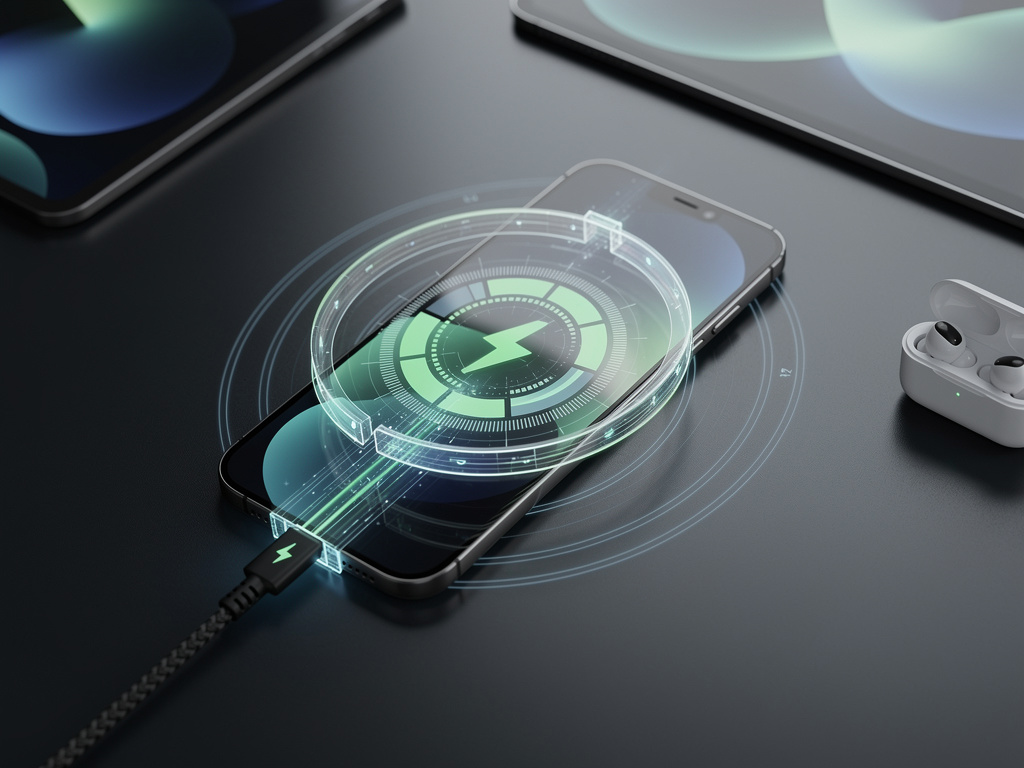
You’re running late. Your phone is at 14%. The Uber is seven minutes away, and you need that phone to get through a packed day of meetings, navigation, and calls. You plug it in, hoping for a miracle. Google, it turns out, has been quietly working on exactly that miracle.
A previously unreported feature buried in the code of Google’s latest software updates reveals that the company is developing what it calls “Priority Charging” — a mode designed to override the battery-preserving charging limits that modern Android phones impose and instead flood the battery with power as fast as the hardware allows. The discovery, first reported by Digital Trends, points to a significant rethinking of how smartphones balance long-term battery health against the immediate, sometimes desperate needs of their owners.
The tension at the heart of this feature is one that every smartphone user has felt but few fully understand. For years, Google and Apple have been training phones to charge more slowly and more carefully, capping battery levels at 80% in some modes, throttling charging speeds during overnight sessions, and using machine learning to predict when a user will unplug. All of this is designed to extend the chemical lifespan of lithium-ion cells, which degrade faster when pushed to full capacity repeatedly or charged at high speeds. It works. But it also means that when you genuinely need a full battery in 20 minutes, your phone’s own intelligence gets in the way.
Priority Charging appears to be Google’s answer to that problem.
According to code strings unearthed from recent Google Play Services updates and analyzed by developer-focused outlets, the feature would allow users to manually tell their Pixel phone — and potentially other Android devices — that speed matters more than longevity right now. When activated, the phone would disable its adaptive charging protections, push past the 80% optimization cap, and charge at the maximum rate the hardware and charger support. The language found in the code describes it as a mode for “rush scenarios,” a phrasing that suggests Google envisions this as an occasional override rather than a default setting.
That distinction matters enormously. Battery degradation from fast charging isn’t a myth or a marginal concern. Lithium-ion batteries lose capacity when subjected to high current, high heat, and sustained high voltage — all conditions that fast charging creates. Research published in the Journal of The Electrochemical Society has consistently shown that charging a lithium-ion cell to 100% at maximum speed, especially in warm ambient conditions, accelerates the formation of solid electrolyte interphase layers and lithium plating on the anode. Over hundreds of cycles, this translates into noticeable capacity loss. Google’s existing Adaptive Charging feature, introduced with the Pixel 4 in 2019 and refined since, was built specifically to mitigate these effects by learning a user’s routine and slowing the charge to reach 100% just before the alarm goes off.
So why build a feature that deliberately undermines those protections? Because real life doesn’t follow routines.
The answer lies in a growing body of user feedback and behavioral data suggesting that battery optimization features, however well-intentioned, frustrate users in unpredictable situations. A traveler whose flight gets moved up. A parent who forgot to charge overnight. A delivery driver between shifts. These aren’t edge cases. They’re Tuesday. And when the phone’s own software prevents a rapid top-up in those moments, the optimization feels less like a feature and more like an obstacle.
Google isn’t the first company to grapple with this. Apple introduced Optimized Battery Charging with iOS 13 in 2019 and has since expanded it to include an 80% charging limit option. But Apple’s implementation has drawn criticism for being opaque — users sometimes find their iPhones stuck at 80% with no clear way to override the behavior quickly. Samsung’s Galaxy devices offer a similar battery protection toggle, but it’s buried in settings and requires manual switching that most users don’t think about until they’re already in a rush. OnePlus and other Chinese manufacturers have taken yet another approach, offering blazingly fast charging speeds — some exceeding 100 watts — while relying on proprietary battery chemistry and dual-cell designs to manage heat and degradation.
What makes Google’s Priority Charging concept different is the framing. Rather than asking users to permanently choose between battery health and charging speed, it creates an explicit, intentional toggle for exceptional circumstances. Think of it as the smartphone equivalent of sport mode in a car: you know it burns more fuel, but sometimes you need the acceleration.
The technical implementation, based on the code analysis reported by Digital Trends, appears straightforward. When a user activates Priority Charging, the system would suspend Adaptive Charging algorithms, remove the 80% cap if one is set, and allow the charging controller to draw maximum current from the connected power source. On current Pixel hardware, that means up to 30 watts via USB Power Delivery on the Pixel 9 Pro, though actual speeds depend on the charger and cable. The feature would likely include a warning about potential battery impact — the code strings reference informational prompts — and would presumably revert to normal adaptive behavior once deactivated or after the phone reaches full charge.
There’s no confirmed timeline for when Priority Charging will ship to consumers. Google has not publicly acknowledged the feature, and code discoveries don’t always translate into released products. Android’s development history is littered with features that appeared in code teardowns and never materialized. But the level of detail found in the current strings — including user-facing descriptions and toggle language — suggests this is more than a prototype. It’s being built for real people with real chargers and real deadlines.
The broader context here is a smartphone industry that has spent the better part of a decade optimizing for battery longevity, sometimes at the expense of user agency. That pendulum may be swinging back. Users are increasingly vocal about wanting control over their devices’ behavior, not just automation. The success of features like Apple’s manual 80% limit — which gives users a choice rather than making it for them — signals that the market is ready for more granular battery management tools.
And the timing aligns with hardware improvements that make aggressive charging less risky than it used to be. Silicon-carbon anode batteries, which companies like Samsung and CATL are pushing into mobile devices, offer better tolerance for fast charging and high state-of-charge cycling than traditional graphite anodes. Google’s own Pixel battery specifications have improved steadily, and the company’s partnership with Samsung SDI for cell manufacturing gives it access to some of the most advanced mobile battery technology available. A Priority Charging feature released alongside next-generation battery chemistry could carry less long-term penalty than the same feature would have imposed three years ago.
There’s also a competitive angle. Chinese smartphone manufacturers — Xiaomi, Oppo, OnePlus, Realme — have made charging speed a primary marketing differentiator. Xiaomi’s HyperCharge technology demonstrated a full charge in under 20 minutes as far back as 2021. These companies have conditioned a significant portion of the global Android market to expect near-instant charging. Google and Samsung, by contrast, have been comparatively conservative, prioritizing longevity over speed. Priority Charging doesn’t close that gap entirely, but it gives Pixel users an escape valve when they need one.
For enterprise and fleet device managers, the feature raises interesting questions. Companies that deploy large numbers of Android phones — in logistics, healthcare, field services — often struggle with charging discipline among workers. Devices get plugged in late, pulled off chargers early, and run to near-zero during shifts. A Priority Charging mode could be a practical tool for shift-change scenarios, but it could also accelerate fleet battery degradation if overused. Whether Google will offer MDM (mobile device management) controls to restrict or allow Priority Charging on managed devices remains to be seen, but it would be a logical addition.
The feature also fits into a larger pattern of Google using software intelligence to mediate hardware limitations. Pixel phones have long punched above their weight in camera quality through computational photography. The Tensor chip’s on-device AI capabilities power real-time transcription, call screening, and photo editing that compensate for hardware that doesn’t always match Apple or Samsung’s flagships spec-for-spec. Priority Charging extends that philosophy to power management: use software to give users the right behavior at the right time, even when the underlying hardware constraints haven’t changed.
But software-mediated hardware management only works if users trust the system. And trust, in the battery space, has been fragile ever since Apple’s 2017 throttling controversy, when the company was caught slowing down older iPhones with degraded batteries without informing users. The resulting backlash — including a $113 million settlement with U.S. states — established a clear consumer expectation: be transparent about what you’re doing to my battery, and give me the choice. Google’s approach with Priority Charging, at least based on the code evidence, appears to honor that expectation. It’s opt-in. It’s explained. And it puts the decision where it belongs — with the person holding the phone.
Whether this feature arrives in a Pixel Feature Drop later this year, ships with the Pixel 10, or gets folded into a broader Android 16 battery management overhaul, the underlying insight is sound. Smartphone battery management has been too paternalistic for too long. Users don’t need their phones to decide for them every time. Sometimes they just need the battery to charge as fast as it can, consequences be damned, because the car is outside and the day won’t wait.
Google, it seems, finally gets that.


 WebProNews is an iEntry Publication