
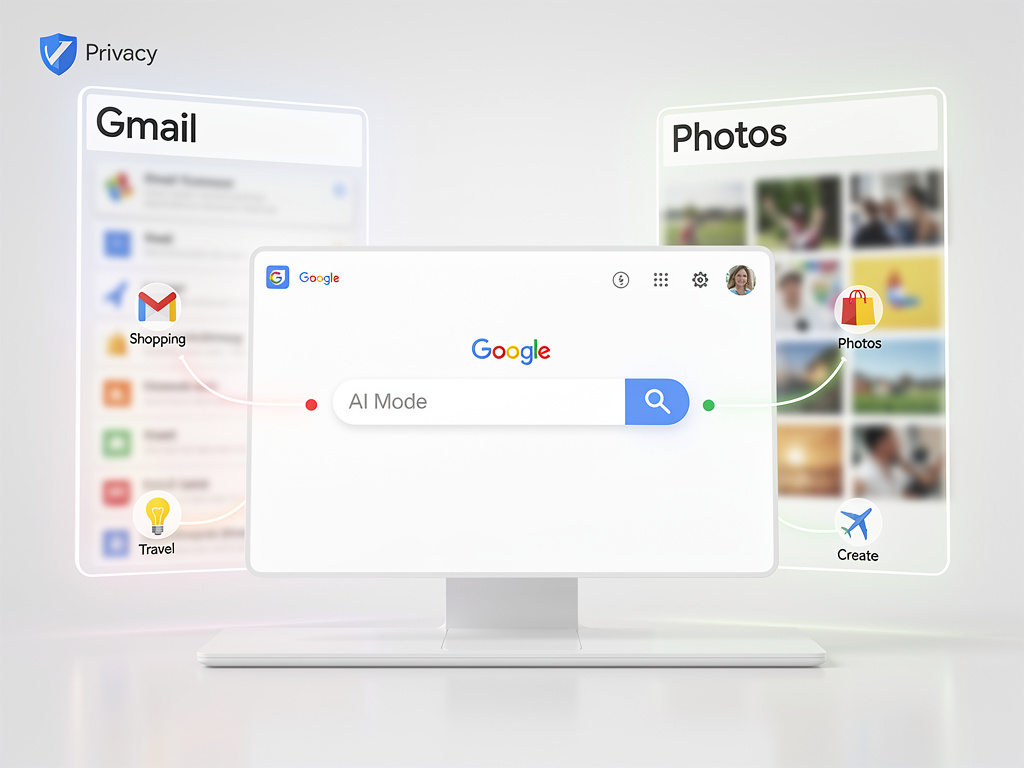
Google has infused its search engine with a dose of individual context, allowing AI Mode to draw from users’ Gmail inboxes and Google Photos libraries to deliver responses customized to personal habits and plans. Announced on January 22, 2026, this expansion of Personal Intelligence marks a pivotal shift for the company’s core product, blending vast public data with private insights for subscribers of its premium AI tiers.
Robby Stein, vice president of product for Google Search, detailed the rollout in a Google blog post, stating, “Starting today, Google AI Pro and AI Ultra subscribers can opt-in to securely connect Gmail and Google Photos to AI Mode.” The feature, powered by the Gemini 3 model, processes queries alongside connected account data without directly training on email or photo contents, limiting model improvement to prompts and responses.
Users activate it through Search Labs at labs.google.com/search/experiment/22, navigating profile settings to link apps. Available initially to English-speaking U.S. users with personal accounts—excluding Workspace, enterprise, or education plans—the opt-in design emphasizes control, with options to disconnect at any time or thumbs-down inaccurate suggestions.
Personalization Powers Everyday Queries
For shopping, AI Mode might spot a recent sneaker purchase in Gmail receipts and propose similar styles unseen before, as Stein illustrated. Travel searches gain depth too: a query for activities could reference hotel confirmations and past trip photos to recommend ice cream spots matching frequent selfie themes, per examples in the Search Engine Journal coverage.
Creative prompts benefit as well, such as planning family scavenger hunts informed by photo relationships or book picks aligned with life stages gleaned from emails. ABC News noted how the system recognizes preferred clothing from Photos or dining favorites, transforming generic results into intuitive aids.
This builds on Personal Intelligence’s Gemini app debut a week prior, connecting additional services like YouTube there, but Search focuses on Gmail and Photos for precision, according to 9to5Google.
Privacy Controls Anchor the Advance
Google stresses security: data access occurs only for relevant queries, with no broad scanning. “Users remain in control,” affirmed the company, allowing feedback to refine outputs. Training avoids private libraries, using solely interaction data to enhance functionality over time, as clarified in The Verge.
Industry observers highlight trust as key. Stein cautioned in his blog that responses “won’t always deliver the best answers,” urging corrections via prompts or symbols. For publishers, Search Engine Roundtable raised questions on traffic impacts if personalized answers reduce clicks, though Google has yet to disclose citation analytics.
Rollout progresses over days, with in-product invitations for eligible subscribers. Android Authority described it as evolving Search from global indexing to personal comprehension, blending web results with private context.
Strategic Push in AI Competition
At a time when rivals like OpenAI’s ChatGPT and Perplexity integrate user data, Google’s move leverages its ecosystem dominance—Gmail’s 1.8 billion users, Photos’ vast libraries—to fortify Search against erosion from conversational AI. Business Standard reported AI Mode’s natural interactions, including voice, images, and Lens, now amplified by personal signals.
Dataconomy outlined shopping aids via purchase history and flights, while Engadget emphasized non-training on private data. Early feedback on X from Stein himself encouraged trials, linking to his post at twitter.com/rmstein/status/2014367985402864089.
For enterprises, exclusion signals caution, focusing premium personal use. Gadgets 360 confirmed U.S.-only start, positioning it as an upgrade for heavy Gmail-Photos users.
Implications for Users and Markets
Travel planning exemplifies value: hotel bookings plus destination photos yield itineraries like weather-matched coats or family activities. Mint and GSMArena echoed opt-in rollout details, stressing manual activation paths.
Publishers watch warily; if context resolves queries internally, referral traffic could dip, per Search Engine Journal. Yet for consumers, it promises efficiency—fewer repetitive details, faster relevance. Yahoo Tech cited coat shopping tied to flights and styles.
Google’s bet: personalization cements loyalty amid AI disruption. As Digit.in analyzed, it shifts Search toward assistant-like decision support, with privacy safeguards enabling broader trust.
Road Ahead for Contextual Search
Future expansions loom, potentially adding Calendar or Drive, though unconfirmed. Current limits—U.S., English, premium—suggest measured scaling. Dataconomy quoted Stein on seamless life integration.
Regulators eye data use; opt-in mitigates concerns, but FTC scrutiny persists. User adoption will dictate success, with Labs feedback shaping iterations. News9live framed it as pushing Search into personalization’s core.
For industry insiders, this heralds search’s next era: not just information retrieval, but proactive, context-rich assistance powered by Google’s unparalleled data moat.


 WebProNews is an iEntry Publication