
Somewhere in the sprawling codebase of Google’s mobile software, engineers are building what amounts to a new vision for the car dashboard. Not with flashy press conferences or developer keynotes, but through a series of code changes buried in recent app updates — the kind of breadcrumbs that only the most dedicated teardown analysts tend to catch.
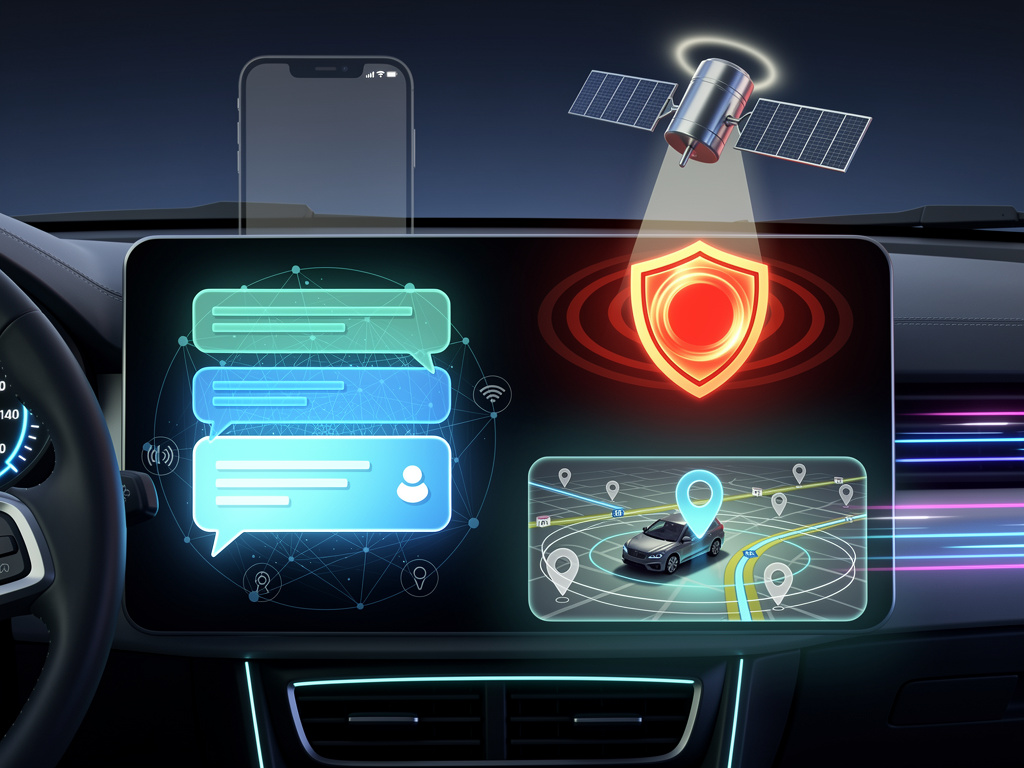
Three significant upgrades appear to be headed for Android Auto: an AI-powered summary feature for messages, satellite-based SOS connectivity for emergencies, and the ability to share your car’s location with contacts. Individually, each is a useful addition. Taken together, they represent Google’s most ambitious expansion of Android Auto’s capabilities in years — and a clear signal that the company sees the in-car experience as a frontline in its competition with Apple.
The findings come from code analysis performed by Android Police, which examined strings embedded in recent versions of the Google app (version 16.25.29 beta). These strings reference features that haven’t been officially announced but are developed enough to have user-facing text and descriptions already written. It’s the software equivalent of finding blueprints on a construction site before the building goes up.
AI Summaries, Satellite SOS, and Location Sharing: What the Code Reveals
The most immediately compelling feature is AI-generated message summaries. According to the code strings discovered by Android Police, Android Auto would use Google’s Gemini AI to create brief summaries of incoming messages, allowing drivers to understand the gist of a conversation without having the full text read aloud. A string reading “Summarized by AI” suggests these condensed versions would be clearly labeled, and drivers could still opt to hear the complete message if needed.
This is a smarter approach than what exists today. Current Android Auto implementations rely on Google Assistant reading messages verbatim — fine for a quick “running late” text, miserable for a group chat that’s been active for twenty minutes. An AI summary that distills a thread into its essential point could meaningfully reduce the cognitive load on drivers. And cognitive load, for anyone who’s fumbled with a car screen while merging onto a highway, is the whole ballgame.
Google has been aggressively threading Gemini through its product lineup for months, from search to Gmail to the Pixel’s on-device features. Bringing it to Android Auto feels inevitable, but the execution matters enormously. Summarization in a driving context has almost no margin for error. A hallucinated detail or a missed nuance in a message about picking up a child from school isn’t just an inconvenience — it’s a safety problem. How Google handles accuracy and user trust here will be telling.
The second feature is satellite-based emergency SOS. Code references point to integration with satellite connectivity for sending emergency messages when cellular service isn’t available. One string reads: “In an emergency, you may be able to send a message to emergency services via satellite when you don’t have cell service.” The feature appears to depend on hardware support from the connected phone, which currently limits it to the Pixel 9 series and its satellite-capable modem.
Apple introduced satellite SOS on the iPhone 14 in 2022. Google followed with its own implementation on the Pixel 9 in 2024. But neither company has extended the capability into their respective car platforms until now. For drivers in rural areas or on long stretches of highway with no cell coverage, this could be the difference between reaching help and not. The code suggests the system would guide users through positioning their phone to connect with overhead satellites — a process that currently requires a clear view of the sky and some patience.
Then there’s location sharing. The code indicates Android Auto will let drivers share their car’s real-time location with selected contacts, likely building on the existing Google Maps sharing infrastructure. This isn’t a new concept — Apple’s Find My and Google Maps already allow location sharing from phones — but surfacing it directly in the car interface removes friction. A parent tracking a teenager’s drive home. A partner checking whether you’re close to the restaurant. Small conveniences, but the kind that get used daily.
What makes these three features notable as a group is their orientation. They’re not about entertainment or media playback, the areas where Android Auto and Apple CarPlay have historically competed most visibly. They’re about safety, communication, and awareness. Google appears to be repositioning Android Auto from a phone-mirroring convenience into something closer to a vehicle intelligence layer.
The timing is interesting. Apple is preparing its next generation of CarPlay, which promises deeper integration with vehicle systems — climate controls, instrument clusters, seat adjustments. Google, meanwhile, has been pushing Android Automotive OS (a distinct product from Android Auto, built directly into vehicle hardware) to manufacturers like Volvo, Polestar, GM, and Ford. The two-track strategy lets Google compete on both fronts: Android Auto for the hundreds of millions of cars already on the road, Android Automotive for new vehicles rolling off assembly lines.
But the competition isn’t just with Apple. Amazon has been quietly expanding Alexa’s automotive presence through partnerships and its own Auto SDK. Chinese automakers, increasingly influential in global markets, are building proprietary software stacks that bypass both Google and Apple entirely. The dashboard has become contested territory in a way it wasn’t five years ago.
There’s also the question of carrier and manufacturer cooperation. Satellite SOS, in particular, requires alignment between Google, satellite network operators like Skylo (which powers the Pixel 9’s satellite features), and potentially automakers who might want to integrate the capability more deeply into vehicle systems. The code suggests the feature will work through the phone’s connection to Android Auto rather than through any vehicle-embedded hardware, which simplifies the rollout but limits it to users with satellite-capable devices.
For the AI summary feature, privacy will be a sticking point. Processing message content — even to summarize it — raises questions about where that processing happens. On-device inference, which Google has been investing in heavily through its Tensor chips, would keep message data local. Cloud-based processing would be faster and potentially more accurate but introduces data transmission concerns. The code strings don’t clarify which approach Google will take, though the company’s broader push toward on-device AI suggests it may favor the local route.
None of these features have been officially confirmed by Google, and code references don’t guarantee a feature will ship. Companies regularly experiment with capabilities that never reach users. But the level of detail in the strings — specific UI text, error states, user-facing descriptions — suggests these are well past the conceptual stage.
So when might they arrive? Google’s annual I/O developer conference and its fall hardware events have historically been launch windows for major Android Auto updates. The current beta version containing these strings is from mid-2025, which puts a public release plausibly in the second half of this year. Or later. Google’s track record with Android Auto feature rollouts has been, charitably, uneven. Features announced at I/O have sometimes taken months to appear on actual car screens.
What’s clear is that Google isn’t content to let Android Auto coast. The three features uncovered in this teardown — AI message summaries, satellite emergency communication, and real-time location sharing — suggest a product team that’s thinking about the car not just as a place where your phone shows up on a bigger screen, but as an environment with its own distinct needs and risks. That’s the right instinct. Whether Google can execute on it consistently, across the staggering variety of vehicles and head units that support Android Auto, is the harder question. It always has been.


 WebProNews is an iEntry Publication