
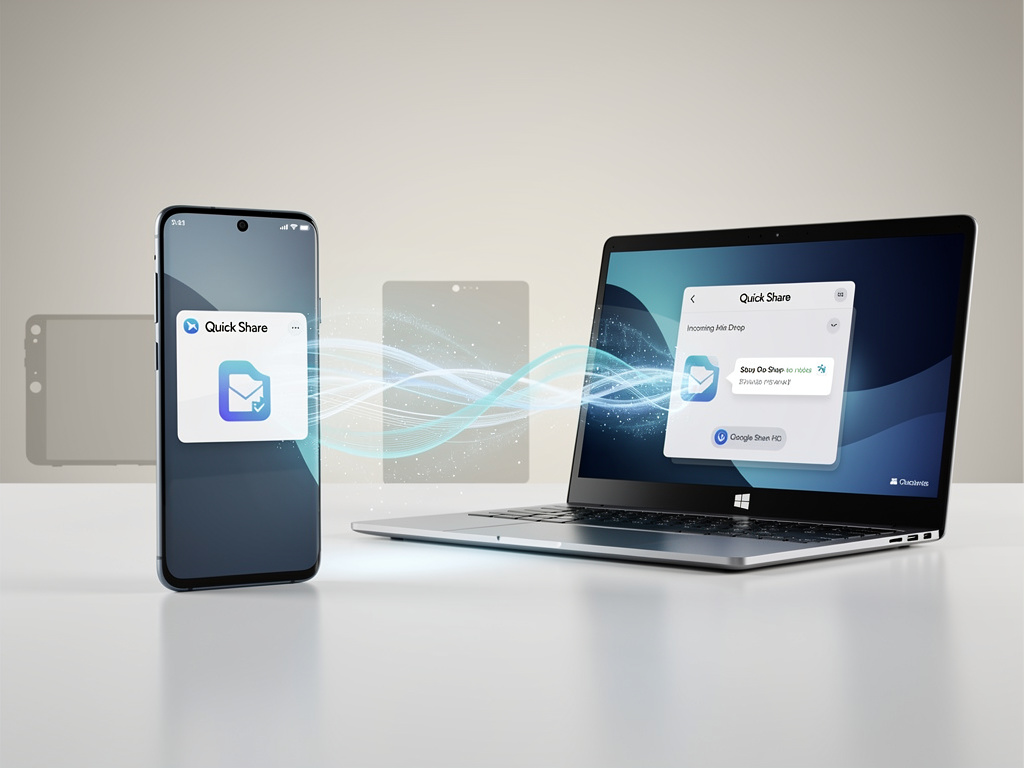
After years of Apple’s AirDrop dominance in seamless file sharing, Google has quietly revolutionized the cross-platform transfer experience with its Quick Share feature, now fully integrated across Android devices and Windows PCs. The evolution from the fragmented Nearby Share ecosystem represents a significant milestone for the tech giant’s interoperability strategy, potentially reshaping how billions of users exchange files across their digital devices.
The transformation addresses a long-standing pain point for Android users who have watched iOS device owners effortlessly share photos, documents, and videos through AirDrop while struggling with email attachments, messaging apps, or third-party solutions. According to Android Police, Google’s Quick Share has now reached feature parity with Apple’s solution, offering comparable speed and reliability while extending compatibility beyond Google’s ecosystem to include Windows machines.
The rebranding from Nearby Share to Quick Share, completed in early 2024, marked more than a cosmetic change. Google consolidated its file-sharing technology with Samsung’s proprietary system, creating a unified platform that works seamlessly across Samsung Galaxy devices, Pixel phones, and other Android manufacturers. This consolidation eliminated the confusion that previously plagued users attempting to share files between different Android brands, where Samsung devices used one system while Google and other manufacturers relied on another.
The Technical Architecture Behind Seamless Transfers
Quick Share employs a sophisticated combination of Bluetooth, Wi-Fi Direct, and peer-to-peer connectivity to establish secure, high-speed connections between devices. Unlike cloud-based sharing methods that require uploading files to remote servers before downloading them to the recipient’s device, Quick Share creates a direct connection between nearby devices. This approach not only accelerates transfer speeds but also enhances privacy by keeping files off third-party servers during transmission.
The system automatically negotiates the fastest available connection method based on device proximity and network conditions. For smaller files like contacts or text snippets, Bluetooth provides sufficient bandwidth while conserving battery life. Larger files such as 4K videos or high-resolution photo albums trigger the system to establish a Wi-Fi Direct connection, capable of transferring gigabytes of data in minutes rather than hours. The seamless handoff between connection types occurs transparently, requiring no user intervention or technical knowledge.
Windows Integration Breaks Down Platform Barriers
The introduction of Quick Share for Windows represents Google’s most ambitious cross-platform initiative since Chrome browser development. Windows users can now download a dedicated Quick Share application that integrates directly into the operating system’s sharing menu, appearing alongside native Windows sharing options. The implementation mirrors the Android experience, with a simple interface that displays nearby devices ready to receive files.
Installation requires minimal technical expertise—users download the application from Google’s official website, grant necessary permissions for Bluetooth and network access, and sign in with their Google account to enable device recognition. Once configured, the Windows PC appears in the Quick Share menu on nearby Android devices, and vice versa. The bidirectional functionality means users can initiate transfers from either their phone or computer, adapting to whichever device proves more convenient for the task at hand.
Performance Metrics and Real-World Applications
Testing conducted across various device combinations reveals impressive performance characteristics. A 500MB video file transfers from a Samsung Galaxy S24 to a Windows 11 laptop in approximately 45 seconds when both devices connect to the same Wi-Fi network. Even without shared network access, Wi-Fi Direct connections maintain respectable speeds, completing the same transfer in roughly 90 seconds. These speeds substantially outperform traditional methods like email attachments, which often impose file size restrictions, or cloud services that depend on upload and download speeds limited by internet connectivity.
The practical applications extend beyond simple file transfers. Photographers can immediately move RAW image files from their Android phones to Windows PCs for professional editing without cables or card readers. Business professionals share presentation files between devices during meetings without fumbling with USB drives or email chains. Students transfer research documents between their phones and laptops while moving between classes. The frictionless nature of these interactions fundamentally changes user behavior, making cross-device workflows feel natural rather than cumbersome.
Security Protocols and Privacy Considerations
Google implemented multiple security layers to protect user data during Quick Share transfers. All connections require explicit user approval on both sending and receiving devices, preventing unauthorized access to files. The system encrypts data in transit using industry-standard protocols, ensuring that even if someone intercepts the wireless signal, they cannot decode the file contents. Additionally, Quick Share operates on local networks or direct device-to-device connections, meaning files never pass through Google’s servers unless users explicitly choose cloud-based alternatives.
Privacy-conscious users appreciate the ephemeral nature of Quick Share connections. Unlike cloud storage services that retain files indefinitely or until manually deleted, Quick Share transfers leave no trace on intermediate systems. The receiving device stores the file locally, and the connection terminates immediately after successful transfer. Google cannot access, analyze, or monetize the transferred content, addressing concerns about data collection that plague many of the company’s other services.
Market Implications and Competitive Dynamics
The maturation of Quick Share intensifies competition in the file-sharing space, directly challenging Apple’s AirDrop supremacy while potentially undermining third-party solutions like Dropbox’s file transfer features or WeTransfer’s peer-to-peer offerings. For enterprise customers evaluating device ecosystems, Quick Share’s cross-platform capabilities reduce the penalty for maintaining heterogeneous device fleets mixing Android phones with Windows computers—a common configuration in businesses that haven’t fully committed to Apple’s ecosystem.
Samsung’s participation in Quick Share development proves particularly significant given the company’s position as the world’s largest Android device manufacturer. The collaboration ensures consistent implementation across hundreds of millions of devices, creating network effects that make Quick Share increasingly valuable as more users adopt compatible devices. This standardization contrasts sharply with the fragmented state of Android file sharing just two years ago, when multiple competing protocols created confusion and compatibility issues.
Adoption Challenges and User Education
Despite Quick Share’s technical capabilities, widespread adoption faces obstacles typical of new technologies requiring behavior change. Many Android users remain unaware of Quick Share’s existence or capabilities, continuing to rely on familiar but inferior methods like email attachments or messaging apps for file transfers. Google’s marketing efforts have not matched Apple’s promotion of AirDrop, resulting in lower awareness among mainstream consumers who might benefit most from the technology.
The Windows application’s separate download requirement creates an additional adoption hurdle. Unlike Android devices where Quick Share comes pre-installed, Windows users must actively seek out and install the application. This extra step, while minor, prevents the spontaneous discovery that drives adoption of pre-installed features. Google could accelerate uptake by partnering with PC manufacturers to pre-install Quick Share on new Windows machines, similar to how many laptops ship with manufacturer-specific utilities.
Future Development and Integration Opportunities
Google continues refining Quick Share with regular updates addressing user feedback and expanding functionality. Recent versions introduced the ability to share files with multiple recipients simultaneously, useful for distributing meeting notes or group photos. The development roadmap reportedly includes enhanced integration with Google’s productivity suite, potentially allowing users to quick-share Google Docs, Sheets, or Slides directly from the applications with automatic permission management.
The technology’s underlying architecture could extend beyond simple file transfers to enable more sophisticated cross-device interactions. Imagine seamlessly continuing a YouTube video from your phone on your PC, or dragging and dropping text between devices as if they shared a common clipboard. These scenarios become technically feasible with Quick Share’s existing connection infrastructure, requiring primarily software development rather than new hardware capabilities. Such features would further differentiate Quick Share from AirDrop while leveraging Google’s strength in cloud services and cross-platform application development.
The Shifting Paradigm of Device Interoperability
Quick Share’s emergence signals a broader industry trend toward breaking down the walls between competing ecosystems. For years, seamless cross-device experiences served as key differentiators that locked users into single-vendor ecosystems—Apple users stayed with Apple partly because AirDrop made their lives easier, while Android users faced friction when attempting similar workflows. Google’s investment in cross-platform compatibility challenges this paradigm, suggesting that openness and interoperability might prove more valuable than proprietary lock-in.
This philosophical shift carries implications beyond file sharing. As users increasingly expect their devices to work together regardless of manufacturer or operating system, companies that embrace interoperability may gain competitive advantages over those maintaining closed ecosystems. Google’s Android platform, already more open than iOS by design, positions the company well to lead this transition. However, success requires more than technical capability—it demands sustained marketing, user education, and ongoing refinement based on real-world usage patterns. Quick Share provides the foundation, but realizing its full potential requires Google to match its engineering prowess with strategic execution in bringing this powerful tool to mainstream awareness.


 WebProNews is an iEntry Publication