
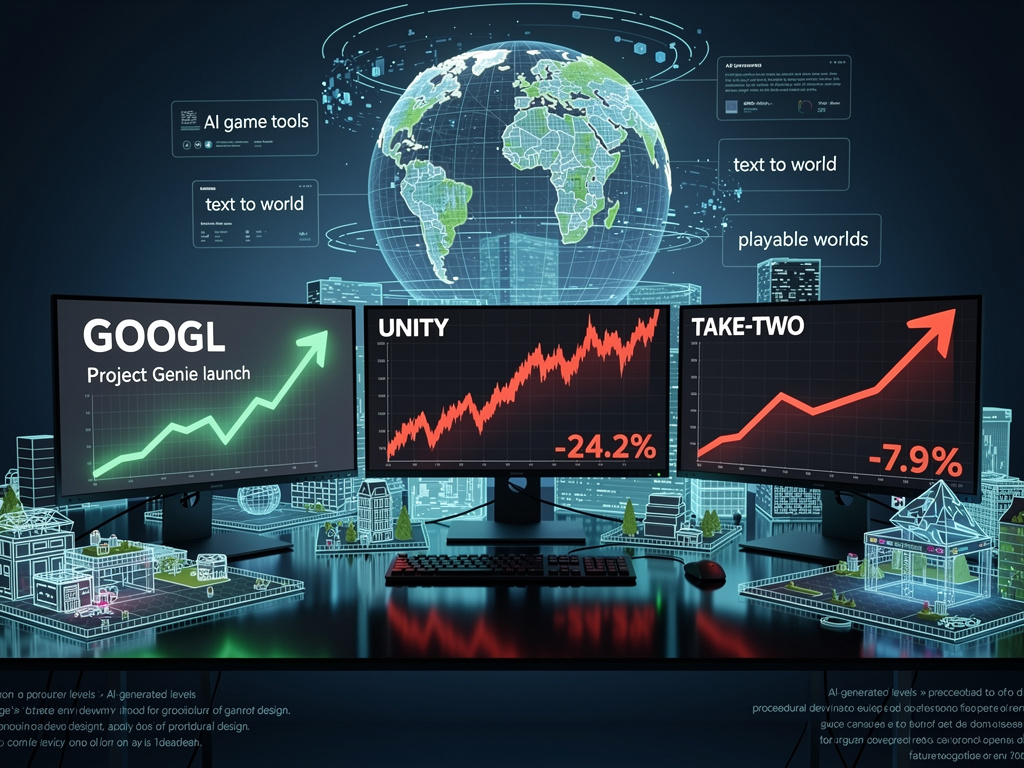
The gaming industry faced a sobering moment of reckoning on Friday as shares of major videogame companies plummeted following Google’s surprise launch of Project Genie, an artificial intelligence model capable of transforming simple text prompts into fully playable interactive worlds. Unity Software, a cornerstone of modern game development, saw its stock crater by 24.2% in afternoon trading, while Take-Two Interactive, the publisher behind Grand Theft Auto and Red Dead Redemption, dropped 7.9%. The selloff rippled across the sector, with Roblox and other gaming-adjacent companies experiencing similar declines as investors grappled with the implications of AI-generated content potentially disrupting a $200 billion global industry built on years of specialized technical expertise and creative labor.
According to Reuters, the technology represents a fundamental shift in how interactive entertainment could be created, allowing users to generate playable environments without traditional programming knowledge or access to expensive development tools. The announcement caught industry veterans off guard, with many questioning whether the decades-old business model of selling game engines, development platforms, and publisher services could survive in an era where consumers might create their own entertainment experiences directly through AI interfaces. The market’s reaction suggested that investors believe the threat is both immediate and existential, particularly for companies whose revenue depends on licensing development technology to professional studios.
Project Genie’s rollout to Google subscribers marks the first time a major technology platform has made world-generation AI broadly accessible to consumers, moving beyond experimental demonstrations to a commercial product. Blue’s News reported that the service is now available through Google’s subscription tiers, suggesting the company views AI-generated gaming content as a strategic priority rather than a research curiosity. The timing of the launch, coming amid broader debates about AI’s role in creative industries, has intensified concerns among game developers who already face pressure from automation, consolidation, and changing consumer preferences.
Industry Leaders Sound Alarm Over Disruption Potential
The response from gaming industry leadership has been swift and pointed, with several prominent figures taking to social media to voice concerns about the technology’s implications. Tim Sweeney, CEO of Epic Games and creator of the Unreal Engine, posted on X that the development represents a significant challenge to traditional game development workflows. In one post, Sweeney acknowledged the technical achievement while raising questions about how AI-generated content would integrate with existing development pipelines and quality standards. His commentary reflected a broader anxiety within the industry about whether human-created content can maintain its value proposition when algorithms can generate playable worlds in seconds.
Sweeney’s concerns were echoed by other industry veterans, including Sebastian Aaltonen, a rendering architect who has worked on cutting-edge graphics technology. In his analysis on X, Aaltonen noted that while Project Genie’s capabilities are impressive from a technical standpoint, significant questions remain about the depth, coherence, and long-term playability of AI-generated worlds compared to carefully crafted human-designed experiences. The debate highlights a fundamental tension in the gaming industry: whether the medium’s value lies primarily in technical execution that can be automated, or in creative vision and narrative design that remains distinctly human.
Michael Bromberg, a game industry analyst, pointed out on X that the market’s reaction might be overblown in the short term, but the long-term implications for companies like Unity cannot be ignored. Unity’s business model depends on developers paying for access to its engine and tools, a value proposition that becomes questionable if users can generate playable content through natural language prompts. The 24.2% single-day decline in Unity’s stock price, as reported by Barron’s, represents a loss of billions in market capitalization and suggests investors are pricing in a future where traditional game engine licensing faces severe headwinds.
Technical Capabilities Raise Questions About Creative Authorship
Project Genie’s technical architecture represents years of research in generative AI, building on Google’s previous work in image and video synthesis. The system reportedly uses a combination of large language models and world-generation algorithms to interpret user prompts and create interactive 3D environments with basic gameplay mechanics. Unlike previous AI tools that assisted developers by generating individual assets or textures, Project Genie attempts to create entire playable experiences from scratch, including terrain, objects, basic physics, and interactive elements. This holistic approach to content generation marks a departure from incremental automation and suggests a future where the boundaries between content creator and consumer blur significantly.
The technology’s emergence raises profound questions about authorship, intellectual property, and creative value in gaming. If an AI system generates a world based on a user’s prompt, who owns the resulting creation? How do copyright and trademark protections apply when algorithms remix and synthesize elements from millions of existing games in their training data? The Verge noted that these legal ambiguities could create significant challenges for both Google and the gaming industry, particularly if AI-generated content begins competing directly with professionally developed titles in the marketplace. The lack of clear regulatory frameworks around AI-generated creative works adds another layer of uncertainty to an already volatile situation.
From a technical perspective, industry observers remain skeptical about whether AI-generated worlds can match the polish, depth, and coherent design of professionally developed games. Modern AAA titles represent hundreds of person-years of specialized labor, from concept artists and level designers to programmers and quality assurance testers. Each element is carefully balanced to create specific emotional responses, gameplay rhythms, and narrative progression. While Project Genie can generate playable spaces, questions remain about whether these AI-created worlds can deliver the carefully orchestrated experiences that define successful games, or whether they will feel more like procedurally generated content that lacks intentional design and emotional resonance.
Market Reaction Reflects Broader AI Disruption Fears
The severity of Friday’s selloff in gaming stocks reflects broader market anxieties about AI disruption across creative industries. Unity’s 24.2% decline represents one of the largest single-day drops for a major gaming technology company in recent years, surpassing even the volatility seen during the pandemic-era boom and subsequent correction. Investing.com reported that trading volumes spiked significantly as institutional investors rushed to reassess their positions in companies whose business models might be vulnerable to AI-driven disruption. The coordinated nature of the selloff across multiple gaming stocks suggests that investors view Project Genie as a sector-wide threat rather than a challenge to individual companies.
Take-Two Interactive’s 7.9% decline, while less dramatic than Unity’s collapse, is particularly noteworthy given the company’s portfolio of established franchises and its position as a content creator rather than a tools provider. The market’s reaction suggests concerns that AI-generated content could eventually compete with professionally developed games for consumer attention and spending, potentially eroding the value of expensive AAA titles that take years to develop. If consumers can generate personalized gaming experiences on demand through AI, the logic goes, they may become less willing to pay premium prices for pre-packaged entertainment, no matter how polished or well-crafted.
Roblox, a platform that already enables user-generated content through more traditional tools, also experienced significant declines despite its business model seeming more aligned with a future of democratized content creation. The selloff in Roblox shares suggests investors worry that Google’s entry into AI-generated gaming could fragment the user-generated content market or that Project Genie’s ease of use might make Roblox’s learning curve and development environment seem unnecessarily complex by comparison. The breadth of the market reaction indicates that investors see few safe harbors in the gaming sector as AI capabilities advance, with both tools providers and content creators facing uncertain futures.
Historical Parallels Offer Limited Guidance for Industry Future
The gaming industry has weathered technological disruptions before, from the transition to 3D graphics in the 1990s to the rise of mobile gaming and free-to-play business models in the 2010s. Each shift created winners and losers, with established companies either adapting successfully or fading into irrelevance. However, the AI-driven disruption represented by Project Genie may be qualitatively different from previous technological transitions because it potentially eliminates the need for specialized technical skills rather than simply changing which skills are most valuable. Previous disruptions still required developers to master new tools and platforms; AI-generated content threatens to remove developers from the creation process entirely for certain types of experiences.
The democratization of content creation has been a recurring theme in gaming history, from the modding communities of the 1990s to modern platforms like Roblox and Fortnite Creative. Each wave of democratization expanded the gaming ecosystem rather than replacing professional development, as user-generated content typically occupied different niches than commercially produced titles. However, The Kansas City Star noted that AI-generated content might be different because it could potentially match professional quality in certain domains while being infinitely faster and cheaper to produce. If the quality gap between AI-generated and human-created content narrows sufficiently, the economic advantages of automation could prove overwhelming.
Industry analysts point to the music industry’s experience with digital disruption as a potential parallel, where new technologies initially seemed to threaten traditional business models but ultimately expanded the market and created new revenue opportunities. Streaming services like Spotify initially faced fierce resistance from record labels but eventually became essential distribution channels that grew overall music consumption. Whether gaming follows a similar path, with AI tools complementing rather than replacing human creativity, remains an open question that will likely take years to resolve. The initial market reaction suggests skepticism about optimistic scenarios, with investors pricing in significant disruption to established business models.
Economic Implications Extend Beyond Stock Prices
The immediate market reaction to Project Genie’s launch, while dramatic, represents only the beginning of a potentially lengthy adjustment process for the gaming industry. Unity’s business model, which generated over $2 billion in annual revenue before Friday’s selloff, depends on thousands of development studios licensing its engine and tools. If even a fraction of those customers conclude that AI-generated content can meet their needs more efficiently, Unity faces a significant revenue challenge. The company has already struggled with profitability despite its market dominance, and a sustained shift toward AI-generated content could force painful restructuring and strategic pivots.
Take-Two Interactive’s exposure to AI disruption operates through different mechanisms but is no less significant. The company invests hundreds of millions of dollars and multiple years into developing flagship titles like Grand Theft Auto VI, betting that the quality and polish of these experiences will command premium prices and sustained player engagement. If AI-generated content becomes sufficiently sophisticated to provide compelling alternatives, even if not matching AAA quality, the return on these massive investments could deteriorate rapidly. Publishers might find themselves in a position similar to traditional media companies competing with user-generated content on social platforms—technically superior but economically disadvantaged by the cost structure difference.
The employment implications of widespread AI-generated content in gaming could be substantial, affecting not just programmers and engineers but also artists, designers, writers, and quality assurance testers. The gaming industry employs hundreds of thousands of people globally, many in specialized roles that have been considered relatively safe from automation. If Project Genie and similar tools can replicate even a portion of this work, the industry could face significant workforce reductions, with ripple effects through related sectors like graphics hardware, motion capture, voice acting, and game journalism. The social and economic consequences of such a transition would extend far beyond stock prices and corporate balance sheets.
Regulatory and Ethical Challenges Loom Large
Google’s decision to commercialize Project Genie before clear regulatory frameworks exist for AI-generated content raises significant policy questions. Unlike traditional software tools that merely facilitate human creativity, generative AI systems make autonomous creative decisions based on training data that may include copyrighted material. The legal status of AI-generated content remains unsettled in most jurisdictions, with ongoing litigation and legislative debates about whether AI systems can infringe copyright, whether AI-generated works deserve copyright protection, and how attribution and compensation should work when algorithms synthesize elements from countless sources.
The gaming industry has historically relied on strong intellectual property protections to justify the massive investments required for AAA development. If AI systems can generate content that resembles existing games without clear legal consequences, the incentive structure that has driven innovation in gaming could be fundamentally altered. Publishers may become reluctant to invest in ambitious new titles if AI systems can quickly generate similar experiences at a fraction of the cost. This dynamic could lead to a tragedy of the commons scenario where the gaming ecosystem degrades as companies free-ride on each other’s innovations through AI synthesis rather than investing in original creation.
Content moderation presents another significant challenge for AI-generated gaming worlds. Traditional games undergo extensive testing and content review before release, ensuring they meet platform standards and legal requirements. AI-generated content created on demand by users could potentially include inappropriate, harmful, or illegal material without the same level of oversight. Google will need to implement robust moderation systems to prevent Project Genie from being used to create problematic content, but the scale and real-time nature of AI generation make this a daunting technical and operational challenge. Failures in this area could result in regulatory backlash that constrains not just Project Genie but the broader development of AI-generated content across industries.
Industry Adaptation Strategies Begin to Emerge
Despite the initial shock of Project Genie’s launch, gaming companies are beginning to articulate strategies for adapting to an AI-augmented future. Some industry leaders argue that AI-generated content will primarily serve as a tool for rapid prototyping and iteration rather than replacing human-driven development entirely. In this view, developers could use systems like Project Genie to quickly test gameplay concepts and world designs, then refine and polish these AI-generated foundations with human expertise. This hybrid approach might allow studios to accelerate development timelines and reduce costs while maintaining the creative direction and quality control that distinguish professional games from amateur productions.
Unity and other game engine providers face particular pressure to articulate how their platforms remain relevant in an AI-driven future. One potential strategy involves integrating AI capabilities directly into existing development tools, positioning themselves as the bridge between AI-generated content and professional game development. Unity could offer AI-assisted asset creation, procedural generation tools, and automated optimization features that enhance rather than replace human developers. By embracing AI as a complementary technology, game engine providers might transform a potential existential threat into a feature differentiator that strengthens their competitive position.
Publishers like Take-Two may increasingly emphasize the narrative depth, character development, and carefully orchestrated experiences that distinguish their titles from AI-generated content. In another post on X, Tim Sweeney suggested that the human elements of game design—storytelling, emotional resonance, and artistic vision—remain difficult for AI systems to replicate convincingly. If this assessment proves correct, the gaming market might bifurcate into AI-generated casual experiences and premium human-crafted titles, similar to how the film industry coexists with user-generated video content. Success in this scenario would require publishers to double down on the elements that justify premium pricing while accepting that AI-generated content will serve certain market segments.
Technical Limitations May Provide Temporary Breathing Room
While Project Genie represents a significant technical achievement, industry experts note several limitations that may constrain its immediate impact on professional game development. Current AI systems excel at generating visually plausible content but struggle with the systemic design challenges that define compelling gameplay. Creating balanced difficulty curves, meaningful player choices, and coherent progression systems requires understanding player psychology and game design principles that extend beyond pattern recognition in training data. These higher-order design challenges may remain in the human domain for the foreseeable future, providing professional developers with continued relevance even as AI handles more routine content generation tasks.
Multiplayer and live service games present particular challenges for AI-generated content due to their need for careful balance, ongoing updates, and community management. Games like Fortnite, League of Legends, and Call of Duty require constant tuning and content updates to maintain player engagement and competitive balance. The iterative, responsive nature of live service development may be difficult for AI systems to manage autonomously, as it requires understanding complex player feedback, anticipating meta-game shifts, and making judgment calls about design tradeoffs. These aspects of modern game development may prove more resistant to AI automation than single-player experiences or static content.
Performance optimization and platform-specific adaptation represent another area where human expertise may remain essential despite AI advances. Modern games must run efficiently across diverse hardware configurations, from high-end gaming PCs to mobile devices and consoles. Achieving smooth performance requires deep technical knowledge of graphics APIs, memory management, and platform-specific optimizations that go beyond content generation. While AI might eventually master these technical domains, the complexity and platform-specific nature of optimization work may provide a longer runway for human developers than content creation tasks that AI is already demonstrating competence in handling.
Investment Community Reassesses Gaming Sector Valuations
The dramatic market reaction to Project Genie’s launch has forced institutional investors to fundamentally reassess their thesis on gaming stocks. Many investment funds had positioned gaming companies as beneficiaries of long-term trends including digital entertainment growth, the metaverse concept, and increasing mainstream acceptance of gaming as an entertainment medium. The sudden emergence of AI-generated content as a potential disruptor has called these bullish assumptions into question, leading to rapid portfolio adjustments and a broader reevaluation of which companies are positioned to thrive in an AI-augmented future.
Valuation multiples for gaming technology companies like Unity had already compressed from pandemic-era peaks, but Friday’s selloff pushed them to levels not seen since the company’s initial public offering. Analysts are now debating whether these depressed valuations represent a buying opportunity for investors willing to bet on the company’s ability to adapt, or whether they reflect a sober reassessment of Unity’s long-term growth prospects in a market where AI might commoditize game engine technology. The answer to this question will likely depend on how quickly AI-generated content improves and whether Unity can successfully pivot its business model to remain relevant in an AI-driven development environment.
Content-focused companies like Take-Two face different valuation challenges, as investors weigh the strength of their intellectual property portfolios against the risk that AI-generated content could fragment consumer attention and spending. Franchises like Grand Theft Auto have historically commanded premium valuations due to their proven ability to generate billions in revenue and sustain player engagement for years. However, if AI-generated content becomes sufficiently compelling to compete for player time, even established franchises might see their economic moats narrow. The market is currently pricing in some probability of this scenario, though the extent of the long-term impact remains highly uncertain and subject to revision as more data becomes available about Project Genie’s actual usage and capabilities.
Consumer Response Will Determine Technology’s Ultimate Impact
While investors and industry insiders debate the implications of Project Genie, the technology’s ultimate impact will be determined by consumer adoption and satisfaction. If users embrace AI-generated gaming experiences and find them sufficiently engaging to reduce spending on traditional games, the disruption feared by investors will materialize. However, if AI-generated content proves to be a novelty that lacks the depth and replayability of professionally developed titles, the technology may find a niche role without fundamentally reshaping the industry. Early consumer reactions will be crucial in determining which scenario unfolds, though it may take months or years for clear usage patterns to emerge.
The gaming community has historically been discerning about quality and quick to abandon experiences that feel shallow or poorly designed. Even technically impressive games can fail commercially if they lack compelling gameplay loops or meaningful progression systems. AI-generated content will need to meet these high standards to gain sustained traction with core gaming audiences, who have demonstrated willingness to pay premium prices for experiences they value. Casual gamers might prove more receptive to AI-generated content if it offers sufficient entertainment value at lower price points, potentially creating a tiered market where different consumer segments have distinct preferences and willingness to pay.
The social dimensions of gaming may also influence how AI-generated content is received. Many successful modern games are built around shared experiences, community engagement, and social interaction rather than purely solo gameplay. AI-generated worlds might struggle to replicate the sense of shared cultural experience that comes from millions of players engaging with the same carefully crafted content. Games like Fortnite and Minecraft have become cultural phenomena partly because they provide common reference points and shared experiences that facilitate social connection. Whether AI-generated content can create similar cultural moments remains an open question that will significantly influence its long-term adoption trajectory.
Global Competition in AI Gaming Technology Intensifies
Google’s launch of Project Genie represents the opening salvo in what is likely to become an intensely competitive race among major technology companies to dominate AI-generated gaming content. Microsoft, which owns both Xbox and significant gaming studios through its Activision Blizzard acquisition, has been investing heavily in AI research and could quickly deploy competing technology. The company’s existing gaming ecosystem and relationships with developers might provide advantages in bringing AI tools to market that integrate seamlessly with existing development workflows and platforms. A competitive response from Microsoft seems inevitable given the strategic importance of gaming to its business and the threat that Google’s technology poses to its gaming investments.
Chinese technology giants including Tencent and ByteDance also represent formidable potential competitors in AI-generated gaming content. These companies have vast resources, extensive gaming portfolios, and strong AI research capabilities. China’s gaming market is the world’s largest by revenue, and Chinese companies have demonstrated ability to rapidly commercialize AI technologies and scale them to hundreds of millions of users. If Chinese firms develop competitive AI gaming technologies, the global gaming industry could fragment along regional lines, with different AI platforms dominating different geographic markets and creating challenges for developers and publishers trying to reach global audiences.
The competitive dynamics of AI gaming technology will likely influence how quickly capabilities advance and how accessible they become to developers and consumers. Intense competition could accelerate innovation and drive down costs, making AI-generated content widely available and potentially accelerating disruption to traditional development models. Alternatively, if a few platforms dominate the market, they might exercise significant control over the terms on which developers can access AI capabilities, potentially creating new gatekeepers and dependencies that reshape industry power structures. The regulatory environment around AI technology will also influence competitive dynamics, with different jurisdictions potentially imposing varying requirements that affect which companies can operate in which markets.
Long-Term Industry Structure Remains Uncertain
The gaming industry’s structure five or ten years from now may look dramatically different than today’s ecosystem of engine providers, publishers, developers, and platform holders. AI-generated content could eliminate certain roles while creating new specializations, shift value from one part of the supply chain to another, and change the fundamental economics of how games are created and monetized. Some analysts predict a future where AI handles routine content generation while human developers focus on high-level design, curation, and quality control—a shift analogous to how automation transformed manufacturing without eliminating the need for human expertise and judgment.
Alternative scenarios are equally plausible, including futures where AI-generated content remains a niche tool used primarily for prototyping and experimentation while professional development continues to dominate commercial gaming. The technology’s ultimate trajectory will depend on factors that are difficult to predict, including the pace of AI capability improvement, regulatory developments, consumer preferences, and the success or failure of early AI-generated gaming experiences in the marketplace. The gaming industry has proven remarkably adaptable to technological change over its history, and many companies will likely find ways to thrive in an AI-augmented environment even if their current business models require significant evolution.
What seems certain is that Friday’s market reaction marks the beginning of a period of significant uncertainty and adjustment for the gaming industry rather than a definitive endpoint. Companies will experiment with different strategies for incorporating AI into their workflows, some approaches will succeed while others fail, and the competitive environment will remain fluid as new technologies and business models emerge. Investors, developers, and consumers will all need to navigate this period of transition, making decisions based on incomplete information about how AI capabilities will evolve and how markets will respond. The companies that successfully navigate this transition will likely be those that remain flexible, continue investing in human creativity and expertise, and find ways to leverage AI as a tool for enhancing rather than replacing the human elements that make gaming compelling.


 WebProNews is an iEntry Publication