
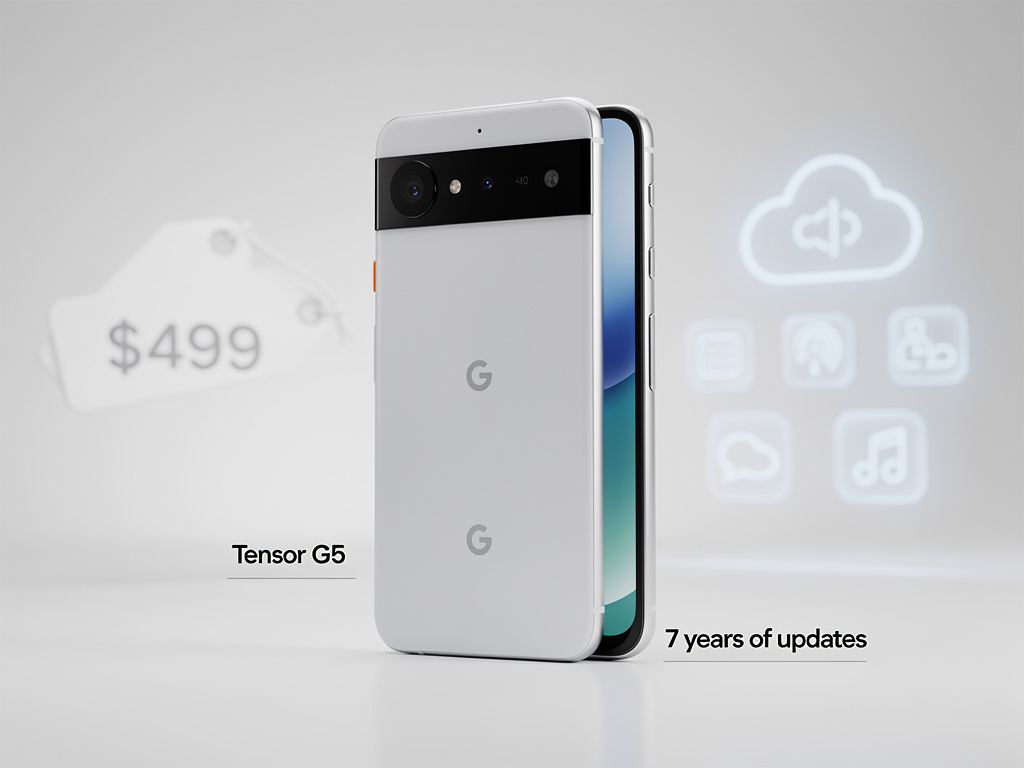
For years, Google’s A-series Pixel phones occupied a peculiar position in the smartphone market — budget devices that punched above their weight but always carried unmistakable compromises. With the Pixel 10a, Google appears to have rewritten the rules entirely, delivering a mid-range phone so capable that it threatens to cannibalize its own flagship lineup. Far from being an accident, this may be the most calculated move Google has made in hardware since launching the Pixel brand nearly a decade ago.
The Pixel 10a, which began shipping to eager buyers in mid-2025, represents a philosophical shift in how Google approaches its hardware business. Rather than strategically hobbling its affordable offering to protect premium sales, Google has loaded the 10a with flagship-grade features that blur the line between its price tiers more aggressively than ever before. The result is a device that has industry analysts, competitors, and even Google’s own retail partners asking the same question: why would anyone buy the more expensive Pixel 10?
A Mid-Range Phone With Flagship Ambitions — and the Specs to Back Them Up
As Android Police detailed in its analysis, Google knows exactly what it’s doing with the Pixel 10a. The publication argued that the device isn’t simply a watered-down flagship but rather a deliberate strategic weapon designed to maximize Google’s footprint in the Android ecosystem. The Pixel 10a ships with Google’s latest Tensor G5 processor — the same chip found in the Pixel 10 and Pixel 10 Pro — paired with 8GB of RAM and up to 256GB of storage. This alone marks a significant departure from previous A-series phones, which typically shipped with the prior generation’s silicon.
The camera system, long the crown jewel of Google’s Pixel lineup, has also received a substantial upgrade. The Pixel 10a features a 50-megapixel main sensor with optical image stabilization, a 13-megapixel ultrawide lens, and Google’s full suite of computational photography tools, including Magic Eraser, Best Take, and the AI-powered photo editing features that debuted on the Pixel 10 Pro. Night Sight performance has been notably improved, and early reviews suggest the 10a’s camera output is nearly indistinguishable from its pricier siblings in most shooting conditions. The 6.1-inch OLED display runs at 120Hz, a feature that was reserved for Google’s Pro-tier devices just two generations ago.
The Price That Changes Everything
At $499, the Pixel 10a undercuts the standard Pixel 10 by a meaningful margin while delivering what many reviewers have called a 90-percent-similar experience. The phone includes seven years of OS and security updates, matching the commitment Google makes to its flagship devices. It supports the same Gemini AI features, the same Google One AI Premium integration, and the same real-time translation capabilities. For the vast majority of consumers — those who don’t pixel-peep camera samples or benchmark processor speeds — the differences between the 10a and the 10 are academic at best.
This pricing strategy reflects a broader shift in Google’s hardware philosophy. Rather than treating the A-series as a gateway drug designed to eventually push users toward premium Pixel devices, Google appears to be optimizing for total addressable market. The company’s real revenue engine isn’t hardware margins — it’s the services, subscriptions, and data that flow through every Pixel device regardless of price point. Every Pixel 10a sold is another user locked into Google’s ecosystem of Photos, Drive, Gemini, and the Play Store, generating recurring revenue that dwarfs the one-time profit from a phone sale.
Why Google Is Willing to Undermine Its Own Flagship
The conventional wisdom in consumer electronics holds that companies should protect their premium products by ensuring meaningful differentiation from budget offerings. Apple, for instance, has been meticulous about maintaining clear hierarchies between the iPhone SE, the standard iPhone, and the iPhone Pro. Samsung similarly ensures that its Galaxy A-series phones never threaten the appeal of its S-series flagships. Google, by contrast, seems almost eager to let the Pixel 10a steal sales from the Pixel 10.
This willingness to cannibalize from within speaks to Google’s unique position as a company that derives the overwhelming majority of its revenue from advertising and cloud services rather than hardware. According to Alphabet’s most recent earnings report, the company’s “Other Bets” and hardware divisions remain a rounding error compared to its search and advertising empire. For Google, the Pixel line has always been less about generating direct profit and more about serving as a reference platform for Android — a showcase for what the operating system can do when hardware and software are tightly integrated. The Pixel 10a, by being so good at such an accessible price, maximizes the number of people experiencing Android at its absolute best.
The Tensor G5 Chip: Google’s AI Trojan Horse
Central to the Pixel 10a’s appeal is the Tensor G5 processor, which Google co-designed with Samsung’s foundry division. Unlike Qualcomm’s Snapdragon chips, which prioritize raw performance benchmarks, the Tensor G5 is architected around machine learning and AI workloads. This means on-device processing for features like Live Translate, Call Screen, and the increasingly sophisticated Gemini Nano model that powers local AI tasks without requiring a cloud connection. By putting this chip in the 10a, Google ensures that its most advanced AI features reach the widest possible audience.
The AI angle is particularly significant given the current arms race among tech giants to establish dominance in on-device artificial intelligence. Apple has invested heavily in its Neural Engine across the iPhone lineup, while Samsung has partnered with Google to bring Galaxy AI features to its devices. By democratizing the Tensor G5 across its entire 2025 Pixel lineup, Google is making a bold statement: AI shouldn’t be a premium feature reserved for those willing to spend $1,000 or more on a phone. It should be table stakes, available to anyone who buys into the Pixel ecosystem.
What the Competition Should Be Worried About
The Pixel 10a’s aggressive positioning sends shockwaves through the mid-range smartphone segment, where companies like Samsung, Motorola, and OnePlus have traditionally dominated. Samsung’s Galaxy A55, priced similarly, offers solid hardware but can’t match the Pixel’s software integration or the promise of seven years of updates. OnePlus continues to deliver excellent value with its Nord series, but Google’s brand recognition and carrier partnerships in the United States give the Pixel 10a a distribution advantage that smaller players struggle to match.
Perhaps more concerning for competitors is the halo effect the Pixel 10a creates for Google’s broader hardware ecosystem. A consumer who buys a Pixel 10a is more likely to purchase a Pixel Watch, Pixel Buds, or a Nest smart home device. Google has been steadily building out this ecosystem over the past several years, and the 10a serves as the most affordable on-ramp yet. The phone’s seamless integration with Google’s services — from automatic photo backup to cross-device copy-paste — creates a stickiness that rivals Apple’s famously locked-in ecosystem.
The Trade-Offs That Still Exist — If You Look Hard Enough
To be fair, the Pixel 10a does make compromises. The build quality, while solid, relies on a polycarbonate back rather than the glass and aluminum construction of the Pixel 10 and 10 Pro. The telephoto camera lens found on the Pro model is absent, meaning the 10a relies on digital zoom for anything beyond its standard and ultrawide focal lengths. The display, while excellent for the price, doesn’t reach the peak brightness levels of the Pixel 10 Pro’s LTPO panel, and the stereo speakers are serviceable rather than exceptional.
But as Android Police noted, these are the kinds of compromises that matter primarily to enthusiasts and reviewers — the small percentage of buyers who obsess over spec sheets and side-by-side comparisons. For the average consumer shopping for a reliable, capable smartphone with an excellent camera and years of software support, the Pixel 10a’s shortcomings are virtually invisible. Google has identified the features that actually drive purchase decisions for mainstream buyers — camera quality, software experience, battery life, and price — and has optimized the 10a ruthlessly around those priorities.
A Masterclass in Strategic Product Positioning
What makes the Pixel 10a so fascinating from a business strategy perspective is that it reveals Google’s long-term vision for its hardware division. This isn’t a company trying to compete with Apple or Samsung on hardware margins. It’s a company using hardware as a delivery mechanism for services and AI capabilities that generate far more value over the lifetime of a device than the initial purchase price ever could. Every Pixel 10a sold at $499 is a multi-year subscription to Google’s ecosystem, generating advertising revenue, cloud storage upsells, and AI service engagement that compounds over the phone’s seven-year support window.
The Pixel 10a also serves as a powerful marketing tool for Android itself. In a world where the iPhone continues to dominate the premium segment in the United States, Google needs a device that can convincingly argue that Android offers a comparable — or even superior — experience at a fraction of the cost. The 10a makes that argument more persuasively than any previous Pixel phone. By refusing to compromise on the features that matter most, Google has created a device that doesn’t just compete in the mid-range segment — it redefines what consumers should expect from a phone at this price point.
For industry watchers, the Pixel 10a is more than just another phone launch. It’s a signal that Google is done playing by the traditional rules of the smartphone business. The company has decided that market share and ecosystem engagement matter more than per-unit margins, and it’s willing to sacrifice the differentiation of its own flagship to prove it. Whether this strategy pays off in the long run depends on whether Google can convert Pixel 10a buyers into loyal ecosystem participants — but if the early reception is any indication, the bet is already paying dividends.


 WebProNews is an iEntry Publication