
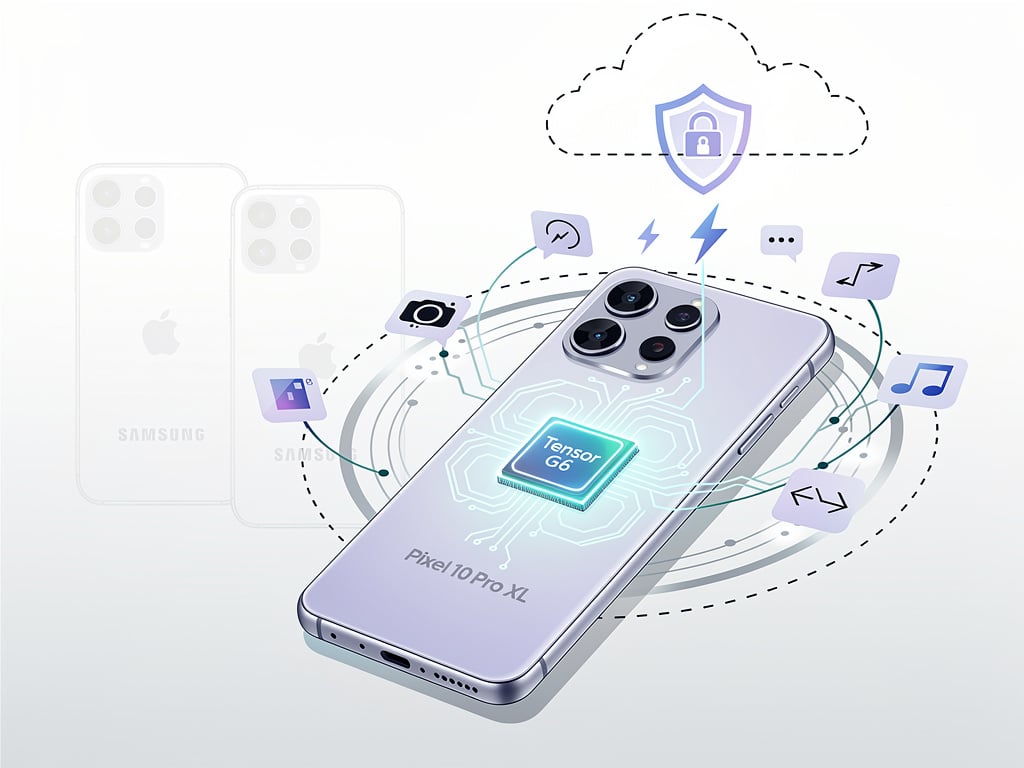
For years, the smartphone industry has chased artificial intelligence as its next great differentiator, with companies from Apple to Samsung racing to embed generative AI features into their flagship devices. But Google, the company that arguably pioneered the consumer AI race, may have just delivered the most compelling argument yet that the future of mobile intelligence doesn’t live in the cloud — it lives right in your pocket. The Pixel 10 Pro XL, Google’s latest premium smartphone, is emerging as a watershed device not because of its camera specs or display quality, but because of how seamlessly its on-device AI transforms everyday tasks into something that feels genuinely futuristic.
The device, which represents Google’s most ambitious integration of its Tensor G6 chip with purpose-built AI capabilities, has drawn particular attention from reviewers and industry watchers who say it finally delivers on the promise that Google has been making since it first introduced its custom silicon. Where previous Tensor chips were sometimes criticized for thermal throttling and inconsistent performance, the G6 appears to mark a turning point — one where Google’s AI-first chip strategy begins to pay real dividends for the user experience.
The Tensor G6 Chip: Google’s Silicon Strategy Comes Into Focus
According to Android Central, the Pixel 10 Pro XL’s most impressive achievement is how its on-device AI operates without requiring a constant internet connection. The publication’s hands-on assessment highlights that features like real-time transcription, photo editing powered by AI, and intelligent call screening all function locally on the device, delivering results with a speed and reliability that cloud-dependent alternatives simply cannot match. This is not a trivial distinction — it means that the phone’s AI capabilities work on airplanes, in underground subway stations, and in rural areas with spotty connectivity, scenarios that render cloud-based AI assistants essentially useless.
The Tensor G6 chip at the heart of the Pixel 10 Pro XL was designed from the ground up to prioritize machine learning workloads. Unlike Qualcomm’s Snapdragon processors, which are engineered primarily for raw computational performance with AI acceleration bolted on, Google’s approach inverts the priority stack. The neural processing unit (NPU) is the star of the show, with traditional CPU and GPU performance taking a supporting role. This architectural philosophy has been controversial since Google introduced the first Tensor chip in 2021, but with the G6, the strategy appears to have matured to the point where the tradeoffs are no longer noticeable to most users.
On-Device AI Features That Actually Change Daily Habits
What makes the Pixel 10 Pro XL’s AI capabilities stand out from the pack is not just their technical sophistication but their practical utility. As Android Central noted, features like the Recorder app’s real-time transcription have reached a level of accuracy that makes them genuinely useful for journalists, students, and business professionals. The transcription works entirely on-device, meaning sensitive conversations never leave the phone — a privacy advantage that is becoming increasingly important as consumers grow wary of how their data is being used by tech companies. Google has leaned heavily into this privacy angle, positioning on-device processing as both a performance and security feature.
The camera system, long the crown jewel of the Pixel lineup, has also benefited enormously from the enhanced on-device AI. Features like Magic Eraser, Best Take, and the new AI-powered photo enhancement tools process images locally with remarkable speed. Where earlier Pixel devices sometimes required a few seconds of visible processing after capturing a photo, the Pixel 10 Pro XL handles these computations almost instantaneously. The result is a camera experience that feels less like using a computational photography tool and more like using a camera that simply takes perfect pictures every time. Google’s integration of Gemini Nano — the lightweight version of its large language model designed specifically for on-device deployment — into the photo pipeline represents a significant technical achievement.
How Google Is Outflanking Apple and Samsung in the AI Arms Race
The timing of the Pixel 10 Pro XL’s release is strategically significant. Apple has been rolling out its Apple Intelligence features gradually, with many capabilities still requiring cloud processing through what the company calls “Private Cloud Compute.” Samsung, meanwhile, has partnered with Google to bring Galaxy AI features to its devices, but many of those features similarly depend on server-side processing. Google’s ability to run sophisticated AI models entirely on the Tensor G6 chip gives the Pixel 10 Pro XL a meaningful edge in scenarios where latency, privacy, and offline functionality matter — which, as it turns out, is a surprisingly large number of everyday use cases.
Industry analysts have noted that Google’s vertical integration — controlling both the hardware (Tensor chip) and the software (Android, Gemini models) — gives it an advantage similar to what Apple has long enjoyed with its A-series and M-series chips. But Google’s advantage may actually be more pronounced in the AI domain, because the company has decades of experience in machine learning research and deployment. The Pixel 10 Pro XL is, in many ways, the physical manifestation of Google’s broader AI research apparatus, from DeepMind’s foundational work to the Gemini model family that now powers everything from Google Search to the phone in your hand.
The Privacy Imperative Driving On-Device Processing
One of the most underappreciated aspects of the Pixel 10 Pro XL’s on-device AI approach is its implications for user privacy. In an era when regulators in the European Union, the United States, and elsewhere are scrutinizing how tech companies handle personal data, a phone that can perform sophisticated AI tasks without sending data to external servers represents a genuine competitive advantage. Google, which has historically faced criticism for its data collection practices, appears to be using the Pixel line as a showcase for a different approach — one where intelligence is delivered locally, and personal data stays personal.
This privacy-first AI strategy also has implications for enterprise adoption. Businesses that handle sensitive information — law firms, healthcare providers, financial institutions — have been cautious about deploying AI tools that require cloud processing due to compliance concerns. A device that can transcribe meetings, summarize documents, and process images entirely on-device could open up new markets for Google’s hardware division. The Pixel 10 Pro XL may be a consumer device, but its enterprise potential should not be underestimated, particularly as Google continues to expand its Workspace integration with on-device AI capabilities.
What the Pixel 10 Pro XL Reveals About the Future of Mobile Computing
The broader significance of the Pixel 10 Pro XL extends well beyond a single product review cycle. It signals a fundamental shift in how smartphone manufacturers think about processing architecture and feature development. For the past decade, the industry has operated on the assumption that the most powerful AI features would always require cloud connectivity — that the phone would serve as a thin client, sending data to massive server farms for processing and receiving results back. Google’s latest device challenges that assumption directly, demonstrating that a well-designed on-device AI system can deliver results that are not only comparable to cloud-based alternatives but in many cases superior, thanks to lower latency and greater reliability.
This shift has implications that ripple across the entire technology sector. If on-device AI continues to improve at its current pace, the economics of cloud computing for consumer AI applications could change dramatically. Companies that have invested billions in GPU clusters for inference workloads may find that a growing share of AI processing migrates to the edge — to phones, tablets, laptops, and other personal devices. Google, by investing heavily in custom silicon optimized for exactly this kind of workload, appears to be positioning itself at the forefront of this transition.
The Stakes for Google’s Hardware Ambitions Have Never Been Higher
For Google’s hardware division, which has long played second fiddle to the company’s advertising and cloud businesses, the Pixel 10 Pro XL represents perhaps its strongest argument yet for continued investment. The Pixel line has never competed with Apple or Samsung on unit sales — Google sells a fraction of the devices that its competitors move — but it has served as a proving ground for technologies that eventually make their way across the Android ecosystem. The on-device AI capabilities showcased in the Pixel 10 Pro XL are likely to become standard features in mid-range Android phones within a few years, much as computational photography features pioneered by earlier Pixel devices are now ubiquitous.
As Android Central emphasized in its assessment, the Pixel 10 Pro XL is not just a good phone — it is a proof of concept for an entirely different vision of what smartphones can be when AI is treated not as a marketing buzzword but as a foundational design principle. Whether the rest of the industry follows Google’s lead or charts a different course will depend on how consumers respond. But for now, the Pixel 10 Pro XL stands as the most persuasive case yet that the most important AI revolution is not happening in data centers — it is happening in the palm of your hand.


 WebProNews is an iEntry Publication