
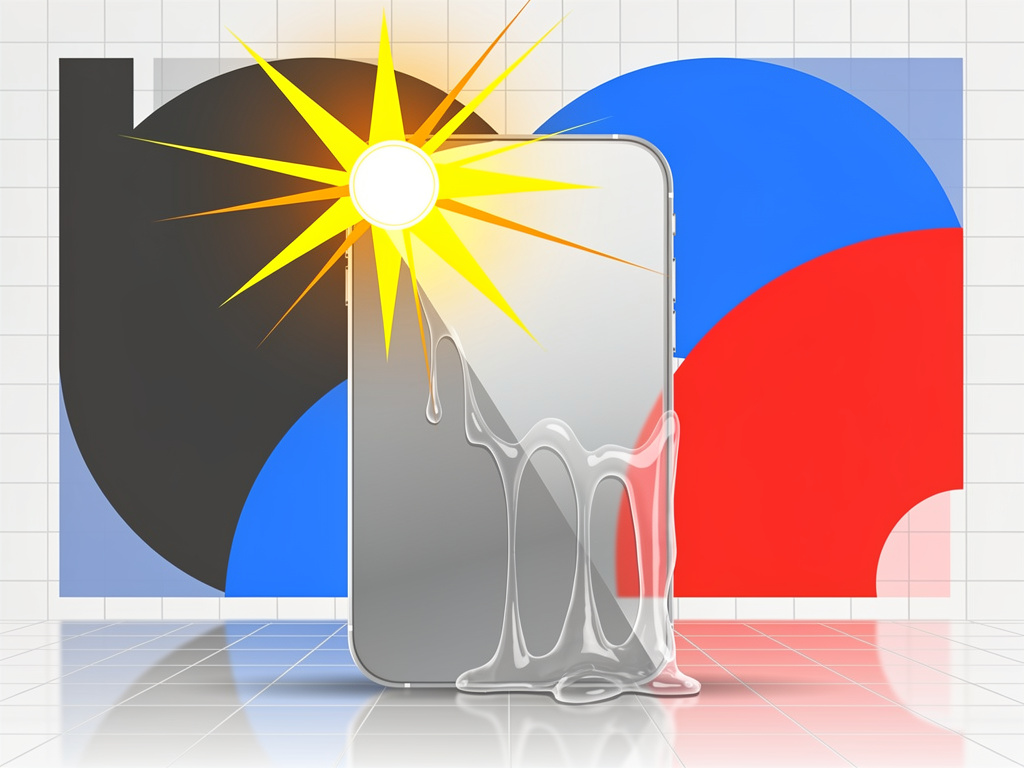
Google’s newest flagship smartphone, the Pixel 10 Pro, launched to generally favorable reviews. Improved cameras. A new Tensor G5 chip. Refined design. But within days of reaching consumers’ hands, a hardware defect has surfaced that’s hard to ignore: the phone’s flashlight appears to be generating enough heat to physically damage its own rear panel.
Reports from early Pixel 10 Pro owners describe a scenario that sounds almost absurd for a $999 device. When the flashlight is activated for an extended period — sometimes as little as a few minutes — the LED flash module produces so much concentrated heat that it warps, discolors, or outright melts the material surrounding it on the phone’s back cover. Photos shared across Reddit, Google’s support forums, and social media platform X show unmistakable deformation around the flash cutout, with the glass or coating appearing bubbled and scorched.
The issue was first reported in detail by Android Authority, which documented multiple user complaints and visual evidence of the defect. The damage isn’t subtle. In the images circulating online, the area immediately around the LED flash shows clear signs of thermal stress — a ring of discoloration that looks like what you’d expect from holding a heat source too close to a plastic surface, except this is happening inside a sealed, factory-built device.
A Flashlight That Eats Its Own Housing
To understand why this matters beyond the obvious cosmetic damage, consider what the flashlight module actually is. In modern smartphones, the camera flash doubles as the flashlight. It’s an LED array positioned behind a small window in the rear panel, designed to produce intense bursts of light for photography and sustained illumination when used as a torch. LEDs generate heat — that’s basic physics. But the thermal management around them is supposed to be engineered so that the heat dissipates safely through the phone’s internal heat spreaders and chassis.
Something in the Pixel 10 Pro’s design apparently went wrong in that calculation.
The reports suggest the problem is most pronounced on the Pro model specifically, though it remains unclear whether the standard Pixel 10 or Pixel 10 Pro Fold are similarly affected. Users on Google’s product forums have described the damage appearing after using the flashlight for tasks as mundane as searching for something under a couch or lighting a path during an evening walk. These aren’t edge cases of someone leaving the flashlight on for hours. They’re normal use patterns.
What’s particularly striking is the speed at which the damage becomes visible. Some owners report noticing the warping after just a single extended flashlight session. Others say it developed gradually over several uses. Either way, the thermal output from the LED module is clearly exceeding what the surrounding materials can tolerate, and the result is permanent physical deformation of the device.
Google has not issued a formal public statement addressing the defect as of this writing. The company’s support channels have reportedly been directing affected users through standard troubleshooting and warranty replacement processes, according to posts compiled by Android Authority. But there’s no indication yet of a broader recall, a service advisory, or an official acknowledgment that a design flaw exists.
That silence is becoming conspicuous.
The Pixel 10 Pro launched in late June 2025, and Google positioned it as a meaningful step forward for its hardware division. The Tensor G5 chip — the first designed fully in collaboration with TSMC rather than Samsung’s foundry — was supposed to signal Google’s maturation as a hardware company. Reviews from major outlets praised the phone’s camera system, display quality, and AI capabilities. The flashlight issue threatens to overshadow that narrative with a problem that feels almost embarrassingly basic.
Historical Context and the Thermal Engineering Challenge
Google’s Pixel line has had its share of hardware controversies. The Pixel 6 series was plagued by modem issues tied to Samsung’s Exynos-derived chip. The Pixel 4’s radar sensor was widely regarded as a gimmick. And various Pixel models over the years have drawn complaints about display flickering, overheating during video recording, and inconsistent build quality. But a flashlight melting its own housing? That’s a new category of problem.
It also raises questions about Google’s quality assurance testing. Any smartphone manufacturer stress-tests its components under various thermal conditions before shipping. Flashlight duration testing should be among the most straightforward QA checks — you turn it on, you leave it on, you measure temperatures at defined intervals, and you verify that no component exceeds its rated thermal tolerance. The fact that this slipped through suggests either the testing protocols didn’t adequately simulate real-world usage patterns, or the issue was identified and deemed acceptable within certain parameters that turned out to be wrong.
The materials involved matter too. The Pixel 10 Pro uses a combination of aluminum and glass in its construction, with what appears to be a coating or finish layer on the rear panel near the camera bar. Glass itself has a high melting point, but coatings, adhesives, and composite layers used in smartphone construction can be far more heat-sensitive. If the thermal pathway from the LED to the rear surface isn’t adequately insulated or ventilated, localized heating can absolutely damage these intermediate materials.
Smartphone flashlight LEDs typically operate at temperatures between 80°C and 120°C at the junction, with surface temperatures kept well below that through thermal spreading. But if the thermal interface between the LED module and the phone’s heat dissipation system is insufficient — whether due to a gap, a missing thermal pad, or a design that traps heat — surface temperatures near the flash window could spike dramatically. Even 60°C to 70°C sustained at the surface would be enough to deform certain polymer coatings or thin adhesive layers.
And this isn’t purely academic. Samsung dealt with a tangentially related issue years ago when some Galaxy devices exhibited yellowing around the flash cutout, though without the structural deformation being reported on the Pixel 10 Pro. Apple’s iPhones have occasionally triggered thermal warnings that disable the flashlight before damage can occur — a software safeguard that the Pixel 10 Pro apparently either lacks or has set at too generous a threshold.
The competitive implications are real. Google has been steadily gaining ground in the premium smartphone market, with the Pixel line earning credibility among enthusiasts and increasingly among mainstream buyers. The company shipped an estimated 10 million Pixel devices in 2024, a record. The Pixel 10 series was expected to build on that momentum. A visible, easily photographed hardware defect — especially one this unusual — is exactly the kind of story that spreads virally and sticks in consumers’ minds.
On X, the reaction has been predictably sharp. Posts showing damaged Pixel 10 Pro units have accumulated thousands of engagements, with users alternating between genuine concern and dark humor about a phone that “self-destructs” when you turn on the flashlight. Tech commentators have pointed out the irony of Google’s AI-forward marketing for the Pixel 10 Pro — a phone smart enough to circle-to-search anything on screen, but apparently not smart enough to avoid cooking itself.
For now, the scale of the problem remains uncertain. It’s unclear whether this affects a small percentage of units due to manufacturing variance or whether it’s a systemic design issue that will eventually manifest in most or all Pixel 10 Pro devices given enough flashlight usage. That distinction matters enormously — both for Google’s potential liability and for its response strategy.
If it’s a batch issue — say, a run of devices with a misaligned thermal pad or a defective adhesive layer — Google can handle it quietly through targeted replacements. If it’s a design-level problem inherent to every Pixel 10 Pro, the company faces a much larger reckoning that could require a software update to limit flashlight brightness or duration, a hardware revision for future production runs, or both.
What Comes Next
The most likely near-term fix is a software-side intervention. Google could push an update that reduces the maximum LED power output when the flashlight is in sustained use, or that implements a more aggressive thermal throttling curve that dims or disables the light before dangerous temperatures are reached. This wouldn’t fix already-damaged units, but it would prevent new damage. It’s also the cheapest and fastest option.
A hardware recall or redesign would be far more costly and disruptive, and Google will almost certainly try to avoid one unless the defect proves widespread enough to create a safety concern. Melting materials near a battery-powered heat source isn’t just a cosmetic issue — if the deformation progresses far enough or affects structural integrity near other components, it could theoretically create risks that regulators would take seriously.
So far, there’s no indication that any regulatory body — the Consumer Product Safety Commission in the U.S. or equivalent agencies elsewhere — has opened an inquiry. But the situation is developing quickly, and the visual evidence is compelling. A phone that visibly damages itself during normal operation is the kind of thing that attracts attention.
Google’s hardware ambitions are significant and growing. The company has invested billions in custom silicon, built out its retail presence, and positioned the Pixel as the definitive Android phone. The Pixel 10 Pro was supposed to be a showcase for all of that investment. Instead, it’s become a cautionary tale about what happens when thermal engineering falls short on even the most basic of smartphone features.
A flashlight. It’s the simplest tool on the phone. And right now, it’s the Pixel 10 Pro’s biggest problem.


 WebProNews is an iEntry Publication