
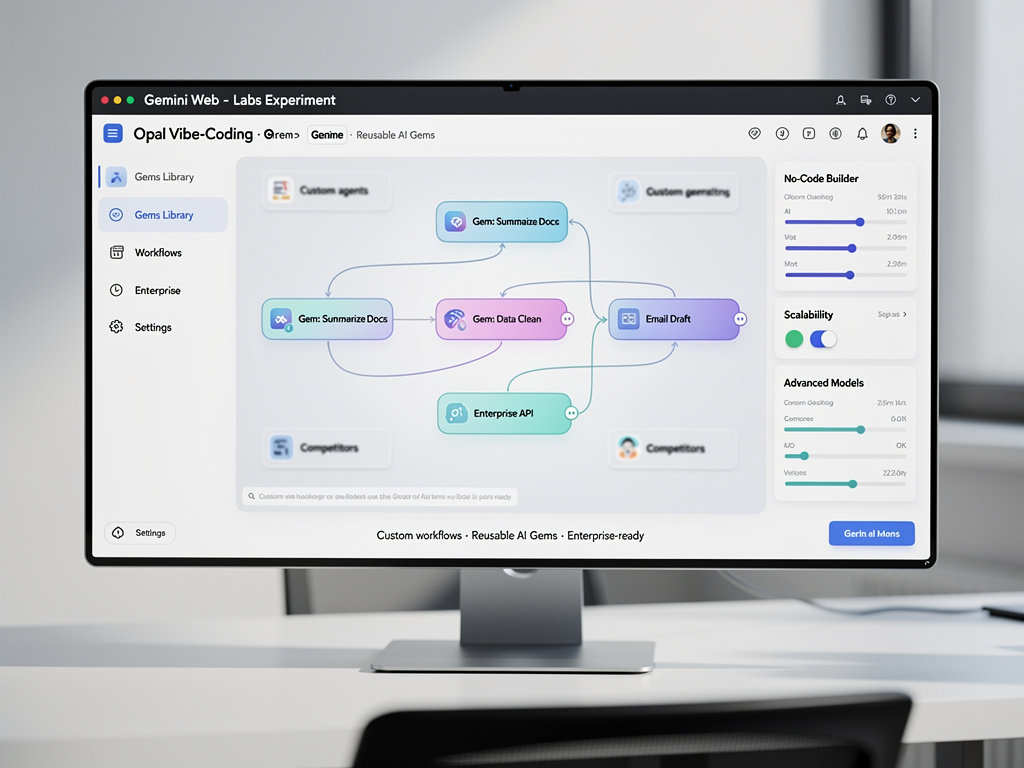
Google has embedded its experimental Opal tool directly into the Gemini web application, enabling users to craft reusable AI-powered mini-apps known as Gems through natural language instructions. Announced on December 17, 2025, this integration marks a pivotal step in democratizing AI development, allowing both developers and non-technical users to build persistent, customized agents without writing code. The move positions Gemini as a formidable contender in the race for versatile AI platforms.
Opal, initially unveiled in Google Labs as a no-code builder for linking prompts, models, and tools, now resides in Gemini’s Gems manager. Users can access it via the web app, describe desired functionalities in conversational terms—such as ‘summarize daily tech news in bullet points’—and iterate on the resulting Gem in real time. These Gems maintain context across sessions, making them ideal for workflows like data analysis or content generation. Google’s blog describes it as a way to ‘create your own custom AI experiences.’
Seamless Integration Transforms Prototyping
The feature requires a Gemini Advanced subscription, tapping into Google’s premium tier to fuel the heavy computational demands of on-the-fly app generation. Early adopters praise the iterative process, where users highlight elements and issue commands like ‘make this button blue’ or ‘animate from the left,’ echoing vibe-coding principles introduced earlier in Google AI Studio. TechCrunch reports that this embedding ‘allows users to create their own custom apps,’ highlighting Opal’s shift from standalone Labs experiment to core Gemini capability. (TechCrunch)
Posts on X from Google Labs underscore the immediacy: ‘Opal, meet @Geminiapp. We’ve now brought Opal… directly into the Gemini web app as an experimental Gem.’ Industry influencer Jaclyn Konzelmann, known as @jacalulu, called it a ‘big unlock,’ noting how it integrates powerful Opals into everyday Gemini workflows. (Google Labs on X; Jacalulu on X)
Vibe Coding’s Evolution from Labs to Mainstream
Opal’s roots trace back to July 2025, when Google Labs launched it in a US-only public beta for building AI mini-apps via natural language. By November, access expanded to over 160 countries, with users creating tools for research automation and marketing campaigns. The Gemini integration builds on this, leveraging multimodal capabilities from models like Gemini 2.5 Flash and the newly announced Gemini 3 Flash, which offers three times the speed of predecessors at lower costs.
For enterprise users, Gems promise scalability, with state management and cloud-backed persistence enabling complex tasks such as financial modeling or customer support. Safeguards like usage limits prevent overuse during this experimental phase, as detailed in Google’s Labs documentation. The Indian Express notes that users can now ‘build and share AI-powered mini apps using natural language and visual editing tools.’ (The Indian Express)
Competing in the Custom AI Arena
This launch intensifies competition with rivals like OpenAI’s GPTs and Anthropic’s custom assistants, but Opal distinguishes itself through seamless web-native reusability within Google’s ecosystem. Developers can export Gems for integration with Workspace tools, while non-coders benefit from visual debugging and API key support to bypass free-tier limits—a feature from earlier AI Studio updates.
Feedback loops are central: Users refine outputs iteratively, with Gemini handling vast context windows up to two million tokens for data-intensive applications in finance and healthcare. TechCrunch emphasizes Opal’s role in ‘building AI-powered mini apps,’ positioning it as a tool that accelerates prototyping beyond traditional coding.
Enterprise Implications and Safeguards
Industry insiders see Gems powering agentic AI, where mini-apps operate autonomously within scopes like sales forecasting. Google Labs’ expansion history—from 15 new countries in October to global reach—signals commitment to broad adoption. Konzelmann highlighted on X how this ‘changes how’ users build, with Discord channels and help centers aiding experimentation.
Technical underpinnings rely on Gemini’s infrastructure for code generation and state persistence, with real-time tweaks fostering rapid build-test-refine cycles. As an experimental feature, it invites user input to shape future iterations, potentially rolling out to mobile and enterprise tiers.
Path to Broader AI Accessibility
Google’s strategy aligns with Labs’ mission to lower barriers, as seen in prior experiments like Jules for GitHub bug fixes. With Opal now in Gemini, the company eyes a future where custom agents become standard, blending intuitive creation with enterprise-grade power. Early buzz on X and web reports confirms strong initial reception, setting the stage for widespread impact.


 WebProNews is an iEntry Publication