
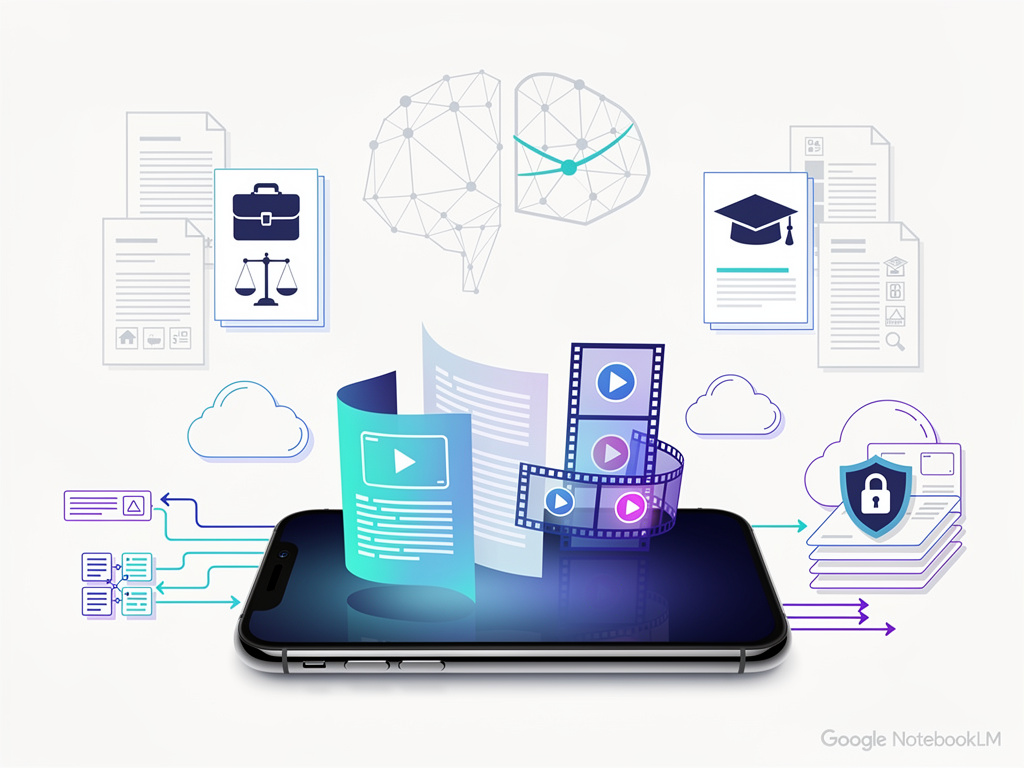
Google has quietly revolutionized how professionals consume and share information with a significant expansion of its NotebookLM artificial intelligence platform. The company’s latest update enables users to transform text documents into video presentations directly from their mobile devices, marking a pivotal shift in how enterprises might approach knowledge management and content distribution in the coming years.
According to Digital Trends, the mobile application now leverages Google’s advanced AI models to convert uploaded documents, notes, and research materials into video format, complete with visual elements and narrative structure. This capability extends NotebookLM’s existing audio overview feature, which previously generated podcast-style summaries of source materials, into the visual medium—a natural progression that industry analysts suggest could fundamentally alter how businesses communicate complex information internally and externally.
The timing of this release coincides with mounting pressure on technology companies to demonstrate practical applications of generative AI beyond chatbots and image generators. While competitors have focused primarily on text-based outputs, Google’s move into automated video creation addresses a critical pain point for enterprise users: the time-intensive process of transforming written content into engaging visual presentations. For industries ranging from consulting firms to educational institutions, the ability to rapidly generate video summaries of lengthy reports or research papers represents a substantial efficiency gain.
The Technical Architecture Behind Document-to-Video Transformation
The underlying technology powering NotebookLM’s video generation capabilities draws from Google’s Gemini AI models, which have been trained on vast datasets encompassing both textual and visual information. The system analyzes uploaded documents to identify key themes, supporting evidence, and logical narrative flow, then constructs a visual presentation that mirrors human-created educational content. This process involves natural language processing to extract salient points, computer vision algorithms to select or generate appropriate imagery, and text-to-speech synthesis to create voiceover narration.
What distinguishes NotebookLM’s approach from existing presentation software is its contextual understanding of source material. Rather than simply converting bullet points into slides, the AI interprets the semantic relationships between concepts and structures the video to maximize comprehension and retention. Early users report that the system demonstrates particular strength in handling technical documentation and research papers, where maintaining conceptual hierarchy proves essential to effective communication.
Enterprise Adoption Patterns and Use Case Development
Initial enterprise feedback suggests that NotebookLM’s video generation feature has found immediate traction in several key sectors. Management consulting firms have begun experimenting with the technology to create client-ready presentations from internal research documents, potentially reducing the billable hours traditionally allocated to slide deck preparation. One senior partner at a major consultancy, speaking on condition of anonymity due to client confidentiality agreements, indicated that preliminary tests showed a 60-70% reduction in time spent converting analytical reports into presentation format.
The legal industry represents another promising adoption frontier. Law firms handling complex litigation or regulatory matters often need to distill thousands of pages of discovery documents or regulatory filings into digestible summaries for clients or juries. NotebookLM’s ability to process extensive text corpora and generate visual explanations could prove transformative for legal communications, though practitioners emphasize that human oversight remains essential to ensure accuracy and appropriate framing of sensitive information.
Competitive Dynamics in the AI-Powered Content Creation Market
Google’s expansion of NotebookLM occurs against a backdrop of intensifying competition in AI-powered productivity tools. Microsoft has integrated similar capabilities into its Copilot platform, while startups like Descript and Synthesia have carved out niches in AI video generation. However, NotebookLM’s integration with Google’s broader ecosystem—including Drive, Docs, and Workspace—provides distribution advantages that standalone competitors struggle to match.
The strategic importance of this product category extends beyond immediate revenue generation. As enterprises increasingly view AI adoption as a competitive necessity rather than an experimental luxury, platforms that can demonstrate clear productivity gains while maintaining data security will capture disproportionate market share. Google’s decision to offer NotebookLM with robust privacy controls, including the assurance that uploaded documents are not used to train AI models, addresses a primary concern among enterprise customers evaluating generative AI tools.
Technical Limitations and Areas for Improvement
Despite the impressive capabilities demonstrated in early releases, NotebookLM’s video generation feature exhibits several limitations that constrain its immediate applicability for certain use cases. The system currently struggles with highly specialized technical content containing domain-specific jargon or complex mathematical notation. Users working with scientific papers in fields such as quantum physics or advanced materials science report that generated videos sometimes oversimplify concepts to the point of inaccuracy, necessitating substantial manual editing.
Additionally, the visual aesthetic of generated videos tends toward a standardized template approach that may not align with established brand guidelines for enterprises with sophisticated visual identity requirements. While this uniformity ensures consistency and professionalism, it limits creative expression and may prove unsuitable for customer-facing communications where brand differentiation matters significantly. Google has indicated that future updates will expand customization options, though specific timelines remain unannounced.
Data Privacy and Security Considerations for Enterprise Deployment
The introduction of video generation capabilities raises important questions about data handling and security protocols, particularly for organizations in regulated industries. Google has positioned NotebookLM as a privacy-first tool, emphasizing that user data remains segregated and is not incorporated into model training processes. However, enterprise security teams conducting due diligence have identified areas requiring clarification, particularly regarding data residency requirements for multinational corporations subject to varying jurisdictional regulations.
Financial services firms and healthcare organizations, which face stringent data protection obligations under regulations such as GDPR and HIPAA, have approached adoption cautiously. Several major banks have established pilot programs with NotebookLM but restrict usage to non-sensitive internal documents while security teams evaluate the platform’s compliance with industry-specific requirements. The outcome of these evaluations will likely influence broader adoption patterns across regulated sectors.
Implications for Content Creation Workflows and Professional Roles
The automation of video content creation through tools like NotebookLM raises substantive questions about the future of professional roles centered on information design and communication. Presentation designers, instructional designers, and corporate communications specialists face a technology that can replicate significant portions of their traditional workflow. However, industry observers suggest that rather than eliminating these roles, AI tools will shift their focus toward higher-order creative and strategic functions that require human judgment.
Educational institutions have begun exploring NotebookLM’s potential to enhance both teaching and learning processes. Professors can generate video summaries of assigned readings to provide students with preliminary orientation to complex material, while students can create video study guides from their notes. This bidirectional application suggests that the technology’s impact may extend beyond pure efficiency gains to enable new pedagogical approaches that were previously impractical due to time constraints.
Market Positioning and Strategic Implications for Google
NotebookLM’s evolution represents a critical component of Google’s broader strategy to demonstrate AI leadership beyond search and advertising. Unlike consumer-oriented AI experiments that generate headlines but limited revenue, enterprise productivity tools offer sustainable business models with clear value propositions. The company’s willingness to invest in features like video generation, which require substantial computational resources and ongoing model refinement, signals confidence that NotebookLM can become a significant revenue contributor within Google’s cloud services portfolio.
The platform’s integration with Google Workspace positions it as a potential differentiator in enterprise software sales conversations, where Microsoft’s dominance in productivity suites has historically limited Google’s market penetration. Organizations already committed to Google’s ecosystem gain incremental value without additional procurement complexity, while those evaluating alternatives may view NotebookLM’s capabilities as a compelling reason to reconsider platform decisions. As the enterprise AI market matures, such integrated capabilities may prove more decisive than standalone point solutions in determining platform winners.
Looking forward, the trajectory of NotebookLM’s development will likely influence how enterprises conceptualize knowledge management in an AI-augmented environment. The shift from static documents to dynamic, multi-format content generation suggests a future where information exists less as fixed artifacts and more as malleable resources that can be instantly adapted to different contexts and audiences. Whether this vision materializes as broadly as Google envisions depends on continued technical refinement, successful navigation of regulatory requirements, and demonstrated value creation that justifies the organizational change management required for widespread adoption. For now, NotebookLM’s video generation capability represents an intriguing proof point that the boundaries of AI-powered productivity tools continue to expand in directions that were speculative just months ago.


 WebProNews is an iEntry Publication