
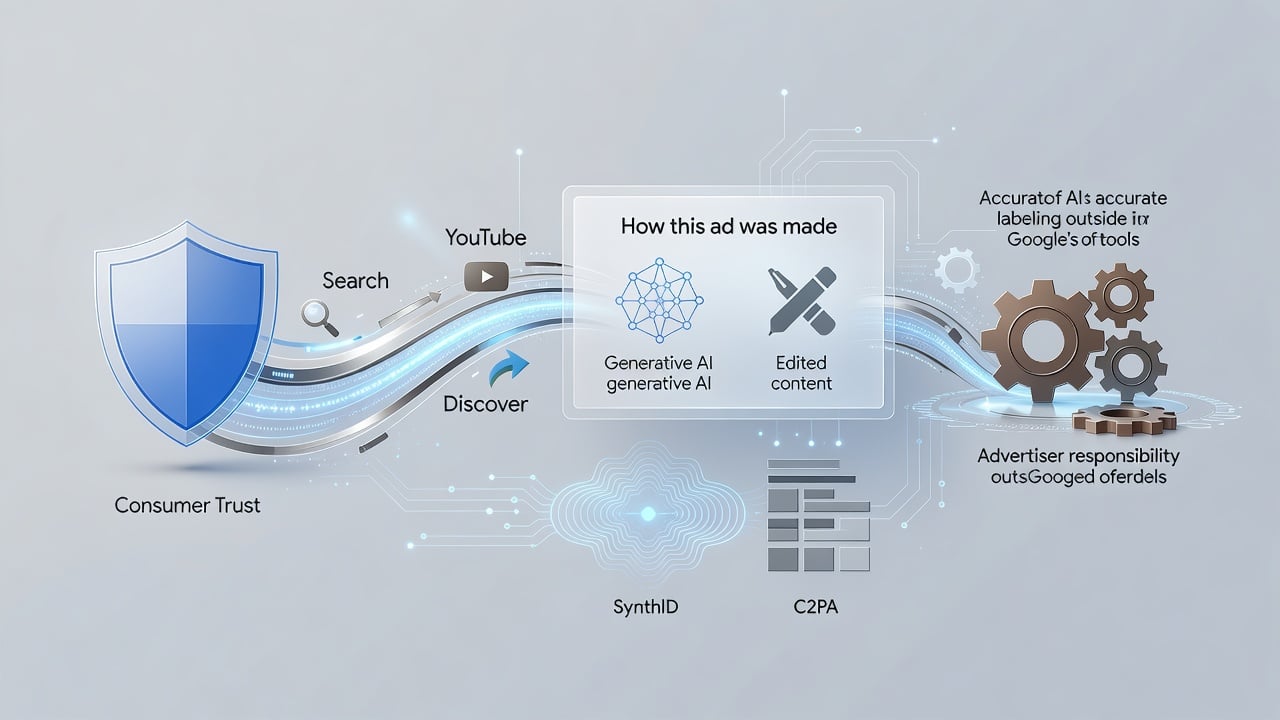
Google just flipped a switch. Starting this week, users clicking the three-dot menu on an ad in Search, YouTube or Discover will often see a new line in the My Ad Center panel: a disclosure that the spot was created or altered with generative AI.
The change landed quietly on July 9, 2026. Yet its implications stretch far beyond a simple tooltip. Advertisers now face mandatory self-reporting when they tap tools like Gemini to generate images, video clips or even voiceovers. Google automates the label for content made inside its own systems. For everything else, the burden falls on the brand.
“Advertisers are responsible for accurately labeling their ads and complying with any local laws,” a Google spokesperson told CNET. The company won’t actively police those outside labels. Enforcement, where it exists, hinges on regulation rather than technical verification.
This move builds directly on years of quiet experimentation. In May, Google expanded SynthID, its invisible watermarking technology, to more surfaces including Chrome and Search. The same blog post that announced the ad labels also pointed to deeper integration with the Coalition for Content Provenance and Authenticity standard. Metadata now travels with images and videos generated inside Google Ads tools. The watermark survives compression and basic edits. Both layers aim to give platforms and watchdogs a machine-readable trail.
But here’s the tension. AI already slashes production costs. A single prompt can spin up dozens of product mockups in impossible settings. A beach that doesn’t exist. A celebrity endorsement that never happened. The creative upside is obvious. The trust risk is equally clear. Consumers have grown wary of polished perfection that turns out to be synthetic.
TechCrunch captured the policy nuance hours after the announcement. While Google bans outright deceptive advertising, it still permits synthetic content as long as the disclosure appears. The label lives in the My Ad Center panel rather than stamped across the ad itself in most cases. That design choice keeps the creative clean yet gives curious users an easy way to check provenance. TechCrunch noted the feature rolled out globally at once.
MediaPost put the timing in context. The update arrives as industry standards shift and governments draft rules. Some jurisdictions already require explicit AI disclosures in commercial messages. Google’s policy gives advertisers one centralized place to meet those obligations. It also signals that self-regulation may soon give way to harder mandates. MediaPost reported the “How this ad was made” section appears for all users worldwide.
Marketers have watched this tension build for months. Research cited in industry analyses shows that slapping an “AI-generated” tag on identical creative can lower perceived authenticity and purchase intent. The label itself changes how people judge the message. Yet hiding the origin risks backlash or regulatory penalties. Brands now walk a narrow path between efficiency and credibility.
Common Thread Collective, an agency focused on ecommerce, published practical guidance within hours of the launch. Their post walks merchants through exactly where the disclosure appears and what compliance looks like for Performance Max and Shopping campaigns. The piece underscores that the change is live and that platforms will reject non-compliant creative in regulated markets. Common Thread Collective emphasized the need for advertisers to audit every asset generated outside Google’s tools.
Audit Socials went further in a March 2026 policy overview that suddenly feels current again. The firm warned that deepfake-style content depicting real people without consent faces immediate disapproval and possible account suspension. Even non-deceptive AI alterations must carry the visible “AI Generated” label directly in the ad unit on certain surfaces. The post mapped the policy across Search, Display, YouTube and Shopping. Audit Socials predicted tighter enforcement as detection tools mature.
Security professionals see the development through a different lens. Synthetic media has already appeared in scams and influence operations. Clear provenance data offers defenders one more signal when they investigate suspicious campaigns. The same data could help fact-checkers and journalists trace the origin of viral ads. Yet the system still depends on honest self-reporting for assets created elsewhere. That gap leaves room for abuse until verification catches up.
Google’s own blog post frames the feature as an expansion of existing trust efforts. The company already lets users control what data shapes the ads they see. Now it adds context about how those ads were built. The post stresses that AI can improve relevance and creativity while the new controls prevent confusion. Google’s official blog lists the My Ad Center panel as the primary destination for the disclosure.
Conversations on X this week reflect the split reactions. Some marketers celebrated the clarity. Others groaned at the thought of their painstakingly prompted campaigns carrying a permanent asterisk. One post captured the mood succinctly: the window is open for high-quality creators while prompt-spammers face new scrutiny. The platform’s users appear to be judging the content, not just the process. But the label forces that judgment into the open.
The rollout also highlights how fragmented the rules remain across the industry. Meta has its own AI labeling requirements for ads on Instagram and Facebook. TikTok places tags directly over videos. YouTube already requires creators to disclose realistic AI-altered content during upload. Google’s move adds another layer but doesn’t harmonize the ecosystem. Advertisers running cross-platform campaigns must track multiple disclosure regimes.
Longer term, the technical infrastructure may matter more than any single label. SynthID and C2PA together create a chain of custody that survives social sharing and format changes. If those standards gain wide adoption, downstream platforms could automatically surface provenance data without waiting for advertisers to self-report. Regulators could demand it. Courts might treat the absence of such metadata as evidence of negligence.
For now, though, the burden sits with the advertiser. Brands that use AI to generate a hyper-realistic product demo must decide whether to declare it. Those that edit a real photo with generative fill face the same choice. The My Ad Center panel makes the answer visible to anyone who cares to look. Most users probably won’t bother. The ones who do will carry that knowledge into their next purchase decision.
Google has spent years telling advertisers that AI will unlock creativity at scale. This week it reminded them that scale comes with strings. The tools get easier. The explanations must get clearer. And the public, slowly but surely, is gaining the ability to see behind the curtain.
The question advertisers must answer isn’t whether they will use AI. It’s whether they are prepared to own what that use reveals about their work.


 WebProNews is an iEntry Publication