
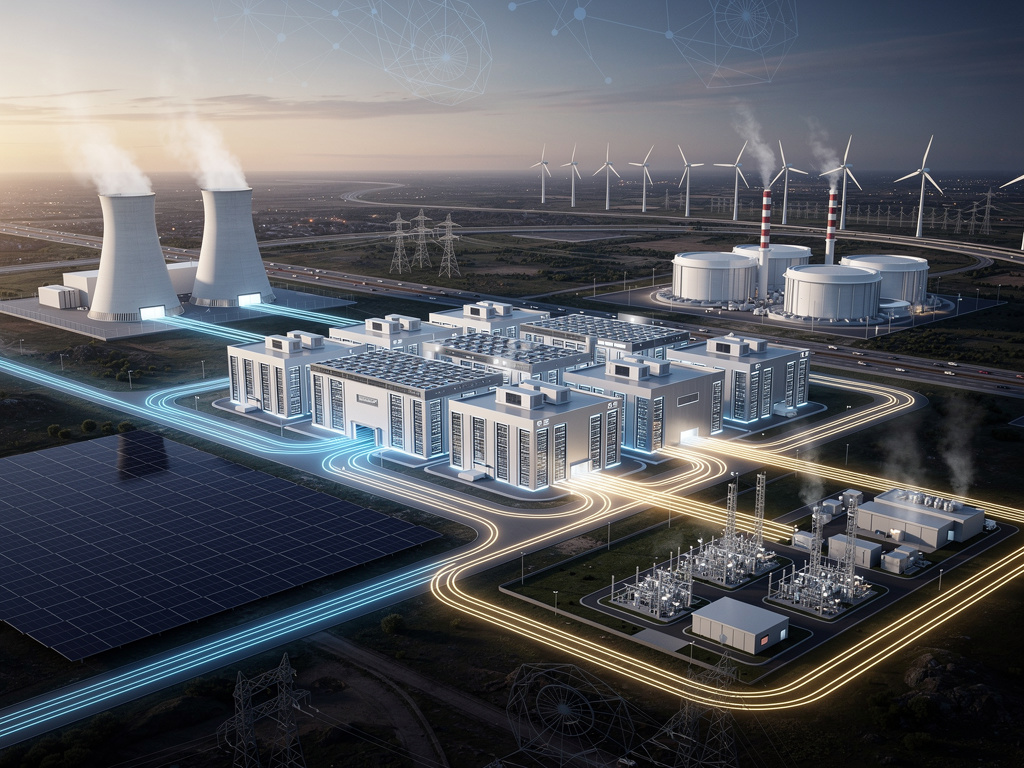
Google is building a power empire. Not in the metaphorical sense that Silicon Valley executives like to invoke when they talk about platform dominance or market share. Literally. The company is assembling a portfolio of energy deals — nuclear, natural gas, solar, geothermal — that in scale and ambition resembles something closer to a regional utility than a technology company.
The strategy, which has come into sharper focus over recent months, reflects a fundamental reality confronting every major artificial intelligence player: the models are getting bigger, the data centers are multiplying, and the electrical grid as it exists today simply cannot keep up. Google’s answer is to stop waiting for the grid and start building around it.
According to TechCrunch, Google’s data center power strategy now spans at least a half-dozen distinct energy pathways, each targeting a different timeline and risk profile. The company has signed agreements for small modular nuclear reactors, invested in next-generation geothermal startups, locked in long-term power purchase agreements for solar and wind, and — most controversially — moved to secure natural gas generation capacity to bridge the gap until cleaner sources come online at scale.
It’s a pragmatic playbook. And a politically complicated one.
The AI arms race has turned electricity into the new bottleneck. OpenAI, Microsoft, Meta, and Amazon are all scrambling for megawatts, but Google appears to be pursuing the broadest and most diversified energy acquisition strategy of any of them. The company’s parent, Alphabet, disclosed in recent filings that its capital expenditures surged past $50 billion in 2025, with a significant and growing share directed at data center infrastructure and the power systems to feed it. Google CFO Ruth Porat has signaled that spending will remain elevated for years.
Why the urgency? A single large-scale AI training run can consume as much electricity as a small city over several weeks. Inference — the process of running trained models to answer queries, generate images, or write code — is even more energy-intensive in aggregate because it happens billions of times per day across Google’s products. Search, YouTube recommendations, Gemini, Cloud AI services: all of it runs on GPUs that are, in thermodynamic terms, extraordinarily hungry machines.
Google’s own environmental reports show that its total electricity consumption grew by more than 17% in 2024 alone, a rate that has only accelerated since. The company’s data centers now consume more power annually than many mid-sized countries. And executives have been candid, at least in private briefings with analysts, that the trajectory points steeply upward.
So Google went shopping.
The nuclear piece of the strategy attracted the most headlines. In late 2024, Google announced a deal with Kairos Power to purchase electricity from small modular reactors, with the first units expected to come online by 2030. The agreement, as reported by TechCrunch, calls for up to 500 megawatts of nuclear capacity — enough to power several hyperscale data centers simultaneously. It was the first corporate power purchase agreement of its kind for SMRs in the United States, and it sent a signal to the energy industry that Big Tech was serious about nuclear.
But nuclear is slow. Regulatory approvals, construction timelines, and the sheer novelty of SMR technology mean that meaningful power delivery is still years away. Google knows this. Which is why the company has simultaneously pursued faster-to-deploy options.
Natural gas is the bridge. Google has quietly secured gas-fired generation capacity near several of its data center campuses, either through direct ownership structures or through tolling agreements with independent power producers. This has drawn criticism from environmental groups, who argue that a company that once pledged to run on 24/7 carbon-free energy by 2030 is now backsliding. Google’s response, conveyed through spokespeople and sustainability reports, is that some fossil generation is necessary in the near term to ensure reliability while zero-carbon sources scale up.
The tension is real. Google has not abandoned its clean energy commitments, but it has implicitly acknowledged that the timeline for achieving them has slipped. The 2030 target for round-the-clock carbon-free energy now looks aspirational rather than firm. Company officials have reframed the goal in recent public statements, emphasizing progress toward the target rather than a hard deadline.
Geothermal represents another front. Google has invested in Fervo Energy, a startup developing enhanced geothermal systems that can produce baseload power — meaning electricity available around the clock, regardless of weather — from hot rock deep underground. Fervo’s pilot project in Nevada has demonstrated the technical viability of the approach, and Google has signed an agreement for power from a larger commercial-scale facility. The advantage of geothermal is that it’s clean, reliable, and doesn’t depend on sun or wind. The disadvantage is that it’s expensive and still unproven at the scale Google needs.
Then there’s solar and wind, the workhorses. Google remains one of the largest corporate buyers of renewable energy on the planet, with power purchase agreements totaling several gigawatts across multiple countries. These deals are economically attractive — solar and wind are now the cheapest sources of new electricity generation in most markets — but they come with an inherent limitation. They’re intermittent. A data center can’t shut down when the wind stops blowing.
Battery storage helps, but only to a point. Google has co-located battery systems with some of its renewable installations, and the economics of lithium-ion storage have improved dramatically. Still, storing enough energy to keep a 100-megawatt data center running through a multi-day weather event remains prohibitively expensive with current technology. This is precisely why Google’s strategy is multi-pronged rather than reliant on any single source.
The financial implications are staggering. Energy costs are becoming a larger share of Google’s operating expenses, and the capital required to secure long-term power supply is reshaping Alphabet’s balance sheet. Wall Street analysts have begun modeling Google’s energy portfolio as a distinct line item, treating the company’s power procurement commitments as a form of infrastructure investment that will generate returns — or impose costs — over decades.
Morgan Stanley estimated in a recent note that the five largest U.S. hyperscalers will collectively need to secure more than 90 gigawatts of new power capacity by 2030 to meet AI-driven demand. That’s roughly equivalent to the entire installed generation capacity of France. Google’s share of that figure is substantial, and the company’s willingness to sign long-term contracts at premium prices is already distorting regional power markets.
In parts of Virginia, Georgia, and Texas — where Google operates major data center clusters — wholesale electricity prices have risen as tech companies compete for limited grid capacity. Utility executives have described the situation as unprecedented. Dominion Energy, which serves northern Virginia’s “Data Center Alley,” has warned that it may need to build new transmission lines and generation facilities specifically to serve hyperscale customers, at costs that could ultimately be passed on to residential ratepayers.
This is where the politics get thorny. Local communities near proposed data center sites have increasingly pushed back, citing concerns about noise, water usage, visual impact, and the strain on electrical infrastructure. Google has responded with community benefit packages and commitments to local hiring, but opposition has slowed permitting in several jurisdictions. The company’s push into natural gas generation has added another layer of controversy, giving environmental advocates and local residents a shared grievance.
And yet the building continues. Google broke ground on new data center campuses in multiple states in 2025 and early 2026, and the company has publicly identified additional sites under consideration. Each new facility requires not just a building and servers but a guaranteed power supply, often negotiated years in advance of construction. The lead times involved mean that decisions Google is making today about energy procurement will shape its cost structure and carbon footprint well into the 2030s.
Competitors are watching closely. Microsoft has pursued its own nuclear strategy, signing a deal to restart a unit at the Three Mile Island plant in Pennsylvania. Amazon has acquired a data center campus adjacent to a nuclear plant in Pennsylvania as well, and has invested in fusion energy startups. Meta has focused primarily on solar and wind, though it too has explored nuclear options. The competitive dynamics are creating a new kind of corporate energy race, one where access to reliable, affordable power is as strategically important as chip supply or engineering talent.
Google’s approach stands out for its breadth. No other tech company is simultaneously pursuing nuclear, geothermal, natural gas, solar, wind, and battery storage at comparable scale. The diversification reflects both the magnitude of Google’s power needs and a hedging strategy against the risk that any single technology fails to deliver on time or at cost. If SMRs are delayed, gas fills the gap. If geothermal scales faster than expected, it displaces some gas. If battery costs plummet, intermittent renewables become more valuable. The portfolio is designed to be resilient to a wide range of outcomes.
There’s a deeper strategic logic too. By locking in power supply early, Google is effectively raising the barrier to entry for competitors who move more slowly. Every megawatt committed to Google is a megawatt unavailable to a rival. In regions where grid capacity is constrained — which is most of them — this first-mover advantage could prove decisive. A company that can’t power its data centers can’t train its models, can’t serve its customers, can’t compete.
Power as competitive moat. It’s not the kind of advantage that shows up in a product demo or a keynote presentation, but it may matter more than any of them.
The regulatory environment is shifting in ways that could either help or hinder Google’s plans. The Federal Energy Regulatory Commission has been grappling with how to handle the surge in data center interconnection requests, and several states are considering legislation that would require hyperscalers to bear a greater share of grid upgrade costs. At the same time, the federal government has expressed support for new nuclear development and has streamlined some permitting processes for energy projects deemed critical to national competitiveness in AI.
Google has been active in Washington on these issues, lobbying for policies that accelerate energy project permitting and support advanced nuclear and geothermal development. The company’s government affairs team has framed the argument in national security terms: if the U.S. wants to maintain its lead in artificial intelligence, it needs to build the energy infrastructure to support it. The argument has found receptive audiences on both sides of the aisle, though specific legislative outcomes remain uncertain.
Back in Mountain View, the calculus is straightforward if daunting. Google’s AI ambitions require power on a scale that didn’t exist in corporate planning a decade ago. The company is spending tens of billions to secure it, accepting higher costs and political friction as the price of staying in the race. Whether the bet pays off depends on factors ranging from reactor construction timelines to lithium prices to the trajectory of AI demand itself.
But Google isn’t hedging on the demand question. Every signal from the company — capital spending plans, hiring patterns, product roadmaps — points to a conviction that AI workloads will grow faster and larger than most outside forecasters currently project. If that conviction proves correct, the companies that secured their power supply early will have an advantage that compounds over time. If it proves wrong, Google will own a lot of expensive electricity contracts.
Either way, the transformation is already underway. Google is no longer just a technology company that happens to use a lot of power. It is becoming, in function if not in name, one of the largest energy buyers and infrastructure developers in the United States. The data center is the factory of the AI era, and factories need fuel. Google is making sure it has plenty.


 WebProNews is an iEntry Publication