
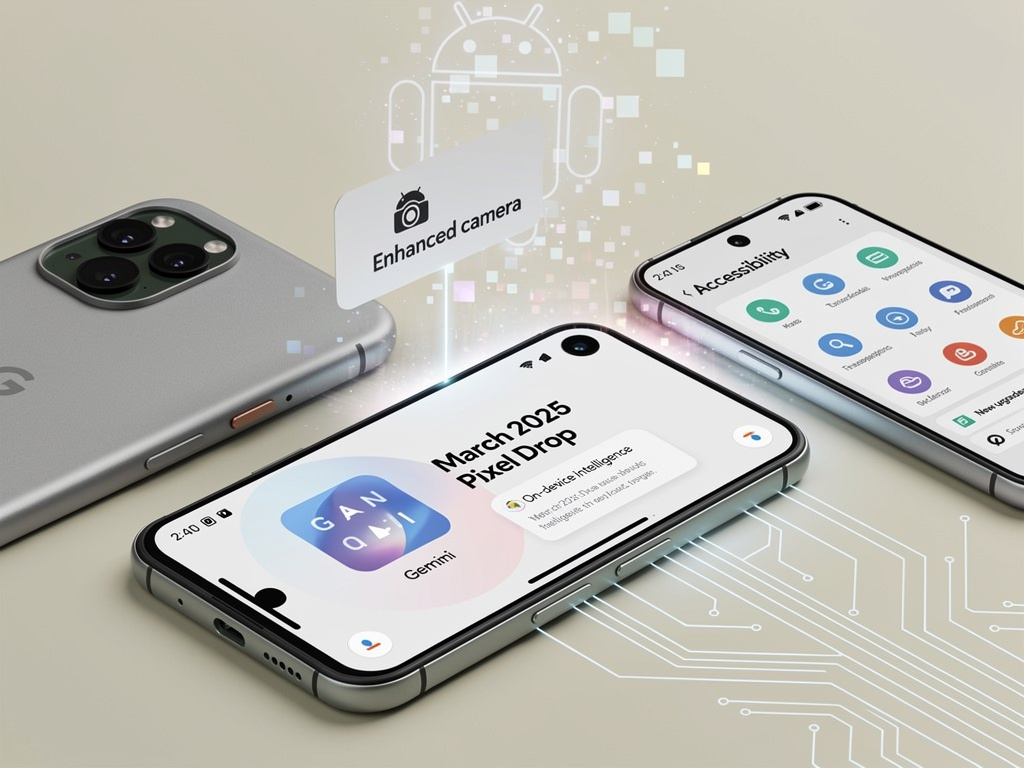
Google has once again used its quarterly Pixel Drop to push the boundaries of what its smartphones can do — and in the process, the company is telegraphing where it believes the entire Android platform is headed. The March 2025 Pixel Drop, accompanied by a broader Android update, delivers a collection of artificial intelligence features, camera improvements, and accessibility tools that together represent Google’s most aggressive integration of on-device AI to date.
The update, which began rolling out to Pixel devices in early March, is notable not just for the individual features it contains but for the way Google is increasingly differentiating Pixel phones from the broader Android universe. While some features will eventually trickle down to other Android manufacturers, Google is clearly using its own hardware as a proving ground for AI capabilities that the company hopes will become table stakes across the mobile industry.
Gemini Takes Center Stage Across the Pixel Experience
At the heart of the March Pixel Drop is a deeper integration of Google’s Gemini AI model into everyday phone functions. As reported by Digital Trends, the update brings Gemini into more corners of the Pixel experience, including the ability for the AI assistant to interact with on-screen content in new ways. Users can now ask Gemini questions about what’s displayed on their screen, whether that’s a webpage, an image, or a conversation thread. This contextual awareness marks a significant step forward from the days when Google Assistant operated largely in isolation from the content a user was actively engaging with.
The Gemini enhancements also extend to the phone’s communication tools. The AI can now help draft messages, summarize long email threads, and suggest replies that are more contextually appropriate than the canned smart replies Android users have grown accustomed to. For Pixel 9 series owners in particular, these features take advantage of the Tensor G4 chip’s on-device AI processing capabilities, meaning many of these functions work without sending data to Google’s cloud servers — a detail that carries real weight for privacy-conscious consumers and enterprise users alike.
Camera and Photo Editing Upgrades Reflect Google’s Computational Photography Ambitions
Google has long positioned the Pixel camera as one of the primary reasons to choose its phones over competitors, and the March update continues that tradition. According to Digital Trends, the drop includes improvements to Night Sight, Google’s low-light photography mode, with better processing that reduces noise and preserves detail in challenging lighting conditions. The Pixel 9 Pro and Pixel 9 Pro Fold receive additional enhancements to their telephoto lenses, improving zoom quality through updated algorithms.
Perhaps more interesting to the average user, however, are the updates to Google Photos’ editing capabilities. The Magic Editor tool, which uses generative AI to allow users to move, resize, or remove objects from photos, has received refinements that make its output more natural-looking. Google has also added new preset styles and filters that go beyond simple color grading, using AI to adjust lighting, depth of field, and composition in ways that mimic professional post-processing techniques. These aren’t just cosmetic additions — they represent Google’s broader bet that computational photography, powered by AI, will increasingly replace traditional optical improvements as the primary driver of smartphone camera quality.
Accessibility and Safety Features Get a Meaningful Boost
One area where Google has consistently outpaced its competitors is accessibility, and the March Pixel Drop reinforces that lead. The update introduces improvements to Live Caption, the feature that provides real-time captions for any audio playing on the device. The captions are now more accurate across a wider range of accents and speaking speeds, and they work in additional languages. For users who are deaf or hard of hearing, these incremental improvements can make a material difference in daily usability.
The update also brings enhancements to car crash detection and emergency SOS features. Google has refined the algorithms that detect when a user may have been in a serious accident, reducing false positives while maintaining sensitivity to actual emergencies. The company has been careful to position these features not as replacements for traditional emergency services but as supplementary tools that can provide faster notification when every second counts. Similar features from Apple have drawn both praise and occasional criticism for false alarms, so Google’s focus on reducing those incidents is a practical response to real-world feedback.
Android-Wide Updates Extend Beyond Pixel Hardware
While the Pixel Drop is exclusive to Google’s own devices, the accompanying Android update delivers improvements to a wider range of phones. Google has pushed updates to Google Play Services and various system components that affect all Android devices running recent versions of the operating system. These include security patches, performance optimizations, and updates to core Google apps like Maps, Messages, and the Google app itself.
The broader Android update also includes refinements to the Find My Device network, Google’s answer to Apple’s Find My. The network, which uses nearby Android devices to help locate lost items and phones, has received improvements to its accuracy and speed. Google has been steadily building out this capability since launching it in 2024, and the March update represents another step toward parity with Apple’s more established system. For users who have invested in Bluetooth trackers compatible with the Find My Device network, these improvements should translate to faster and more reliable location results.
The Strategic Implications for Google’s Hardware Business
The cadence of quarterly Pixel Drops has become one of Google’s most effective tools for maintaining consumer interest in its hardware between major product launches. By delivering meaningful new features every three months, Google ensures that Pixel phones feel like they’re improving over time rather than stagnating after purchase. This approach mirrors what Apple has done with its mid-cycle iOS updates, but Google has arguably been more aggressive in using these drops to introduce entirely new capabilities rather than simply fixing bugs and refining existing features.
The strategy also serves a competitive purpose. Samsung, Google’s most significant Android partner and rival, has been investing heavily in its own Galaxy AI features, many of which overlap with what Google offers through Gemini and the Pixel Drop program. By keeping its own devices a step ahead in AI integration, Google maintains a reason for consumers to choose Pixel over Galaxy — even as Samsung’s hardware often surpasses Google’s in areas like display technology and build quality. The March drop, with its emphasis on Gemini integration and on-device AI processing, underscores that Google sees artificial intelligence as its primary competitive differentiator in the hardware market.
What This Means for the Rest of 2025
Looking ahead, the March Pixel Drop offers clues about where Google is directing its resources for the remainder of the year. The heavy emphasis on Gemini integration suggests that the Pixel 10 series, expected in the fall, will likely push AI capabilities even further, potentially with a new generation of the Tensor chip designed specifically to handle more complex on-device AI tasks. Google’s investment in computational photography also signals that the company is unlikely to engage in the megapixel and sensor-size arms race that has defined much of the smartphone camera competition in recent years, instead doubling down on software-driven improvements.
For Android users on non-Pixel devices, the March update is a reminder that Google continues to invest in the platform as a whole, even as it reserves its most exciting features for its own hardware. The tension between Google’s role as Android’s steward and its ambitions as a hardware manufacturer has always been present, but the Pixel Drop program makes it more visible than ever. As AI features become increasingly central to the smartphone experience, the question of which features remain Pixel exclusives and which become available to all Android users will only grow more consequential — for consumers, for Google’s hardware partners, and for Google’s own bottom line.
The March 2025 Pixel Drop may not contain a single headline-grabbing feature that transforms the way people use their phones overnight. But taken together, the updates represent a clear and consistent vision: Google believes the future of the smartphone is defined not by hardware specifications alone but by the intelligence of the software running on that hardware. Whether that vision proves correct — and whether Google can execute on it faster than Apple, Samsung, and the growing field of AI-focused competitors — will be one of the defining questions of the mobile industry in the years ahead.


 WebProNews is an iEntry Publication