
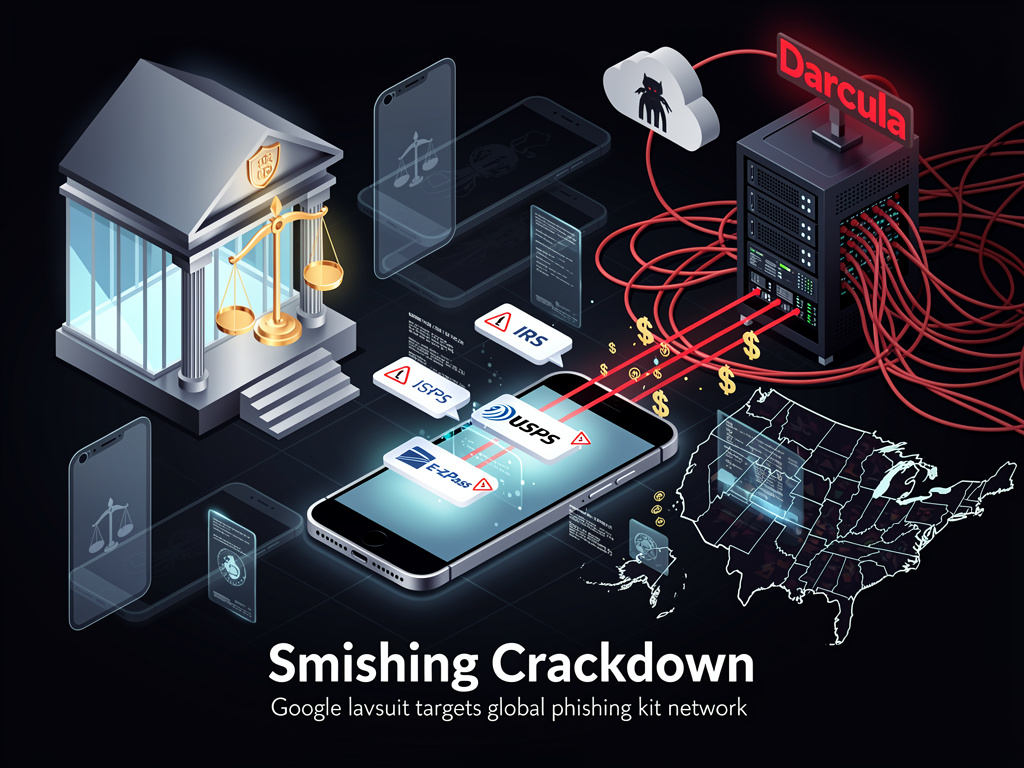
Google has launched a federal lawsuit in California against a Chinese-speaking cybercriminal collective known as Darcula, accusing it of orchestrating a vast phishing operation that bombarded Americans with fraudulent text messages impersonating government agencies and services. The suit, filed in the U.S. District Court for the Northern District of California, seeks a restraining order to halt the group’s activities and seize related domains and infrastructure. This marks Google’s latest aggressive move to combat smishing—phishing via SMS—that has plagued U.S. mobile users throughout 2025.
The complaint details how Darcula operated a sophisticated phishing-as-a-service platform called ‘Predator,’ enabling even novice criminals to launch convincing scams mimicking entities like the IRS, USPS, E-ZPass toll systems, and even lottery alerts such as Mega Millions. Google alleges the group generated over $50 million in illicit revenue by renting these tools for fees ranging from $100 weekly to $2,000 annually, with scammers harvesting login credentials, payment details, and personal data from victims.
Darcular’s Tactical Arsenal
At the heart of Darcula’s operation was a kit that automated the creation of fake login pages and SMS campaigns, complete with URL-shortening services to evade detection. The platform boasted over 10,000 active users at its peak, dispatching billions of texts via hijacked U.S. phone numbers obtained through SIM farms in China. ‘This is a criminal enterprise on an industrial scale,’ Google’s legal filing states, as reported by NBC News.
Cybersecurity firm Proofpoint, cited in the lawsuit, tracked Darcula’s evolution from earlier platforms like ‘Lighthouse,’ which Google disrupted in November 2025. That prior action targeted similar smishing rings behind E-ZPass and USPS scams, shutting down operations within 24 hours, according to CNBC. Darcula refined these tactics, incorporating AI-generated content for more realistic phishing sites and multilingual support to target global victims.
From Toll Scams to Tax Fraud
Victims received texts like ‘Your E-ZPass toll is overdue—pay now to avoid fees’ or ‘USPS package await pickup—claim here,’ directing them to counterfeit sites that stole Google account credentials. IRS impersonations peaked during tax season, promising refunds in exchange for sensitive data. A WWLTV report highlighted related Mega Millions scams using similar tactics, warning of fake prize claims leading to data theft.
Slashdot coverage of the suit notes Darcula’s use of bulletproof hosting in China and encrypted Telegram channels for customer support, making takedowns challenging. ‘The group provided tutorials, templates, and 24/7 assistance,’ the lawsuit claims, lowering barriers for entry-level fraudsters. Google identified over 1,200 malicious domains registered under Darcula control.
China’s Cybercrime Ecosystem
Darcula operated from servers in Fujian province, leveraging China’s lax enforcement on underground forums like those on Telegram and WeChat. Participants used pseudonyms such as ‘AdminDarcula’ and communicated in Mandarin. The U.S. Justice Department has previously indicted similar groups, but civil suits like Google’s aim to freeze assets swiftly without lengthy criminal probes.
Posts on X from cybersecurity accounts, including The Hacker News, describe Darcula as an offshoot of the ‘Lighthouse’ network, which scammed over a million users across 120 countries for $1 billion. Google’s action follows FTC warnings on rising smishing, with losses exceeding $1.3 billion in 2025 per FBI data.
Legal Weapons and Early Wins
The lawsuit invokes the Computer Fraud and Abuse Act, Lanham Act for trademark infringement, and California’s anti-phishing statutes. Google requests court orders to transfer domains to its control and block payments via processors like PayPal. A temporary restraining order was granted ex parte on December 16, 2025, per court filings cited by Slashdot.
This mirrors Google’s November 2025 victory against Lighthouse, where infrastructure was dismantled rapidly, as detailed by CNBC. Industry insiders anticipate similar outcomes, though Darcula’s decentralized structure—using resellers and VPNs—poses ongoing risks.
Tech Giants’ Broader Offensive
Google’s Android security teams integrated real-time SMS filtering, blocking 99% of known Darcula links since Q3 2025. Partnerships with carriers like Verizon and AT&T enhanced number blacklisting. Microsoft and Apple have filed parallel suits against overlapping networks, signaling a coordinated industry push.
CBS News reported on the Lighthouse suit’s scope, noting stolen data fueled identity theft and ransomware. Proofpoint’s analysis, referenced across filings, links Darcula to 15% of U.S. smishing incidents in 2025, with average victim losses at $1,200.
Victim Toll and Economic Impact
An estimated 10 million Americans encountered Darcula texts, per Google’s telemetry. High-profile cases include a New Jersey driver losing $5,000 after an E-ZPass scam and retirees falling for IRS refund lures. The operation exploited post-pandemic remote work and stimulus fears.
Wired detailed how platforms like Predator offered tiered subscriptions: basic for $88/week (500 texts/day), premium for $1,588/year (unlimited with analytics). Refunds were even provided for poor performance, building loyalty among 5,000+ affiliates.
Enforcement Hurdles Across Borders
U.S. authorities face jurisdictional barriers, as Darcula members reside in mainland China, beyond extradition reach. Treasury sanctions on similar entities have frozen $100 million, but crypto payments via USDT evade traditional banking oversight.
NPR covered Google’s prior suit, quoting experts: ‘Civil litigation is faster than DOJ indictments for disrupting ops.’ X discussions highlight user frustration with persistent scams despite filters.
Future Defenses and Industry Shifts
Google plans RCS enhancements for verified sender IDs, reducing SMS vulnerabilities. Carriers advocate STIR/SHAKEN protocols, though adoption lags at 70%. Cybersecurity firms like Lookout offer endpoint protections scanning links pre-click.
The suit exposes gaps in global telecom regulation, with EU probes into Chinese SMS providers underway. For insiders, Darcula’s model—SaaS for crime—underscores the need for AI-driven threat intel sharing across Big Tech.
Asset Seizure and Long-Term Disruption
Court-ordered freezes target $2 million in Bitcoin wallets linked to Darcula. Google’s counsel, Perkins Coie, seeks permanent injunctions. Success here could deter copycats, as seen post-Lighthouse with 40% smishing drop, per Proofpoint.


 WebProNews is an iEntry Publication