
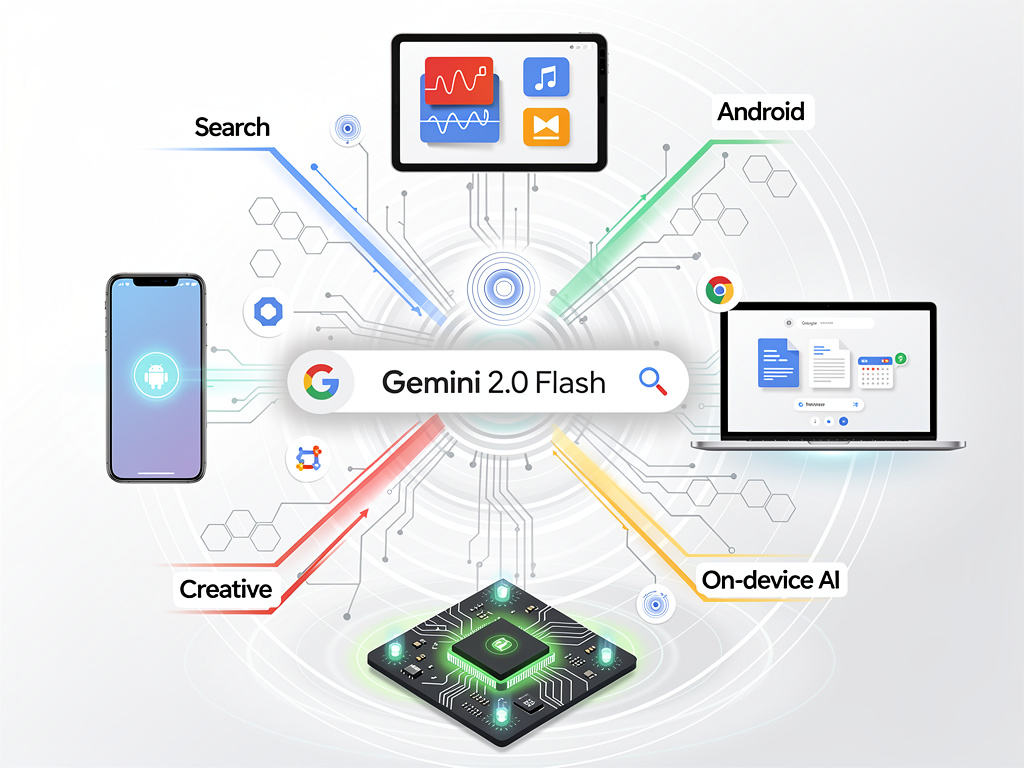
In the span of a single month, Google has unleashed a torrent of artificial intelligence updates that touch nearly every corner of its product ecosystem — from search and workspace tools to Android devices and creative applications. The January 2026 announcements represent what may be the most concentrated burst of AI-driven product launches the company has ever executed, signaling that the race for AI supremacy is no longer a slow burn but a full sprint.
The updates, detailed in a sweeping blog post published by Google’s official blog, span dozens of individual product enhancements and new features, all unified by a common thread: the deep integration of Google’s Gemini family of AI models into the tools that billions of people use every day. For industry insiders who have watched Google methodically build its AI infrastructure over the past three years, the January 2026 rollout is the moment where that infrastructure meets the consumer at scale.
Gemini 2.0 Flash Takes Center Stage Across Google’s Core Products
At the heart of nearly every announcement is Gemini 2.0 Flash, the model Google has positioned as its workhorse for consumer-facing applications. According to the company’s blog, Gemini 2.0 Flash is now the default model powering the Gemini app experience, replacing earlier iterations that served as placeholders while the technology matured. The model is designed to deliver faster responses with improved reasoning capabilities, and Google has made it available across a remarkably broad surface area — from the standalone Gemini app to integrations within Google Search, Google Workspace, and Android.
The significance of making Gemini 2.0 Flash the default cannot be overstated. In previous cycles, Google’s most capable models were often gated behind subscriptions or limited to specific use cases. By pushing this model into the default experience, Google is effectively raising the floor for what hundreds of millions of users encounter when they interact with AI. This is a strategic move that mirrors what competitors like OpenAI and Anthropic have attempted with their own model deployments, but Google’s advantage lies in the sheer number of touchpoints it controls — from the browser to the phone to the email inbox.
Deep Research and Agentic Capabilities Signal a New Phase of AI Utility
Among the most notable features announced is the expansion of Deep Research, a capability within the Gemini app that allows users to commission multi-step research tasks. As described by Google, Deep Research can now handle more complex queries and produce comprehensive reports by autonomously browsing the web, synthesizing information from multiple sources, and presenting findings in structured formats. This is not a simple question-and-answer interaction — it is an agentic workflow where the AI operates semi-independently to complete a task that might otherwise take a human researcher hours.
The agentic theme extends beyond Deep Research. Google has introduced what it calls “Gems” — customizable AI agents within the Gemini ecosystem that users can configure for specific tasks. Whether it’s a Gem designed to help with project management, one tuned for coding assistance, or another built for creative brainstorming, the concept reflects Google’s bet that the future of AI is not a single monolithic assistant but a constellation of specialized agents. This approach has been gaining traction across the industry, with Microsoft’s Copilot agents and Anthropic’s tool-use capabilities pursuing similar paradigms, but Google’s integration advantage gives it a unique distribution channel.
The company has also expanded Gemini’s ability to interact with Google’s own services in more sophisticated ways. Users can now ask Gemini to pull information from Gmail, Google Drive, Google Calendar, and other Workspace applications simultaneously, creating what amounts to a unified intelligence layer across a user’s digital life. For enterprise customers, this means that Gemini can draft emails based on documents stored in Drive, schedule meetings based on context from email threads, and generate summaries of project status by pulling from multiple data sources — all within a single conversational interface.
Google Search Gets Its Most Radical AI Overhaul Yet
Perhaps no product area has been more closely watched than Google Search, and the January 2026 updates suggest the company is accelerating its transformation of the search experience. AI Overviews — the AI-generated summaries that appear at the top of search results — have been expanded with new capabilities, including the ability to generate more detailed, multi-section responses for complex queries. Google reports that AI Overviews are now being served to users in more than 100 countries, a significant expansion from the initial rollout that began in the United States.
The evolution of AI Overviews has been controversial since their introduction. Publishers have raised concerns about traffic diversion, arguing that when Google answers a query directly at the top of the page, users have less incentive to click through to the source material. Google has attempted to address these concerns by including more prominent source links within AI Overviews and by introducing new formats that encourage exploration of the underlying sources. According to the company’s blog post, the latest iteration includes expandable sections that allow users to dive deeper into specific aspects of a topic, with each section linking to relevant web pages.
For the search advertising business — which remains the engine that funds Google’s AI ambitions — the integration of AI into search results creates both opportunity and risk. Google has begun testing ad placements within AI Overviews, a move that could open new revenue streams but also risks alienating users who have come to expect AI-generated responses to be free of commercial influence. The company has been careful to label these placements clearly, but the tension between monetization and user experience is one that will define the next chapter of search advertising.
Android and On-Device AI: The Smartphone as an Intelligent Companion
The January updates also bring significant AI enhancements to Android, reinforcing Google’s strategy of making the smartphone itself an AI-powered device rather than merely a portal to cloud-based AI services. Gemini Nano, the on-device version of Google’s AI model, has received updates that improve its ability to process text, images, and audio directly on the phone without sending data to Google’s servers. This has implications for both performance — on-device processing is faster for many tasks — and privacy, a selling point that Google has been increasingly emphasizing.
One of the standout Android features is an enhanced version of Circle to Search, the tool that allows users to circle any content on their screen to get instant AI-powered information about it. The updated version can now handle more complex visual queries, including identifying objects within scenes, translating text in images in real time, and providing contextual information about products, landmarks, and more. Google has positioned Circle to Search as one of the defining features of the Android experience, and the January updates suggest the company sees it as a key differentiator against Apple’s iOS, which has been integrating its own AI features through Apple Intelligence.
The competition between Google and Apple on mobile AI is intensifying. Apple’s approach has emphasized privacy and on-device processing, while Google has leaned into the power of its cloud-based models while also investing in on-device capabilities. The January 2026 updates suggest Google is trying to have it both ways — offering the full power of Gemini 2.0 Flash through cloud connections while simultaneously improving what Gemini Nano can do locally. For consumers, this dual approach means that AI features work even when connectivity is limited, a practical advantage that could matter in markets where mobile data is expensive or unreliable.
Google Workspace Transforms into an AI-First Productivity Suite
For enterprise customers, the Workspace updates may be the most consequential announcements of the month. Google has introduced new AI-powered features across Gmail, Google Docs, Google Sheets, and Google Slides that go beyond the “help me write” tools that debuted in earlier iterations. In Docs, Gemini can now assist with document formatting, suggest structural changes to improve readability, and generate entire sections based on brief prompts. In Sheets, the AI can now perform complex data analysis, create visualizations, and even write custom formulas based on natural language descriptions of what the user wants to accomplish.
The Slides updates are particularly noteworthy. Google has introduced an AI-powered presentation builder that can generate entire slide decks from a text prompt or a document upload. The tool creates not just the content but also the visual design, selecting layouts, images, and color schemes that match the tone and subject matter of the presentation. While similar features have been available from startups like Gamma and Beautiful.ai, Google’s integration of this capability directly into Slides — a product already embedded in millions of enterprise workflows — gives it an immediate distribution advantage.
Google has also expanded the availability of Gemini for Workspace to more pricing tiers, making advanced AI features accessible to smaller businesses and individual users who previously would have needed a premium subscription. This democratization of AI tools within Workspace is a competitive response to Microsoft’s aggressive push of Copilot across its Microsoft 365 suite. The battle for the enterprise AI productivity market is one of the most consequential in the technology industry right now, and Google’s January moves suggest it is unwilling to cede ground to Microsoft.
Creative Tools and NotebookLM Push the Boundaries of AI-Assisted Content
Beyond productivity, Google has made significant updates to its creative and knowledge management tools. NotebookLM, the AI-powered research and note-taking application that gained a devoted following in 2024 and 2025, has received new features that enhance its ability to synthesize information from uploaded documents. Users can now upload a wider variety of file types, including audio and video, and NotebookLM will generate summaries, key takeaways, and even study guides based on the content. The tool’s “Audio Overview” feature, which generates podcast-style discussions of uploaded material, has been refined with more natural-sounding voices and the ability to customize the focus of the conversation.
On the creative side, Google has updated its image generation capabilities across multiple products. The Imagen model, which powers image generation in Gemini and other Google tools, has been improved to produce higher-quality outputs with better adherence to user prompts. Google has also introduced new editing tools that allow users to modify generated images with natural language instructions — asking the AI to change the lighting, add or remove objects, or adjust the style of an image. These capabilities put Google in more direct competition with tools like Midjourney and Adobe’s Firefly, though Google’s advantage again lies in integration: image generation is available directly within Gemini, within Google Slides, and within other products where users are already working.
The company has also made moves in video generation, though it has been more cautious in this area than some competitors. Google’s Veo model, which generates short video clips from text prompts, has received quality improvements but remains in a more limited release compared to image generation tools. The caution is understandable given the potential for misuse of AI-generated video, and Google has implemented watermarking and content provenance tools to help identify AI-generated media. As the broader industry grapples with the implications of synthetic media, Google’s approach of measured rollout with safety guardrails reflects a calculated balance between innovation and responsibility.
The Infrastructure Play: TPUs, Cloud, and the Economics of AI at Scale
Underlying all of these consumer and enterprise features is Google’s continued investment in the infrastructure needed to run AI models at scale. The company has been expanding its fleet of Tensor Processing Units (TPUs), the custom AI chips that power much of its model training and inference workload. While the January blog post focuses primarily on product features, the infrastructure story is inseparable from the product story — every AI Overview served in Search, every Gemini response generated in Workspace, and every image created by Imagen runs on Google’s cloud infrastructure, and the cost of serving these features to billions of users is enormous.
Google Cloud has been a beneficiary of the AI boom, with the company reporting strong growth in cloud revenue driven in part by demand for AI services. The January product updates are likely to further stimulate demand for Google Cloud’s AI platform among enterprise customers who want to build their own AI applications using Google’s models and infrastructure. For Google, the virtuous cycle is clear: consumer AI features drive engagement with Google’s products, which generates data and revenue that funds further infrastructure investment, which in turn enables more capable AI features.
The economics of AI inference — the cost of running trained models to generate responses for users — remain a critical challenge for the entire industry. Google’s development of Gemini 2.0 Flash as a highly efficient model is partly a response to this challenge: Flash is designed to deliver strong performance at lower computational cost than larger models, making it economically viable to deploy as the default experience for hundreds of millions of users. The naming convention itself — “Flash” — signals speed and efficiency, qualities that matter as much to Google’s finance team as they do to end users waiting for a response.
What January 2026 Tells Us About Google’s Strategic Direction
Taken together, the January 2026 updates paint a picture of a company that has moved beyond the experimental phase of AI and into full-scale deployment. The breadth of the announcements — spanning search, mobile, productivity, creativity, and infrastructure — suggests that Google views AI not as a feature to be bolted onto existing products but as a fundamental transformation of how those products work. This is a company-wide bet, and the January rollout is the most visible evidence yet of how deeply that bet has been placed.
The competitive implications are significant. Microsoft, which has been the most aggressive among Big Tech companies in integrating AI into its products through its partnership with OpenAI, now faces a Google that is matching it feature for feature across productivity tools while maintaining advantages in search and mobile. Apple, which has taken a more deliberate approach to AI, faces pressure to accelerate its own roadmap as Google raises the bar for what AI can do on a smartphone. And the startup ecosystem — from AI-native search engines like Perplexity to productivity tools like Notion AI — must contend with the reality that Google is rapidly incorporating capabilities that once differentiated smaller players.
For industry observers, the January 2026 announcements are a reminder that the AI era is not a future state but a present reality. Google is shipping AI features at a pace that would have been unimaginable even two years ago, and it is doing so across a product portfolio that touches virtually every aspect of digital life. The question is no longer whether AI will transform how we search, work, and create — it is whether Google will be the company that defines that transformation, or whether competitors will find ways to outmaneuver it. Based on the evidence of January 2026, Google is not waiting to find out.


 WebProNews is an iEntry Publication