
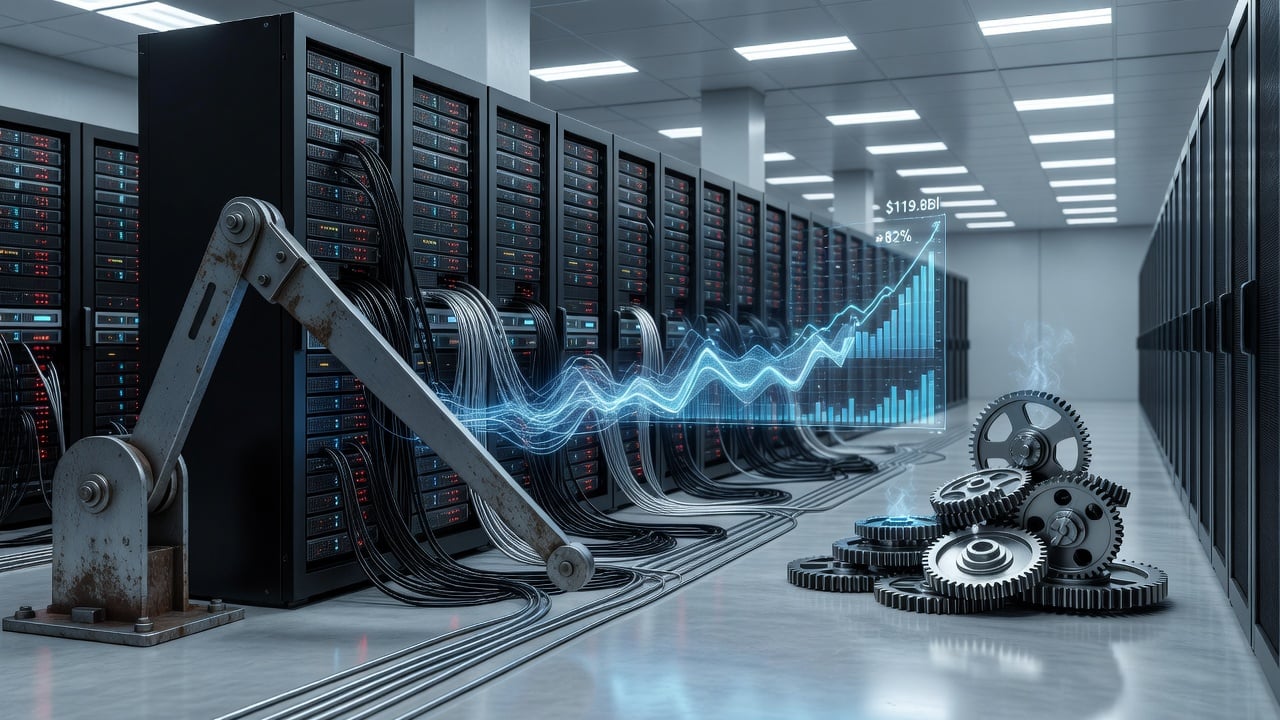
Google parent Alphabet just posted its strongest quarterly revenue growth in years. Yet shares tumbled after the market closed. The reason sits in a single line from the earnings report. Free cash flow swung to a negative $5.9 billion.
This marks the first time in the company’s history as a public entity that it has reported negative quarterly free cash flow. Operating cash flow reached $39.1 billion. Capital expenditures hit $44.9 billion. The gap tells its own story.
And the gap is widening. Alphabet raised its full-year 2026 capital expenditure forecast to between $195 billion and $205 billion. That tops the previous range of $180 billion to $190 billion. Chief financial officer Anat Ashkenazi warned spending would climb significantly higher in 2027. Analysts already model the next year’s figure near $250 billion or more.
Business Insider captured the shift in stark terms. The bill for the AI spending spree has arrived. Data centers. Custom chips. Massive energy infrastructure. All of it now outpaces the cash the advertising and cloud businesses generate in the near term.
Revenue still beat expectations handily. Alphabet brought in $119.8 billion for the quarter, up 24 percent from a year earlier. Google Cloud revenue exploded 82 percent to $24.8 billion. CEO Sundar Pichai called the period amazing. “Our AI investments are redefining what’s possible across every part of our business,” he said in the earnings release.
Those investments show results in the top line. Cloud growth accelerated sharply on demand for AI infrastructure and solutions. The Gemini app reached 950 million monthly active users. Model APIs now process 22 billion tokens per minute. Nearly 90 percent of the Fortune 100 use Gemini in some form. Advertising revenue climbed to $81.63 billion.
But investors looked past the growth numbers. They focused on the cash outflow. The Wall Street Journal reported that the cash flow turn and capex forecast entered what one analyst termed scary territory. Youssef Squali of Truist Securities had expected the company to hold its prior guidance. Instead the raise signals even heavier outlays ahead.
Squali now sees 2027 capex potentially reaching $250 billion to $255 billion at the high end. “You can’t be offloading this much cash and not talk about it,” he noted. Ashkenazi acknowledged the pressure. She told the earnings call that free cash flow would remain under strain as the company pours resources into technical infrastructure to capture the AI opportunity.
The pattern echoes across the sector. Tesla also reported negative free cash flow this week for the first time in over two years. Its capex jumped 142 percent. 36Kr drew the parallel. Both companies burn cash for AI. Google already sees returns through cloud revenue and profits. Tesla still funds robotaxi and robotics efforts largely through vehicle sales.
Alphabet’s trailing twelve-month free cash flow stays positive at $53.3 billion. That figure, however, dropped 20 percent year over year. The quarterly bars for capex keep stacking higher. Some analysts point to rising costs for memory chips and materials. Inflation in the supply chain stretches each dollar invested.
Gizmodo highlighted the historic nature of the $5.9 billion negative print. The company updated its 2026 spending outlook to as high as $205 billion. Ashkenazi repeated that investments would drive attractive returns over time. The market wants proof sooner.
Pichai struck an optimistic tone on the call and in his public statement. He pointed to momentum in search, YouTube, the Gemini app and enterprise adoption. Google shipped new Flash models just before the earnings release. Demand for its TPUs appears strong enough that the company recorded first revenue from direct sales of the custom chips.
Still, the stock reaction spoke volumes. Shares fell more than 2 percent in after-hours trading. Some observers saw the drop as a healthy reminder. Growth at any cost has limits when the cost accelerates faster than the growth. Big Tech as a group plans more than $700 billion in capital spending this year. That total only seems headed higher.
Executives insist the bet makes sense. AI infrastructure underpins new products, improves existing ones and creates entirely new revenue streams. Cloud customers pay premiums for GPU clusters and AI tooling. Enterprise deals cite Gemini features as a deciding factor. The $514 billion cloud backlog some analysts cite offers a glimpse of future revenue.
Yet the cash conversion cycle has lengthened. Building data centers takes years. Training next-generation models requires unprecedented power and specialized hardware. Energy costs rise in tandem. Supply constraints on high-bandwidth memory and networking gear add further expense.
So the question lingers. How long will investors tolerate negative free cash flow before demanding clearer signs of payback? Ashkenazi offered no specific timeline for a return to positive territory. She emphasized continued investment to stay competitive.
Alphabet holds advantages. Its search business still prints money. YouTube grows. The advertising market remains resilient. Cloud now contributes real scale. Those pillars provide breathing room that pure-play AI companies lack.
But the scale of spending surprises even seasoned watchers. Previous capex guidance already looked aggressive. The new range and 2027 commentary suggest the pace will not slow anytime soon. One former semiconductor engineer turned analyst read Pichai’s comments on upcoming Gemini models as bullish for memory demand rather than a sideshow.
Other voices on X echoed the tension. One post noted the 82 percent cloud surge validates monetization even if Gemini does not lead every technical benchmark. Another highlighted that Indian IT services firms spend a fraction on research compared with Google’s $18 billion quarterly R&D outlay.
The market appears split. Bulls see a necessary down payment on dominance in the AI era. Bears worry about diminishing returns and competition from leaner players. Microsoft, Amazon and Meta face similar pressures. Their upcoming reports will draw equal scrutiny.
For now Alphabet reports strong beats on revenue and profit. Net income reached $112.1 billion for the quarter. Operating income stood at $40.77 billion. The machine still runs hot. The fuel, however, costs more than ever.
Whether that fuel delivers outsized returns depends on execution in the quarters ahead. Executives sound convinced. The numbers show progress. The cash flow statement tells a more complicated tale. One the street will watch with growing intensity.


 WebProNews is an iEntry Publication