
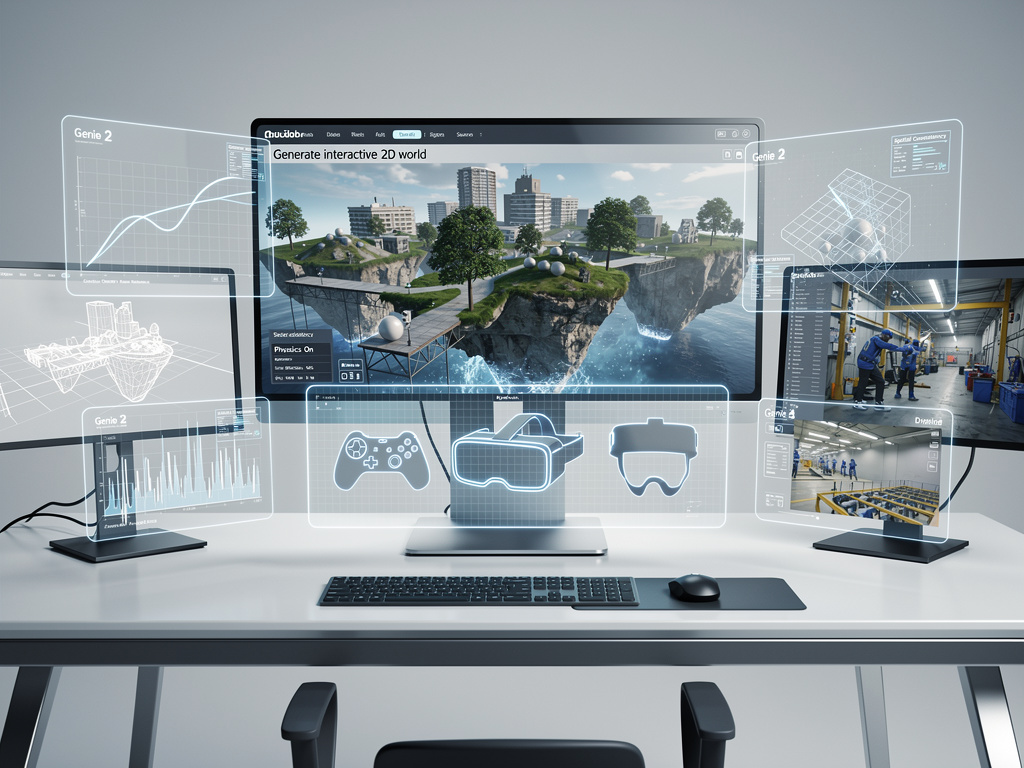
Google DeepMind has unveiled Genie 2, a groundbreaking artificial intelligence model that transforms simple text prompts and images into fully interactive, playable 3D virtual environments. This technological leap represents a fundamental shift in how digital worlds are created, potentially disrupting game development, simulation training, and creative industries while raising questions about the future of human-crafted digital experiences.
The foundation model, announced in December 2024, generates explorable environments that respond to user inputs in real-time, creating experiences that persist and maintain consistency across multiple perspectives. According to Android Police, users can navigate these AI-generated spaces using keyboard and mouse controls, with the system rendering new viewpoints and maintaining object permanence as they move through virtual terrain. Unlike previous AI image generators that produce static outputs, Genie 2 creates dynamic environments where physics, lighting, and spatial relationships adapt continuously to user actions.
The technology builds upon Google’s earlier Genie 1 model, which was trained on video game footage to understand interactive mechanics. Genie 2 represents a significant evolution, capable of generating diverse environment types ranging from alien planets and futuristic cities to natural settings and abstract spaces. The system demonstrates an understanding of complex physical interactions, including water dynamics, gravity effects, and object behaviors that would traditionally require extensive manual programming by development teams.
Technical Architecture Powering Virtual World Generation
At its core, Genie 2 employs a sophisticated neural network architecture that processes text descriptions or reference images to construct coherent 3D spaces. The model has been trained on vast datasets of interactive content, learning the underlying patterns that govern how objects behave, how lighting changes with perspective, and how environments maintain spatial consistency. This training enables the system to extrapolate beyond its input data, creating novel combinations of elements that have never existed together in its training set.
The model’s ability to maintain temporal consistency across frames sets it apart from earlier generative AI systems. When a user moves through a Genie 2 environment, the system doesn’t simply generate disconnected images but rather maintains a coherent world model that tracks object positions, lighting conditions, and environmental states. This persistence allows for exploration that feels genuinely interactive rather than like a series of independent AI-generated snapshots stitched together.
Implications for Game Development and Creative Industries
The emergence of Genie 2 arrives at a pivotal moment for the game development industry, which has traditionally required teams of artists, programmers, and designers working for months or years to create immersive environments. The technology suggests a future where rapid prototyping of game concepts becomes trivial, allowing developers to iterate on ideas at unprecedented speed. Independent creators who previously lacked resources to build complex 3D worlds could potentially compete with major studios in terms of environmental scope and variety.
However, industry observers note that while Genie 2 excels at generating exploratory spaces, it currently lacks the narrative structure, gameplay mechanics, and intentional design choices that define compelling gaming experiences. The technology serves as a powerful tool for environmental creation but doesn’t replace the creative vision required to craft meaningful player experiences. Game designers may find Genie 2 most valuable as a rapid prototyping tool or as a means to generate background environments that human artists can then refine and populate with purposeful content.
Applications Beyond Entertainment
The potential applications of interactive world generation extend far beyond gaming into training simulations, architectural visualization, and educational experiences. Military and emergency response organizations could use the technology to generate diverse training scenarios without the expense of building physical mockups or manually creating digital simulations. Medical professionals might practice procedures in AI-generated hospital environments that adapt to different emergency situations.
Architects and urban planners could leverage Genie 2 to rapidly visualize proposed developments, allowing stakeholders to virtually walk through spaces before construction begins. The technology could generate multiple variations of a design concept in minutes, facilitating faster iteration and more informed decision-making. Educational institutions might create immersive historical recreations or scientific visualizations that students can explore interactively, making abstract concepts tangible and engaging.
Technical Limitations and Current Constraints
Despite its impressive capabilities, Genie 2 faces several technical limitations that constrain its immediate practical applications. The model currently generates environments at limited resolutions and frame rates compared to professionally developed games and simulations. Complex physics interactions sometimes break down, with objects occasionally behaving in ways that violate expected physical laws. The system also struggles with generating coherent interiors for buildings or maintaining consistency across very large virtual spaces.
Computational requirements present another significant barrier to widespread adoption. Generating and maintaining interactive environments in real-time demands substantial processing power, likely requiring high-end graphics processing units or specialized AI accelerators. This hardware dependency could limit accessibility for individual creators and smaller organizations, at least until the technology matures and becomes more computationally efficient.
Competitive Positioning in the AI Arms Race
Google’s release of Genie 2 represents a strategic move in the intensifying competition among technology giants to dominate generative AI applications. While companies like OpenAI have focused primarily on text and static image generation, and others have pursued video synthesis, Google has staked a claim in interactive content creation. This positioning could prove particularly valuable as the industry moves toward more immersive computing experiences, including virtual and augmented reality applications.
The technology also serves Google’s broader ecosystem strategy. Integration with existing Google services could enable users to generate virtual meeting spaces, create interactive product demonstrations, or develop educational content that leverages Google’s search and knowledge graph capabilities. The company’s extensive cloud infrastructure provides a natural distribution channel for computationally intensive world generation services.
Ethical Considerations and Content Authenticity
The ability to generate convincing interactive environments raises important questions about content authenticity and potential misuse. As the technology improves, distinguishing between human-created and AI-generated virtual spaces may become increasingly difficult. This ambiguity could have implications for digital evidence, virtual real estate markets, and the perceived value of human creative labor.
Concerns about training data provenance also persist. Like other generative AI systems, Genie 2’s capabilities derive from training on existing content, raising questions about compensation for original creators whose work informed the model’s understanding of interactive environments. The game development community has expressed particular sensitivity about AI systems trained on their creative output being used to potentially automate aspects of their profession.
The Road Ahead for Interactive AI Generation
Google has indicated that Genie 2 remains primarily a research project rather than an immediately available commercial product. The company is exploring potential applications while addressing technical limitations and ethical concerns. Future iterations will likely focus on improving consistency across larger environments, enhancing physics simulation accuracy, and reducing computational requirements to make the technology more accessible.
Integration with other AI systems could unlock additional capabilities. Combining Genie 2’s environmental generation with large language models for narrative creation and AI agents for populating worlds with interactive characters could produce increasingly sophisticated virtual experiences. The convergence of these technologies suggests a future where the barriers between conceiving and experiencing digital worlds become vanishingly thin.
Industry Transformation on the Horizon
The introduction of Genie 2 signals a broader transformation in how digital content is created and experienced. As AI systems become capable of generating increasingly complex interactive environments, the role of human creators will likely shift from manual construction to high-level creative direction and curation. This evolution parallels historical technological disruptions in creative industries, where new tools initially sparked concern about displacement but ultimately expanded the scope of what creators could accomplish.
For technology companies, content platforms, and creative professionals, Genie 2 represents both opportunity and uncertainty. The technology promises to democratize access to sophisticated content creation tools while simultaneously challenging established workflows and business models. Organizations that successfully integrate these capabilities while preserving the intentionality and craft that define compelling experiences will likely emerge as leaders in the next era of digital content creation. The question is no longer whether AI will transform how we build virtual worlds, but rather how quickly that transformation will unfold and who will shape its direction.


 WebProNews is an iEntry Publication