
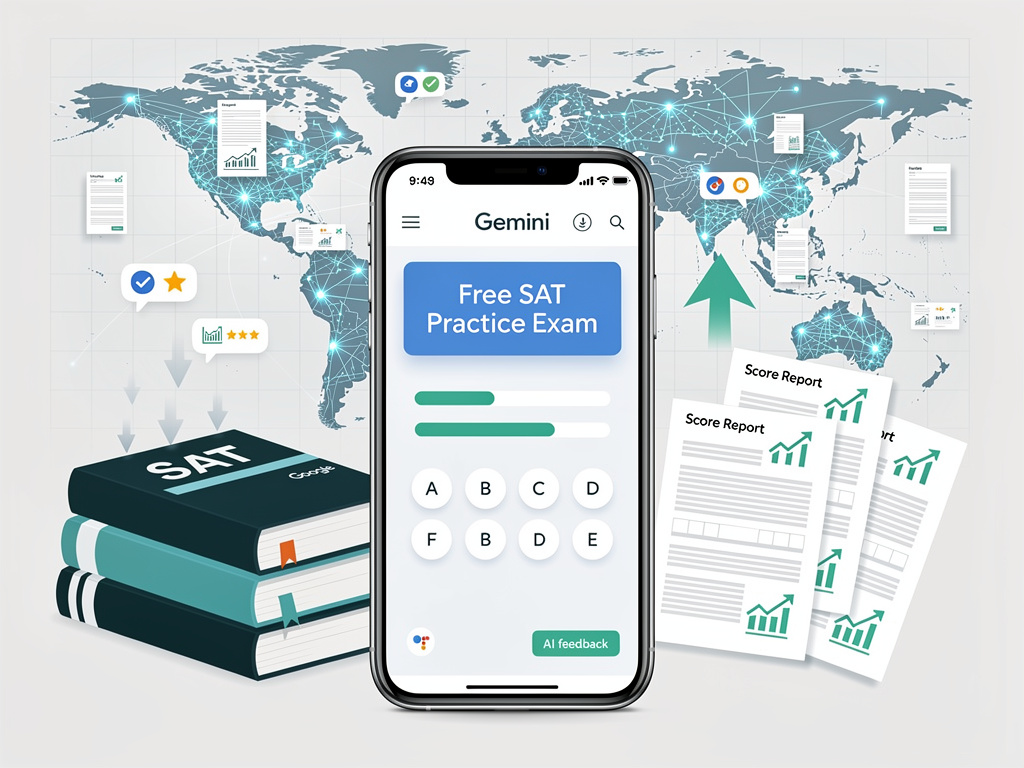
Google has thrust its artificial-intelligence arm, Gemini, into the $2 billion test-preparation industry with a bold move: free, full-length SAT practice exams available on demand in its mobile app. Announced at the Bett 2026 education conference in London, the feature pairs Google’s AI prowess with content vetted by The Princeton Review, offering students instant feedback, performance breakdowns and tailored explanations—tools traditionally locked behind paywalls.
This launch arrives amid intensifying competition in edtech, where AI tutors from Khan Academy to Duolingo vie for student attention. Google’s entry, detailed in a company blog post, promises ‘rigorously vetted content’ mimicking real exam conditions, complete with timed sections for reading, writing and math. Early adopters report the AI not only scores responses but dissects errors with step-by-step reasoning, a capability powered by Gemini’s advanced models.
Disrupting a Paywalled Domain
The SAT prep market, dominated by players like Kaplan and Princeton Review, generates revenue through pricey courses and books often exceeding $1,000 per student. Google’s no-cost offering, accessible via the Gemini app on Android and iOS, levels the field for millions of U.S. high schoolers facing college admissions pressures. As ZDNet notes, ‘Can Google’s AI assistant be an accessible tool for college prep in an otherwise expensive industry?’ The answer appears to be yes, with posts on X from Google highlighting over 500,000 views on launch announcements.
Implementation is straightforward: Users prompt Gemini with ‘Take a practice SAT,’ triggering a proctored simulation. Post-exam, the AI delivers a score report, percentile rankings and weakness-focused drills. This interactivity draws from Gemini’s multimodal capabilities, handling text, images and even video explanations, as expanded in recent updates announced at Bett.
Partnerships Fuel Authenticity
Central to credibility is the collaboration with The Princeton Review, whose experts crafted questions aligned with College Board standards. ‘Gemini now offers full-length, no-cost practice SATs, featuring content from The Princeton Review,’ states Google’s education blog. This isn’t generic AI generation; questions undergo human vetting to ensure fairness and accuracy, addressing concerns over hallucinated content plaguing earlier AI tools.
Feedback mechanisms shine here. For a math error, Gemini might explain: ‘You selected B, but the correct answer is A because the quadratic equation requires factoring x^2 – 5x + 6 = (x-2)(x-3).’ Such precision, per TechCrunch, includes ‘performance analysis and detailed explanations for incorrect answers,’ positioning it as a virtual tutor rivaling human coaches.
Broader Edtech Ripples
Beyond SATs, Google’s Bett announcements unveiled Gemini integrations for Google Classroom, including audio-video recordings and a Khan Academy-powered Writing Coach. ‘Save time and do your best work with new capabilities, like practice SATs in Gemini,’ the blog proclaims. X posts from Google, such as one garnering 5.4 million views, emphasize expansion: ‘We’re launching full-length, on demand practice exams for standardized tests in @GeminiApp, starting with the SAT.’
Industry insiders see strategic timing. With the digital SAT fully in effect since 2024, demand for adaptive practice surges. Digital Trends reports Gemini ‘helps students prepare for the SAT using realistic mock tests, moving beyond generic AI questions.’ Free access could siphon users from paid apps like Magoosh or UWorld, pressuring margins in a sector already squeezed by AI commoditization.
AI’s Precision Edge
Gemini’s edge lies in its reasoning depth. Drawing from models like Gemini 2.5, it simulates exam pressure with timers and no peeking. Android Authority highlights ‘free prep tests vetted by experts now available through Gemini.’ Users receive customized study plans post-test, prioritizing weak areas like algebra or passage analysis—features echoing premium services but at zero cost.
Accessibility extends globally, though initially U.S.-focused with English content. Rollout to free tiers and more languages is promised, per Google’s X replies. This democratizes prep amid equity debates; low-income students, who score 200 points lower on average per College Board data, stand to gain most.
Challenges and Backlash Fears
Not all reactions are glowing. Critics on X question AI bias in scoring, while educators worry over reduced critical thinking if explanations spoon-feed answers. Complex frames it as ‘Google has announced that free, full-length SAT practice,’ but notes potential overreliance. Google counters with human oversight, stating on X: ‘Practice SATs are grounded in rigorously vetted content.’
Monetization remains opaque. While free, Gemini ties into Google One Premium subscriptions offering advanced features. This freemium model mirrors ChatGPT’s success, potentially funneling users toward paid AI tiers. Rivals like OpenAI’s GPTs for education may accelerate their own test-prep pushes.
Market Realignment Ahead
For test-prep incumbents, the math is stark: 1.8 million annual SAT takers, per College Board, now have a free powerhouse alternative. NDTV details access steps, underscoring ease. As AI evolves, expect SAT expansions to ACT, GRE and beyond, per Google’s roadmap.
At Bett 2026, Google’s SVP of Education, Jim Goldman, emphasized impact: ‘Transform teaching and learning with updates to Gemini.’ With 14 million views across X launch posts, momentum builds. Investors eye edtech stocks; M&A activity could spike as firms adapt or consolidate.
Strategic Implications for Admissions
Colleges may recalibrate as AI-prepped scores rise uniformly, diluting test’s predictive power. Admissions officers, already test-optional post-pandemic, face new dynamics. Digit.in praises ‘instant feedback, helping students prepare smarter.’ Long-term, this could standardize preparation, narrowing score gaps but challenging holistic review models.


 WebProNews is an iEntry Publication