
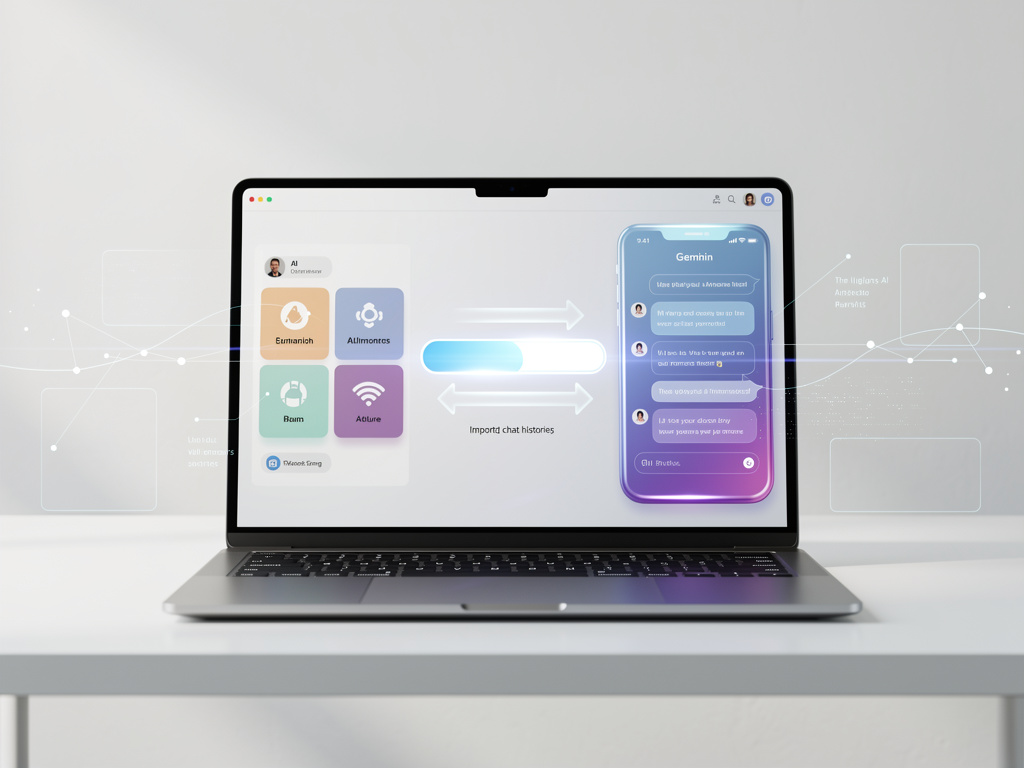
Google is developing a feature that will allow users to import chat histories from competing artificial intelligence platforms directly into Gemini, according to code discovered in recent application updates. The move signals an escalating battle among technology giants to capture and retain the valuable conversational data that users generate through interactions with AI assistants, while simultaneously attempting to reduce friction for customers considering a switch between services.
The discovery, first reported by Android Central, reveals that Google engineers have been working on infrastructure to enable seamless migration of chat histories from rival platforms. Code strings found within Gemini’s Android application suggest users will soon be able to select conversations from other AI services and transfer them into their Gemini account, preserving context and continuity that many users have built up over months of interactions with alternative platforms.
This development represents a significant strategic shift in how major technology companies approach user retention and acquisition in the artificial intelligence sector. Rather than forcing users to abandon their conversational history when switching platforms—a psychological and practical barrier that has historically protected incumbent services—Google appears prepared to eliminate this friction point entirely. The implications extend beyond mere convenience, touching on fundamental questions about data portability, competitive dynamics, and the future architecture of AI services.
The Technical Architecture Behind Conversational Migration
The leaked code reveals a sophisticated system designed to parse and translate chat formats from multiple AI platforms. According to the strings discovered in Gemini’s application, the import functionality will support various file formats and potentially direct API connections to competitor services. This technical approach suggests Google has invested substantial engineering resources into understanding how rival platforms structure their conversational data, a prerequisite for accurate migration.
Industry analysts note that the challenge extends beyond simple data transfer. Each AI platform maintains conversations with different metadata structures, including timestamps, user preferences, model versions used for specific responses, and contextual markers that influence how the AI interprets follow-up questions. Successfully migrating this information requires not just copying text, but translating the entire conversational context into Gemini’s native format while preserving the utility users expect from their chat history.
Competitive Implications in the AI Assistant Market
The timing of this feature development coincides with intensifying competition among AI platforms. OpenAI’s ChatGPT maintains significant market share in conversational AI, while Anthropic’s Claude has gained traction among enterprise users and developers who prioritize specific safety features. Microsoft’s integration of AI capabilities across its product ecosystem through Copilot, and the emergence of specialized AI assistants for vertical markets, have fragmented user attention across multiple platforms.
By offering import functionality, Google directly addresses one of the primary obstacles preventing users from experimenting with Gemini: the accumulated value of existing conversations. Users who have spent months refining prompts, building project-specific contexts, or maintaining ongoing dialogues with other AI assistants face a significant switching cost. The ability to bring that history to Gemini could substantially lower barriers to platform migration, potentially accelerating Google’s user acquisition in a market where it currently trails OpenAI despite Google’s foundational contributions to transformer architecture that powers modern language models.
The feature also raises questions about reciprocity. While Google appears willing to import data from competitors, there is no indication that the company plans to offer equally frictionless export capabilities to rival platforms. This asymmetry could attract regulatory scrutiny, particularly in jurisdictions like the European Union where data portability has become a central tenet of digital policy. The General Data Protection Regulation already mandates certain data portability rights, and regulators have shown increasing interest in ensuring competitive markets for AI services.
User Data Sovereignty and Privacy Considerations
The introduction of chat import functionality inevitably raises privacy and security questions. Conversational AI interactions often contain sensitive information, from proprietary business strategies discussed by enterprise users to personal details shared by individual consumers. Transferring this data between platforms requires robust security protocols and clear user consent mechanisms to prevent unauthorized access or unintended disclosure.
Google’s implementation will need to address how it handles potentially sensitive information discovered during the import process. Will the company’s existing data retention and analysis policies apply to imported conversations? Can users selectively import specific chats while excluding others? These questions have both technical and policy dimensions that Google must navigate carefully, particularly given the company’s history of regulatory challenges related to data practices.
Furthermore, the feature creates potential complications around intellectual property. If a user has developed valuable prompts or conversational patterns on a competitor’s platform, does importing that data to Gemini grant Google any rights to analyze or learn from those interaction patterns? The terms of service governing such imports will likely receive intense scrutiny from privacy advocates and legal experts as the feature moves toward public release.
Strategic Positioning Against Established Competitors
Google’s move to facilitate chat migration reflects broader strategic imperatives in the AI sector. Despite the company’s deep expertise in machine learning and its pivotal role in developing transformer technology, Google has struggled to translate technical leadership into market dominance in consumer-facing AI applications. The company’s initial AI assistant efforts, including the now-discontinued Bard branding before the Gemini rebrand, failed to capture public imagination to the same degree as ChatGPT’s viral adoption.
The chat import feature represents an acknowledgment that technical superiority alone does not guarantee user adoption. Network effects in AI platforms operate differently than in traditional social networks, but they remain powerful. Users develop familiarity with specific interfaces, accumulate valuable conversation histories, and integrate AI assistants into workflows that can be difficult to replicate on alternative platforms. By directly addressing the switching cost problem, Google demonstrates a pragmatic understanding that winning the AI assistant market requires more than just better models.
This approach also positions Google to benefit from the substantial investment competitors have made in user education. Users who have learned to effectively prompt ChatGPT or Claude have developed skills that transfer relatively seamlessly to Gemini, given the similar underlying architectures. By making it easy for these educated users to bring their conversation histories with them, Google essentially allows competitors to serve as training grounds for future Gemini users.
Enterprise Adoption and Workflow Integration
The implications of chat portability extend particularly forcefully into enterprise markets, where organizations increasingly rely on AI assistants for knowledge work. Companies that have built substantial institutional knowledge within ChatGPT Enterprise or Claude for Work face significant migration challenges if they wish to switch providers. Contracts, pricing changes, or feature developments might make alternative platforms more attractive, but the practical difficulty of moving accumulated conversational assets creates lock-in effects.
Google’s import feature could appeal specifically to enterprise customers evaluating AI platforms for organization-wide deployment. The ability to conduct pilot programs with Gemini while preserving existing AI-assisted work represents a lower-risk evaluation path. IT departments can test Google’s offering without forcing employees to abandon months of accumulated context, potentially accelerating enterprise adoption cycles and reducing the sales friction Google faces in competing for large organizational contracts.
However, enterprise adoption also amplifies security and compliance concerns. Organizations subject to regulatory requirements around data handling will need assurance that imported conversations receive appropriate protection and that the transfer process itself meets security standards. Google’s success in enterprise markets may depend as much on the robustness of its security documentation and compliance certifications for the import feature as on the functionality itself.
Market Dynamics and Future Platform Competition
The development of chat import capabilities suggests a maturing AI assistant market where competition increasingly resembles dynamics in other technology sectors. Just as email providers eventually enabled migration tools and cloud storage services developed import utilities, AI platforms appear to be entering a phase where data portability becomes a competitive differentiator rather than an afterthought.
This evolution could accelerate innovation by reducing user lock-in and enabling more fluid competition based on model quality, features, and pricing rather than switching costs. If users can easily move between platforms, providers face stronger incentives to continuously improve their offerings rather than relying on accumulated user data to maintain market position. The result could be a more dynamic competitive environment that ultimately benefits users through better services and more competitive pricing.
Yet the same dynamics that make portability attractive to users could create new forms of platform power. If Google successfully implements comprehensive import capabilities while competitors lack equivalent features, the asymmetry could advantage Google’s platform in ways that ultimately reduce rather than enhance competition. Much depends on whether other major AI providers respond with their own import tools, creating a genuinely portable ecosystem, or whether Google’s move represents a one-way street designed primarily to facilitate inbound migration.
Technical Challenges in Cross-Platform Translation
Beyond the strategic and policy questions, significant technical challenges remain in implementing effective chat migration. Different AI platforms use varying approaches to conversation threading, context windows, and memory management. ChatGPT’s approach to maintaining context across conversations differs from Claude’s constitutional AI framework, which in turn operates differently from Gemini’s integration with Google’s broader knowledge infrastructure.
Successfully translating conversations between these systems requires more than simple text copying. The imported chats must function within Gemini’s architecture in ways that preserve their utility to users. If imported conversations lose contextual understanding or fail to integrate properly with Gemini’s capabilities, the feature could disappoint users and potentially damage Google’s reputation rather than enhancing it. The engineering challenge involves creating translation layers that maintain semantic meaning and practical functionality across fundamentally different AI architectures.
Google’s success in addressing these technical challenges will likely determine whether chat import becomes a meaningful competitive advantage or merely a marginal feature. Users who import substantial conversation histories will expect those chats to work seamlessly with Gemini’s capabilities, including its multimodal features, integration with Google Workspace, and advanced reasoning abilities. Anything less could create frustration and undermine the feature’s strategic purpose.
Regulatory Environment and Data Portability Mandates
The development occurs against a backdrop of increasing regulatory attention to data portability in digital services. European regulators have made data portability a cornerstone of digital market regulation, both through GDPR’s individual rights provisions and through the Digital Markets Act’s requirements for designated gatekeepers. While AI assistants have not yet faced the same level of regulatory scrutiny as social media platforms or mobile operating systems, that situation may change as these services become more central to digital life.
Google’s proactive development of import capabilities could be interpreted as anticipating regulatory requirements, positioning the company favorably should mandates for AI data portability emerge. Alternatively, the feature might be purely competitive in motivation, with regulatory compliance being a secondary benefit. Regardless of intent, the existence of functional import tools could influence how regulators approach AI platform competition, potentially setting precedents for what constitutes adequate data portability in this emerging sector.
The global nature of AI services complicates regulatory dynamics. Different jurisdictions maintain varying approaches to data protection, competitive policy, and technology regulation. A feature designed primarily for competitive advantage in the United States market must also function within European privacy frameworks, Asian data localization requirements, and emerging AI-specific regulations in multiple countries. Google’s implementation choices for chat import will need to navigate this complex regulatory environment while maintaining a consistent user experience across markets.


 WebProNews is an iEntry Publication