
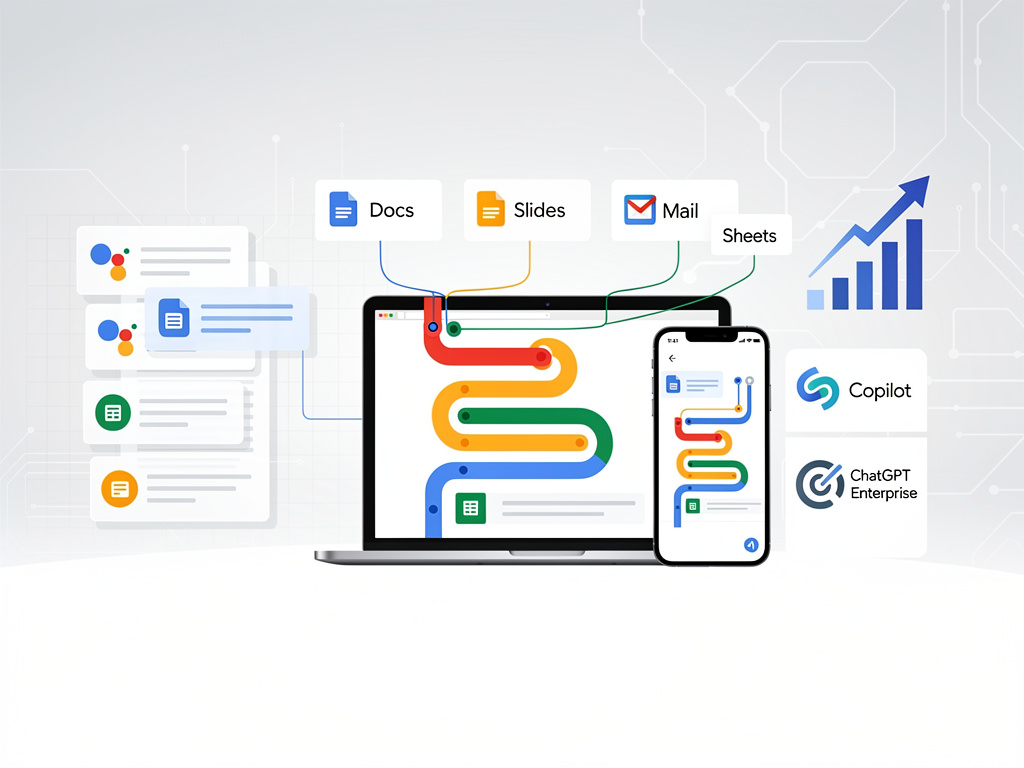
For months, Google’s Gemini assistant in Workspace operated with a peculiar limitation: every conversation was essentially a one-night stand. Users could ask the AI to draft emails, summarize documents, or analyze spreadsheets, but the moment they closed the chat panel, that entire exchange vanished into the ether. No record. No way to pick up where you left off. For enterprise customers paying a premium for AI-powered productivity tools, this was more than an inconvenience — it was a fundamental gap in functionality.
That changes now. Google has begun rolling out persistent chat history for Gemini across its Workspace applications, a feature that allows users to view, revisit, and continue previous conversations with the AI assistant directly within Gmail, Google Docs, Sheets, Slides, and Drive. The update, first reported by TechRadar, represents one of the most significant quality-of-life improvements to Google’s enterprise AI offering since Gemini was embedded into Workspace last year.
From Amnesia to Institutional Memory
The new feature works through a dedicated “Recent chats” section that appears in the Gemini side panel across Workspace apps. When a user opens the panel, they can see a chronological list of their prior interactions, organized by application. Clicking on any previous conversation reopens it in full, preserving the context, prompts, and responses from the original session. Users can then continue that thread as if they had never left.
This is not merely a cosmetic update. In practice, the lack of chat persistence meant that enterprise users who relied on Gemini for complex, multi-step tasks — such as iterating on a financial model in Sheets or refining a presentation deck over several sessions — had to re-explain their requirements from scratch each time. The cognitive overhead was significant, and it undermined one of the core promises of AI assistants: that they would reduce, not increase, the friction of knowledge work.
Who Gets It First — and Who Has to Wait
Google is rolling out the feature to customers on several Workspace tiers, including Gemini Business, Gemini Enterprise, Gemini Education, and Gemini Education Premium subscribers. According to TechRadar, the rollout follows Google’s typical graduated deployment schedule, meaning some organizations will see the feature before others. Google has indicated that the update will reach all eligible accounts over the coming weeks.
Notably, the feature is arriving at a moment when Google faces intensifying competition in the enterprise AI space. Microsoft has been aggressively expanding the capabilities of its Copilot assistant across the Microsoft 365 product line, and OpenAI’s ChatGPT Enterprise and Team plans have been gaining traction among businesses looking for standalone AI tools that integrate with existing workflows. For Google, ensuring feature parity — and ideally, feature superiority — in Workspace is not an academic exercise. It is a commercial imperative tied directly to the retention and expansion of its enterprise customer base.
The Privacy and Data Governance Dimension
Persistent AI chat history in an enterprise context immediately raises questions about data retention, privacy, and administrative control. When conversations with an AI assistant are ephemeral, the compliance picture is relatively simple: there is nothing to store, nothing to subpoena, nothing to audit. Once those conversations become persistent records, they enter the same governance framework that applies to emails, documents, and other corporate communications.
Google appears to be aware of this tension. The company has stated that Gemini conversations within Workspace are subject to the same data handling and privacy policies that govern other Workspace data. For organizations operating in regulated industries — financial services, healthcare, government — the ability to retain and review AI interactions could actually be a net positive, providing an audit trail that demonstrates how AI-generated content was produced and what human oversight was applied. However, it also means that IT administrators will need to consider how Gemini chat logs fit into their broader data retention and e-discovery strategies.
What This Means for Daily Workflows
The practical implications of persistent Gemini history are perhaps best understood through specific use cases. Consider a marketing manager who uses Gemini in Google Docs to brainstorm campaign copy over the course of a week, refining the tone and messaging through multiple sessions. Previously, each session started cold. Now, the manager can pull up Monday’s conversation on Thursday, review the AI’s earlier suggestions, and build on them without losing momentum.
Or consider a data analyst working in Google Sheets who asks Gemini to help build a formula for a complex revenue projection. If the analyst is interrupted — by a meeting, a lunch break, or simply the end of the workday — they no longer lose that thread. The conversation persists, and the analyst can return to it with full context intact. This kind of continuity is table stakes for human collaboration. The fact that it was missing from AI collaboration until now speaks to how rapidly these tools have been deployed, often outpacing the development of basic usability features.
Google’s Broader AI Strategy in the Enterprise
The chat history update is part of a broader pattern of incremental but meaningful improvements Google has been making to Gemini in Workspace throughout 2025. Earlier this year, the company expanded Gemini’s ability to reference multiple documents simultaneously, improved its summarization capabilities in Gmail, and added new data analysis features in Sheets. Each of these updates, taken individually, is modest. Taken together, they represent a concerted effort to make Gemini a more capable and reliable daily-use tool rather than a novelty that enterprise users try once and abandon.
Google’s approach contrasts somewhat with Microsoft’s strategy for Copilot, which has emphasized flashy demonstrations and broad capability announcements. Microsoft has faced criticism from some enterprise customers who found that Copilot’s real-world performance did not always match its marketing. Google, by focusing on foundational improvements like chat persistence, appears to be betting that reliability and usability will matter more in the long run than headline-grabbing features. Whether that bet pays off will depend on execution — and on whether Google can close the remaining gaps between Gemini and its competitors quickly enough to retain enterprise customers who are actively evaluating alternatives.
The Competitive Pressure from Microsoft and OpenAI
Microsoft’s Copilot already offered conversation history features in several of its implementations, giving it a structural advantage in enterprise accounts where users expected the same kind of persistence they experienced in consumer AI products like ChatGPT. OpenAI, for its part, has made conversation memory a central feature of ChatGPT, allowing the model to remember user preferences and past interactions across sessions. Google’s move to add chat history to Gemini in Workspace brings it closer to parity with these competitors, but the company still has ground to make up in areas like cross-application memory — the ability for Gemini to remember context not just within a single app, but across the entire Workspace product line.
Industry analysts have noted that the enterprise AI market is entering a phase where differentiation will increasingly come from integration depth and workflow optimization rather than raw model capability. As the underlying large language models from Google, OpenAI, and Anthropic converge in performance, the competitive battleground shifts to how well these models are embedded into the tools that workers actually use every day. Persistent chat history is a small but telling example of this shift: it is not about making the AI smarter, but about making it more useful in context.
What Enterprise Buyers Should Watch For
For CIOs and IT decision-makers evaluating their AI investments, the Gemini chat history update is a signal worth paying attention to — not because it is transformative on its own, but because it indicates the direction of Google’s product development. The company is clearly listening to feedback from enterprise users who found the lack of persistence frustrating, and it is responding with targeted improvements rather than sweeping overhauls.
The key questions going forward are whether Google will extend this memory capability beyond individual app silos, whether administrators will get granular controls over chat log retention and access, and whether the persistent history will eventually feed into Gemini’s ability to learn user preferences over time. Each of these developments would represent a meaningful step toward making Gemini a true enterprise AI assistant rather than a sophisticated autocomplete engine. For now, the ability to simply pick up where you left off is a welcome — and overdue — addition to Google’s AI toolkit.


 WebProNews is an iEntry Publication